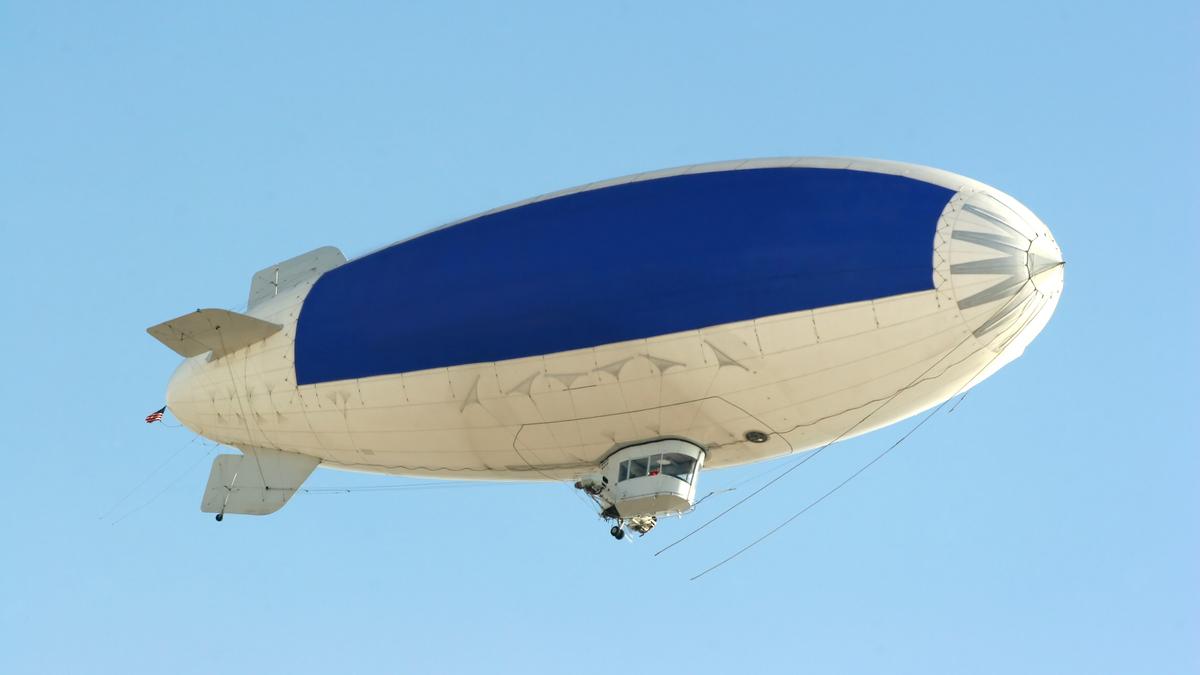
What is a blimp?
The Hindu
Discover the fascinating world of blimps, their history, functionality, and significance in aviation and advertising.
It is not a giant balloon. It is not an airplane. Well, it is in spirit, both. A blimp is a type of airship. Airships are, simply said, lighter-than-air pressure ships. Technically, it is a powered (like how we say ‘engine-powered’ for example) and steerable lighter-than-air aircraft. Hence, it is ‘self-propelled’. Lighter-than-air (LTA) here means that the aircraft uses lifting gas that is less dense than the air around. A blimp floats with the help of buoyant force.
Airships are of three types, namely, non-rigid, semi-rigid, and rigid. Non-rigid airships also go by the name, blimp.
The famous example of blimps are the goodyear blimps.
I doubt only a handful of you may have heard of this, much less see an actual blimp in the sky. Ever since airplanes became the ‘it’ thing in aviation, blimps became a gentle casualty. During the World War eras, the military had wonderful uses when it came to airships. Blimps were used in a prolific fashion by the navy for patrolling, surveillance, and anti-submarine warfare. Getting on a blimp was quite frequent for many as part of national defense.
Why? Blimps were utilised for such functions in the war because of its slow speed, steady flight capabilities, and dynamic maneuverability.
A goodyear blimp. | Photo Credit: Unsplash Images


Warmer oceans and depleting food have affected the ubiquitous loggerhead turtle’s reproductive and migratory patterns — and even its size.

Toyota Urban Cruiser Ebella review: Explore design, range, features, ride comfort and safety of Toyota’s new electric SUV for India. Expected price ₹14–18 lakh, with up to 500 km claimed range and practical urban usability.

Explore India's potential in bio-based chemicals and enzymes, highlighting industry leaders and challenges in sustainable manufacturing.

Astronomers discover an unusual planetary system with a rocky planet formed outside its gaseous neighbors, challenging existing formation theories.

Four new astronauts arrive at the ISS to replace a crew evacuated due to a serious health issue.

Neurobehavioural therapy can transform brain connectivity in functional neurological disorders, highlighting the link between cognition, emotion, and behavior.

The centuries-long quest for synthetic diamonds, also known as lab-grown diamonds or human-made diamonds, came to an end in 1954-55. On February 15, 1955, the creation of the first synthetic diamonds were announced, and it was quickly picked-up by newspapers around the world. A.S.Ganesh tells you more about these diamonds and the man who first made it happen…

Kadhambari S. Viswanathan highlights online education's evolution and its coexistence with traditional methods at The Hindu Tech Summit 2026.

The Hindu science quiz on Charles Darwin on February 13 2026

Explore the immersive art exhibit "A Story in Red" in Fort Kochi, featuring 13 installations celebrating memory, culture, and emotion.

Explore why different animals have varying litter sizes based on reproduction strategies and survival adaptations.

Experience Bitter Nectar at Bikaner House, an engaging exhibition exploring ecological issues through interactive art installations until February 15.

Discover the fascinating world of blimps, their history, functionality, and significance in aviation and advertising.