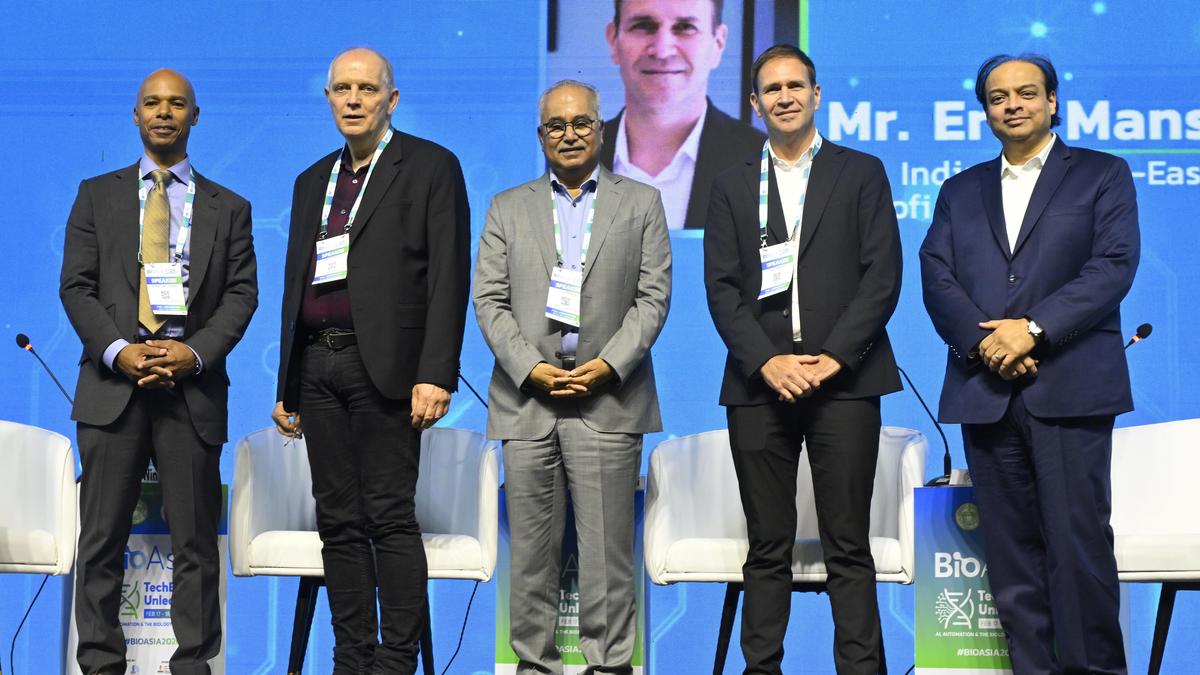
India’s capacity to scale next-generation biologics draws focus at BioAsia 2026
The Hindu
Day 1 of BioAsia 2026 sees a panel discussion on advanced therapies highlighting India’s evolving role as a global manufacturing backbone for next-generation biologics.
India’s evolving role as a global manufacturing backbone for next-generation biologics came into focus during a panel discussion on advanced therapies at BioAsia 2026 here on Tuesday where industry leaders pointed to the country’s capacity to scale complex technologies ranging from vaccines and RNA platforms to cell and gene therapies.
The panel, moderated by Gil Bashe, chair, Global Health and Purpose at Finn Partners, brought together senior executives and clinicians who underlined that innovation in biologics was no longer a solo pursuit but depended on collaboration, manufacturing depth and the ability to deliver therapies at scale.
Setting the context, Raches Ella, chief development officer of Bharat Biotech, highlighted India’s centrality to global vaccine production. “One in three children worldwide receives a vaccine produced in India, with manufacturing spanning research and development through to commercial production. The company’s ambition is to reach the entire global birth cohort of about 125 million children each year,” he added.
From a technology platform perspective, Jose Castillo, chief executive officer of Quantoom Biosciences, described India as one of the earliest and most risk-taking markets for biomanufacturing innovation. Recalling that some of the first commercial bioreactors using his technology were deployed in India, Mr. Castillo said the country remained a critical market for promoting and scaling research and development technologies.
The importance of manufacturing ecosystems and skilled manpower was reinforced by Darrin Morrissey, chief executive officer of National Institute for Bioprocessing Research and Training. Representing Ireland’s biopharmaceutical sector, he said the country had spent over two decades building biologics manufacturing capabilities in partnership with multinational companies. He noted that Ireland now produces biologic medicines worth €100 billion annually, making it one of the world’s largest manufacturers in this space.
He added that discussions are under way with the Telangana government to explore partnerships, reflecting growing interest in aligning global manufacturing expertise with India’s expanding biologics ecosystem.


Warmer oceans and depleting food have affected the ubiquitous loggerhead turtle’s reproductive and migratory patterns — and even its size.

Toyota Urban Cruiser Ebella review: Explore design, range, features, ride comfort and safety of Toyota’s new electric SUV for India. Expected price ₹14–18 lakh, with up to 500 km claimed range and practical urban usability.

Explore India's potential in bio-based chemicals and enzymes, highlighting industry leaders and challenges in sustainable manufacturing.

Astronomers discover an unusual planetary system with a rocky planet formed outside its gaseous neighbors, challenging existing formation theories.

Four new astronauts arrive at the ISS to replace a crew evacuated due to a serious health issue.

Neurobehavioural therapy can transform brain connectivity in functional neurological disorders, highlighting the link between cognition, emotion, and behavior.

The centuries-long quest for synthetic diamonds, also known as lab-grown diamonds or human-made diamonds, came to an end in 1954-55. On February 15, 1955, the creation of the first synthetic diamonds were announced, and it was quickly picked-up by newspapers around the world. A.S.Ganesh tells you more about these diamonds and the man who first made it happen…

Kadhambari S. Viswanathan highlights online education's evolution and its coexistence with traditional methods at The Hindu Tech Summit 2026.

The Hindu science quiz on Charles Darwin on February 13 2026

Explore the immersive art exhibit "A Story in Red" in Fort Kochi, featuring 13 installations celebrating memory, culture, and emotion.

Explore why different animals have varying litter sizes based on reproduction strategies and survival adaptations.

Experience Bitter Nectar at Bikaner House, an engaging exhibition exploring ecological issues through interactive art installations until February 15.

Discover the fascinating world of blimps, their history, functionality, and significance in aviation and advertising.