Red is reimagined in Fort Kochi with 13 installations and an unexpected colour palette
The Hindu
Explore the immersive art exhibit "A Story in Red" in Fort Kochi, featuring 13 installations celebrating memory, culture, and emotion.
I am often hesitant to say I love the colour red. Being a Malayali, many joke that it reveals my (non-existent) Communist leanings. Being dark skinned, others warn me to skip it in my wardrobe. But for me it’s the colour of manjadikuru, the lucky red seeds I used to collect in my grandmother’s overgrown backyard in Alappuzha. Of piping hot red matta rice that my mother would serve every visit home.
And now, thanks to Asian Paints’ A Story in Red, perhaps of my (next) living room ceiling? The immersive multi-room exhibit at Bafna House in Fort Kochi has certainly given me options: scarlet, fig shell, Bordeaux burgundy, otter brown, and a stunning fuchsia.
Curated by interior stylist and textile aficionado Ranji Kelekar, the site-specific experience has been put together with the intent to showcase the potential a colour can have to move between forms and textures, to travel across cultures and communities, and even to “perform”. As Amit Syngle, MD and CEO of Asian Paints, puts it, red is “rooted in craft, design and ritual — in the protests of Kerala, the auspiciousness of festivals in Tamil Nadu and West Bengal”, the bangles clinking on wrists across India. “It has a certain kind of storytelling that merges seamlessly with the installations at the [Bafna] house,” he says, “the interplay of light, form and pigment coming together to give the space and its objects multidimensionality.”
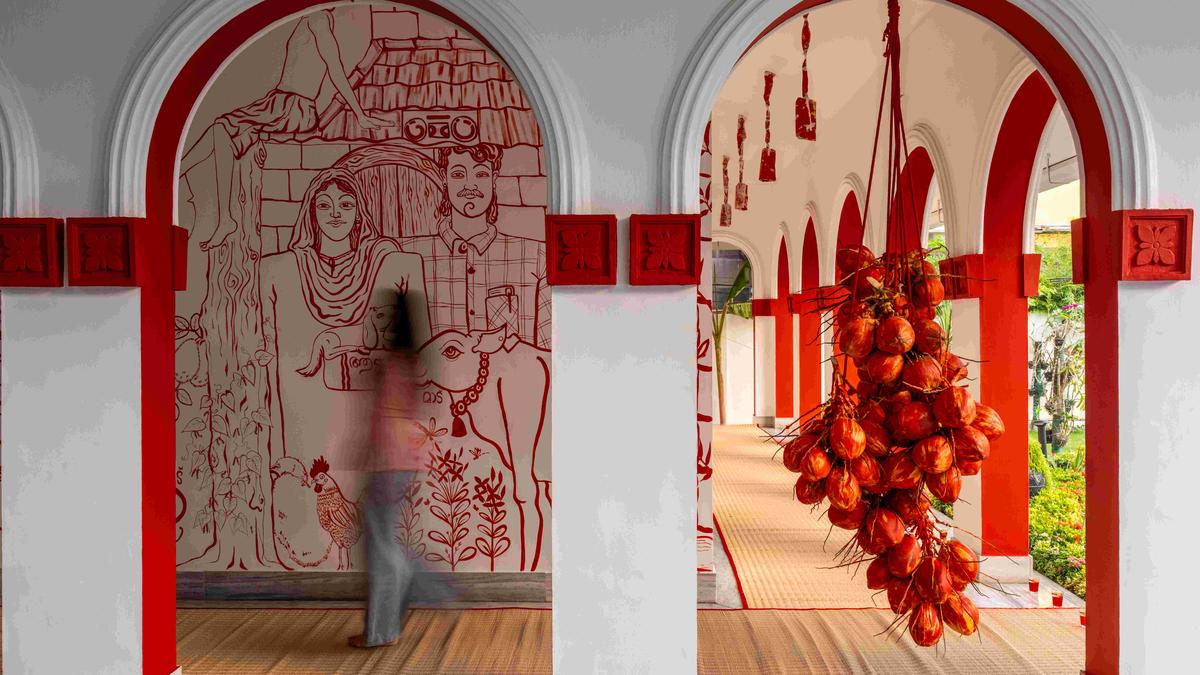
A bunch of coconuts painted red hang from the verandah of the quiet Kochi residence on Tower Road. Behind it is a mural by five young Kerala artists: Harisankar Muraleedharan, Athul P., John Martin, Affin Anu Singh, and Sudharsana B. Shenoy. Titled Dhesham, it picks out vignettes of their lives in dark red.
As you walk in, the scene shifts to Goa, with a stunning okmus displayed at the entrance. Kelekar shares that designer Savio Jon created the ceremonial red and white robe (worn by pallbearers in the Procession of Saints during Lent) with satin, velvet and lace, and a pussybow at the collar, specially for the event. Next come the trio of rooms where the full “story” unfolds, cocooned by Asian Paints Royale’s red repertoire — in bold stripes on the walls and chevron-esque patterns on the ceiling.
Savio Jon’s okmus, with satin, velvet and lace


Warmer oceans and depleting food have affected the ubiquitous loggerhead turtle’s reproductive and migratory patterns — and even its size.

Toyota Urban Cruiser Ebella review: Explore design, range, features, ride comfort and safety of Toyota’s new electric SUV for India. Expected price ₹14–18 lakh, with up to 500 km claimed range and practical urban usability.

Explore India's potential in bio-based chemicals and enzymes, highlighting industry leaders and challenges in sustainable manufacturing.

Astronomers discover an unusual planetary system with a rocky planet formed outside its gaseous neighbors, challenging existing formation theories.

Four new astronauts arrive at the ISS to replace a crew evacuated due to a serious health issue.

Neurobehavioural therapy can transform brain connectivity in functional neurological disorders, highlighting the link between cognition, emotion, and behavior.

The centuries-long quest for synthetic diamonds, also known as lab-grown diamonds or human-made diamonds, came to an end in 1954-55. On February 15, 1955, the creation of the first synthetic diamonds were announced, and it was quickly picked-up by newspapers around the world. A.S.Ganesh tells you more about these diamonds and the man who first made it happen…

Kadhambari S. Viswanathan highlights online education's evolution and its coexistence with traditional methods at The Hindu Tech Summit 2026.

The Hindu science quiz on Charles Darwin on February 13 2026

Explore the immersive art exhibit "A Story in Red" in Fort Kochi, featuring 13 installations celebrating memory, culture, and emotion.

Explore why different animals have varying litter sizes based on reproduction strategies and survival adaptations.

Experience Bitter Nectar at Bikaner House, an engaging exhibition exploring ecological issues through interactive art installations until February 15.

Discover the fascinating world of blimps, their history, functionality, and significance in aviation and advertising.