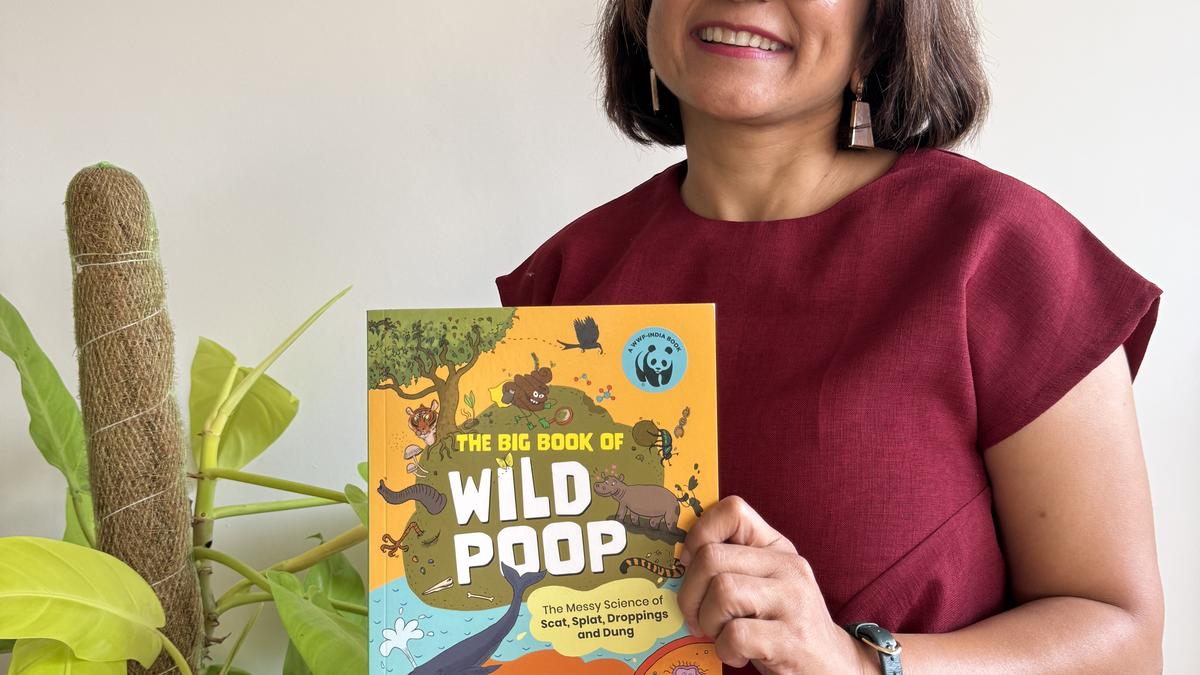
Poop is a metadrive of information: Shweta Taneja
The Hindu
Shweta Taneja's new book explores how digestive waste tells stories of how animals live, think, feel, migrate, communicate and evolve
Shweta Taneja has always been drawn to the things that exist on the fringes of a society. “The dark spaces that people shove under the carpet or put into the closet have always attracted me,” explains the Bengaluru-based writer, whose latest book, The Big Book of Wild Poop (Juggernaut/Indian Pitta), is yet another exploration of something we do not talk about enough: digestive waste.
“Poop can be disgusting. (But) It is the most natural process in the world,” writes Shweta in the book, pointing out that it happens because we eat. And yes, it is “a metadrive of information”, something she constantly reiterates. For instance, “the wiggling invisible DNA inside the sticky, smelly stuff tells the story of how animals live, think, feel, migrate, communicate and evolve. Analysing this information, ecologists can figure out how to save them.”
Poop can tell us more about wild animals | Photo Credit: Sunaina Coelho
Like many of her other books, The Big Book of Wild Poop, which came out in January this year, is a collaborative effort between her and the illustrator, Sunaina Coelho, a process she enjoys. “When you work with an artist, for a graphic novel or a visual book, you have to give space for the artist’s vision as well, so there will be more reiterations,” she says, adding that a lot of work went into this book during the editing stage to align the visuals and text. “The reason I adore comics and graphic novels is that there is such a beautiful collaboration and trust between each other’s vision that comes together.”
The book is a collaborative effort between Shweta and her illustrator | Photo Credit: Sunaina Coelho
The book’s overall aesthetic, packed with beautiful illustrations and quirky facts about faecal matter, is certainly a testament to this collaboration, offering a ridiculously fun, detailed read. It may occasionally cause the ick, but mostly makes one laugh out loud, allowing the reader to learn many aspects of biology without it feeling too academic.


Warmer oceans and depleting food have affected the ubiquitous loggerhead turtle’s reproductive and migratory patterns — and even its size.

Toyota Urban Cruiser Ebella review: Explore design, range, features, ride comfort and safety of Toyota’s new electric SUV for India. Expected price ₹14–18 lakh, with up to 500 km claimed range and practical urban usability.

Explore India's potential in bio-based chemicals and enzymes, highlighting industry leaders and challenges in sustainable manufacturing.

Astronomers discover an unusual planetary system with a rocky planet formed outside its gaseous neighbors, challenging existing formation theories.

Four new astronauts arrive at the ISS to replace a crew evacuated due to a serious health issue.

Neurobehavioural therapy can transform brain connectivity in functional neurological disorders, highlighting the link between cognition, emotion, and behavior.

The centuries-long quest for synthetic diamonds, also known as lab-grown diamonds or human-made diamonds, came to an end in 1954-55. On February 15, 1955, the creation of the first synthetic diamonds were announced, and it was quickly picked-up by newspapers around the world. A.S.Ganesh tells you more about these diamonds and the man who first made it happen…

Kadhambari S. Viswanathan highlights online education's evolution and its coexistence with traditional methods at The Hindu Tech Summit 2026.

The Hindu science quiz on Charles Darwin on February 13 2026

Explore the immersive art exhibit "A Story in Red" in Fort Kochi, featuring 13 installations celebrating memory, culture, and emotion.

Explore why different animals have varying litter sizes based on reproduction strategies and survival adaptations.

Experience Bitter Nectar at Bikaner House, an engaging exhibition exploring ecological issues through interactive art installations until February 15.

Discover the fascinating world of blimps, their history, functionality, and significance in aviation and advertising.