Toyota Urban Cruiser Ebella: Toyota’s quiet electric thesis for urban India
The Hindu
Toyota Urban Cruiser Ebella review: Explore design, range, features, ride comfort and safety of Toyota’s new electric SUV for India. Expected price ₹14–18 lakh, with up to 500 km claimed range and practical urban usability.
Toyota has long taken a measured, pragmatic approach to electrification. While competitors rushed to dominate early EV headlines, Toyota focused on strengthening its hybrid strategy, backing real-world efficiency and infrastructure readiness over hype-driven ambition. The Urban Cruiser Ebella represents a quiet but decisive evolution in that philosophy. This is Toyota acknowledging that the Indian market is ready for a mass-market electric SUV—on its terms. In characteristic Toyota fashion the Ebella does not attempt to shout above the competition. It is instead trying to be the most sensible one.
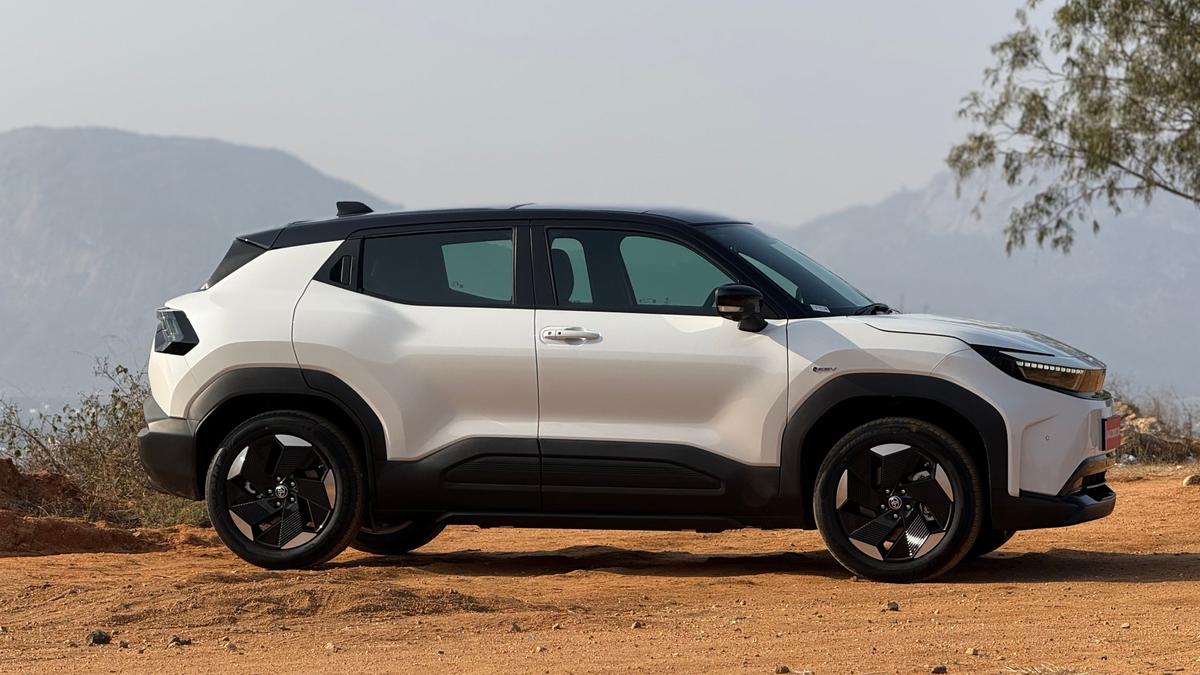
Surfacing and restrained styling lend the Ebella a mature, urban-ready road presence | Photo Credit: Special Arrangement
Visually, the Ebella strikes a careful balance between familiarity and modernity. Its shared underpinnings with the Maruti Suzuki e Vitara are apparent, yet Toyota asserts its distinct identity, most clearly expressed at the front. The signature hammerhead grille lends the SUV a contemporary, almost concept-inspired face, while slim LED lighting elements, clean surfacing and restrained body sculpting create an impression of quiet confidence. It doesn’t chase futuristic excess; instead, it leans into a quiet, assured presence that will age well. In a segment where visual noise often masquerades as innovation, the Ebella’s restraint feels refreshing.
On the road, that restraint continues, but with a surprising layer of engagement. The Ebella feels well planted and composed, especially at city speeds, where its light steering and smooth, predictable throttle mapping make navigating traffic effortless. What impresses more is its composure as speeds rise. As velocities climb into three-digit territory, the chassis settles, the steering gains reassuring weight, and the overall demeanour becomes more confident than one might expect from a compact urban-focused EV. There is a quiet coherence to the way the Ebella behaves—nothing feels rushed or underdeveloped—and that cohesion makes it unexpectedly engaging for an electric SUV in this class.
The panoramic glass roof adds an airy feel to the Ebella’s practical interior | Photo Credit: Special Arrangement
Battery options include a 49 kWh and a 61 kWh pack, both tuned for real-world usability rather than spec-sheet theatrics. The larger battery’s claimed range figure comfortably north of 500 km on the ARAI cycle positions the Ebella as one of the more credible long-range offerings in the compact electric SUV segment. In practice, even conservative estimates suggest that 400 km-plus should be easily achievable in mixed driving, which, in the Indian context, is more than sufficient for urban commuting with the occasional intercity run. Toyota’s approach here is classic brand logic: remove the psychological barrier of range anxiety first, then let the rest of the ownership experience do the convincing.


Warmer oceans and depleting food have affected the ubiquitous loggerhead turtle’s reproductive and migratory patterns — and even its size.

Toyota Urban Cruiser Ebella review: Explore design, range, features, ride comfort and safety of Toyota’s new electric SUV for India. Expected price ₹14–18 lakh, with up to 500 km claimed range and practical urban usability.

Explore India's potential in bio-based chemicals and enzymes, highlighting industry leaders and challenges in sustainable manufacturing.

Astronomers discover an unusual planetary system with a rocky planet formed outside its gaseous neighbors, challenging existing formation theories.

Four new astronauts arrive at the ISS to replace a crew evacuated due to a serious health issue.

Neurobehavioural therapy can transform brain connectivity in functional neurological disorders, highlighting the link between cognition, emotion, and behavior.

The centuries-long quest for synthetic diamonds, also known as lab-grown diamonds or human-made diamonds, came to an end in 1954-55. On February 15, 1955, the creation of the first synthetic diamonds were announced, and it was quickly picked-up by newspapers around the world. A.S.Ganesh tells you more about these diamonds and the man who first made it happen…

Kadhambari S. Viswanathan highlights online education's evolution and its coexistence with traditional methods at The Hindu Tech Summit 2026.

The Hindu science quiz on Charles Darwin on February 13 2026

Explore the immersive art exhibit "A Story in Red" in Fort Kochi, featuring 13 installations celebrating memory, culture, and emotion.

Explore why different animals have varying litter sizes based on reproduction strategies and survival adaptations.

Experience Bitter Nectar at Bikaner House, an engaging exhibition exploring ecological issues through interactive art installations until February 15.

Discover the fascinating world of blimps, their history, functionality, and significance in aviation and advertising.