Vellalore Lake in Coimbatore is now home to city’s first Butterfly Park
The Hindu
Vellalore Lake in Coimbatore is now home to city’s first Butterfly Park
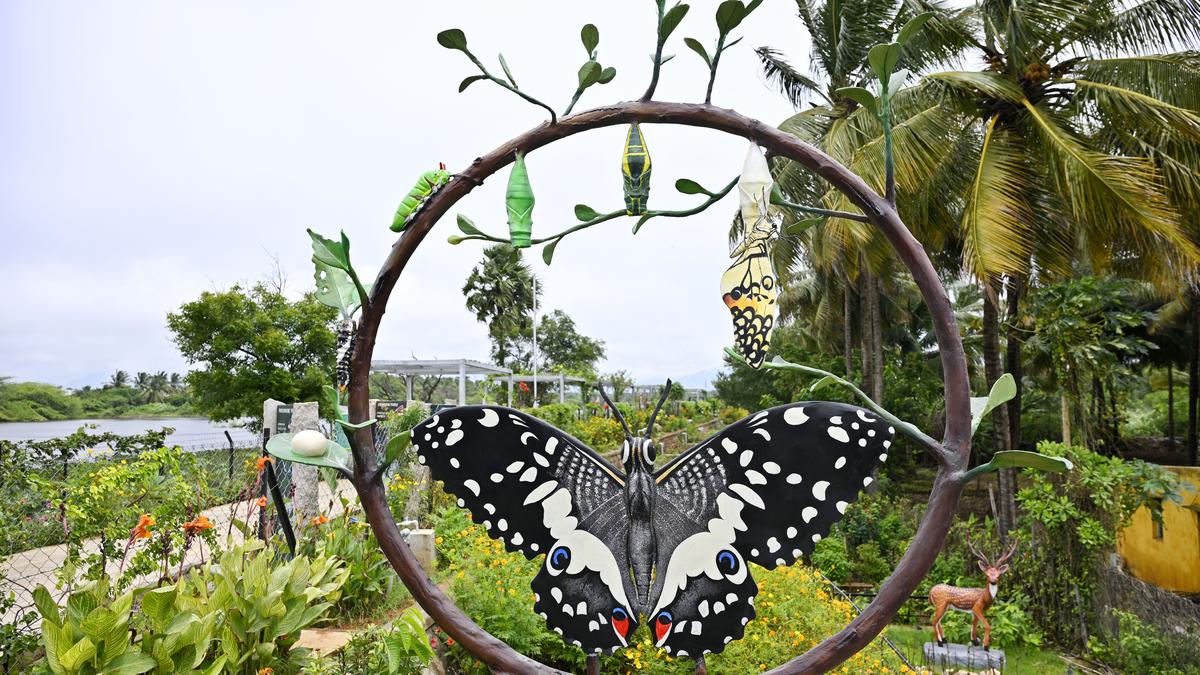
It is a rainy August morning and we are at the 90-acre Vellalore Lake, admiring the calm scenery. Ducks paddle in the still waters, while cormorants and pelicans flutter their wings around the trees on the little islands. As the rain pauses we bask in warm sunshine beside a striking giant 18-ft butterfly replica, orange in colour with a dark brown outer ring, at the city’s first ever Butterfly Park.
It is an installation of the Tamil Yeoman, also known as Tamil maravan, an endemic butterfly of the Western Ghats, the state butterfly of Tamil Nadu. Once inside the park, a profusion of colourful butterflies — the dark blue tiger, blue tiger, common rose, and glossy black common crows — buzz around yellow marigolds, showy orange lantana blooms, red velvet flower bunches and yellow dahlias.
Blue Mormons, the fourth largest butterfly of India and state butterfly of Maharashtra, have been sighted here in great numbers. A beautiful bluish-green butterfly called the common banded peacock, and other rare ones like medus brown, chocolate albatross, and bamboo tree brown are often seen drinking nectar from the blooms, much to the excitement of butterfly enthusiasts.
When Vellalore Lake, once a hub of migratory birds, ran dry it became a dumping ground for garbage and debris. This blocked the inlet channels that fed the lake with water from the Noyyal, the lifeline of Coimbatore. Many old timers recall an unforgettable sight at the lake where rosy starlings, a winter migratory bird, flocked in thousands to roost.
A team of eco-warriors led by R Manikandan, founder of Kovai Kulangal Paadukaappu Amaippu (KKPA), a water conservation NGO started in 2017, along with Coimbatore Corporation and other public works departments, de-silted the rajavaaikaal channel, which connects the lake with the Noyyal, removed encroachments, cleared the debris of plastics and thorny seema karuvelam bushes, an invasive species.
After a gap of 15 years, the lake filled to brim with water during the monsoons in 2018. “Once there was copious water, magic unfolded,” says Manikandan as he recalls how birds and butterflies thronged in great numbers, an indication of a thriving bio-diversity.
A Miyawaki forest canopy was raised along the bund with 10,000 towering native trees in batches including bamboo, neem, banyan, pungai, poovarasu, and as many 270 varieties. Along with trees, rows and rows of herbal plants and a dense greenery of flowering and nectaring plants like hibiscus, castor, lime, curry leaves, turmeric and banana has turned the lake into a butterfly hotspot.


First-level randomisation of EVMs completed in Nagapattinam for upcoming elections, ensuring transparency and security.

A district-level committee in Krishnagiri has been formed to assess and verify seizure claims of goods and cash.

Minister Anam Ramanarayana Reddy pledges government support for local fishermen and farmers facing challenges in Andhra Pradesh.

MP M. Sribharat urges collective efforts to revive Visakhapatnam Steel Plant, highlighting key reforms for crucial recovery and growth.

141 candidates have filed nominations for Kozhikode's Assembly elections, with scrutiny on March 24 and campaigning intensifying.

BJP's Vijayendra accuses Congress of using money to influence Bagalkot bypolls, urging voters to reject their tactics.

First randomization of electronic voting machines completed in Tirunelveli and Tenkasi districts for upcoming Assembly elections.

RPF seizes 10.12 kg of unclaimed cannabis worth ₹5.06 lakh from a train in Mangaluru.

Kolar's groundwater levels rise to 50-100 ft due to the K.C. Valley project, ensuring clean water and improved health outcomes.

Three smugglers arrested in Sangareddy with 574 kg of ganja valued at ₹2.87 crore during a police operation.

Mysuru MP urges a 'flex-free Mysuru' by discouraging birthday banners, promoting responsible celebrations to preserve the city's heritage.

Farmers of Kalakudi demand payment for paddy bags procured at DPC

BJP's seal on a 2019 Election Commission letter ignites controversy in Kerala, prompting claims of careless handling by CPI(M).