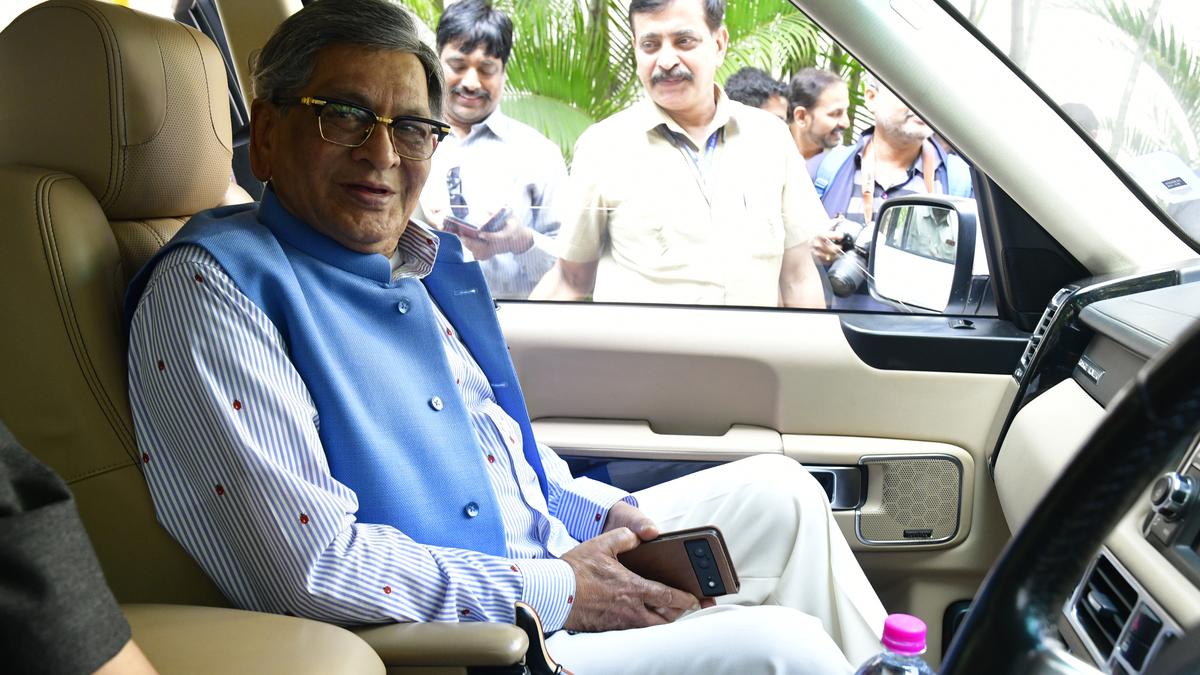
SMK-Y2K combo ushered in tech growth in Karnataka
The Hindu
SMK understood that unless the infrastructure of the fast-growing Bengaluru was attended to, the City would lose its edge as an emerging IT capital of India and also find it difficult to attract new investments.
Somanahalli Mallaiah Krishna (S.M. Krishna), or SMK as friends fondly called him, was the most tech-savvy, flamboyant, well-informed and widely travelled Chief Minister of Karnataka.
His tenure as the Chief Minister, from 1999 to 2004, were the foundational years of Indian IT. Krishna played a huge role in growing the tech industry to a certain size by encouraging Indian and foreign enterprises to invest in Karnataka through his diplomatic interventions and convincing pitches, although in the early 2000s no one could foresee that Bengaluru (Bangalore then) and Karnataka in some years would emerge as the tech flag bearer for the entire country. The State currently accounts for over 40% of the country’s total IT exports worth around $260 billion and houses operations of almost all Fortune 500 firms and a thousand start-ups.
Krishna understood the importance and advantage of having IT companies set up operations in Bengaluru, so he encouraged their presence and actively wooed them during his tenure. He knew Craig Barrett, CEO and later Chairman of Intel Corporation, John Chambers, CEO and Executive Chairman of Cisco Systems, Bill Gates, co-founder of Microsoft Corporation and several Silicon Valley entrepreneurs and investors of Indian origin such as Kanwal Rekhi, Vinod Khosla, Gururaj Deshpande, Kumar Malavalli, Pramod Haque and others. This was when IT companies were also actively courted by Hyderabad, whose Chief Minister, Chandrababu Naidu, had projected himself as a tech-savvy politician.
‘’Whenever large global IT companies wanted to set up their tech development centers in India, both Krishna and Chandrababu Naidu made sure that they or their respective bureaucrats, would proactively reach out to these companies and encourage them to choose their State. It sort of became a race between these two CMs,” recalled a former tech journalist who frequently interacted with Krishna and Naidu.
SMK understood that unless the infrastructure of the fast-growing Bengaluru was attended to, the City would lose its edge as an emerging IT capital of India and also find it difficult to attract new investments. To his credit was also nurturing the Bangalore Agenda Task Force (BATF), a public-private partnership (PPP) to bring business and civic leaders to the same table to discuss and suggest ways to develop Bangalore.
Interestingly, SMK and Y2K (the millennium bug) happened to Karnataka concurrently in 1999 and these two played extremely critical roles in unleashing big-bang tech growth in the State, and since then world started taking notice of Bengaluru, which was till then known mostly for its weather and PSU presence. Later, the City quickly emerged as the tech capital of the country, the “Silicon Valley of India.”
‘’It so happened when I became the Chief Minister in 1999, there was vigorous activity in the IT and BT sector. Fortunately, we were right there to catch the benefit of the beginning of the tech revolution that was taking place. We went all out, to explore the opportunity, you know, and we did not look back at all,’‘ he had told The Hindu in an interview just ahead of 2023 Assembly polls in Karnataka.


Perundurai's industrial growth faces challenges of pollution, water scarcity, and healthcare, impacting residents ahead of the 2026 elections.

The Travancore Devaswom Board asserts that courts should respect community beliefs in its Supreme Court submission on Sabarimala's entry issue.

Karnataka cancels Deendayal Upadhyay event at KSOU due to protocol violations, citing inconsistency with university objectives.

Illegal pickle unit busted in Hyderabad, one arrested; unhygienic stock worth ₹3 lakh seized

Karnataka has entered a state of demographic transition where a large working-age population will no longer be enough to drive economic growth, and future gains will depend on how productively people are employed, the ‘State of Working India 2026’ report said.

Key demands in Sulur Assembly constituency include reviving the powerloom sector, addressing farmers' needs, and protecting River Noyyal.

Kodihalli urges Karnataka CM to allocate ₹10,000 crore revolving fund for seamless procurement of farm products under MSP scheme.

Kerala's political parties continue to marginalize women candidates, highlighting a troubling disconnect between gender demographics and representation.

The High Court of Karnataka on Tuesday ordered the issue of a notice to the State government on a PIL petition, which had complained about disturbances caused to people residing in the localities around the National Public School situated in Rajajinagar 5th block due to use of loudspeakers with high volume in the school and parking of school buses in residential areas.

China is extensively mapping ocean floors to enhance submarine warfare capabilities against the U.S. and allies across key oceans.

AIADMK's 2026 manifesto promises free rations, women's benefits, education reforms, and economic growth initiatives for Tamil Nadu.

The vehicle towing drive will soon resume in the city to ease traffic congestion. The Bengaluru Traffic Police (BTP), in coordination with the Greater Bengaluru Authority (GBA), is set to relaunch the vehicle towing drive across the city shortly to tackle traffic congestion and illegal parking.

Panic buying, not shortage, is leading to long queues at Hyderabad petrol pumps.