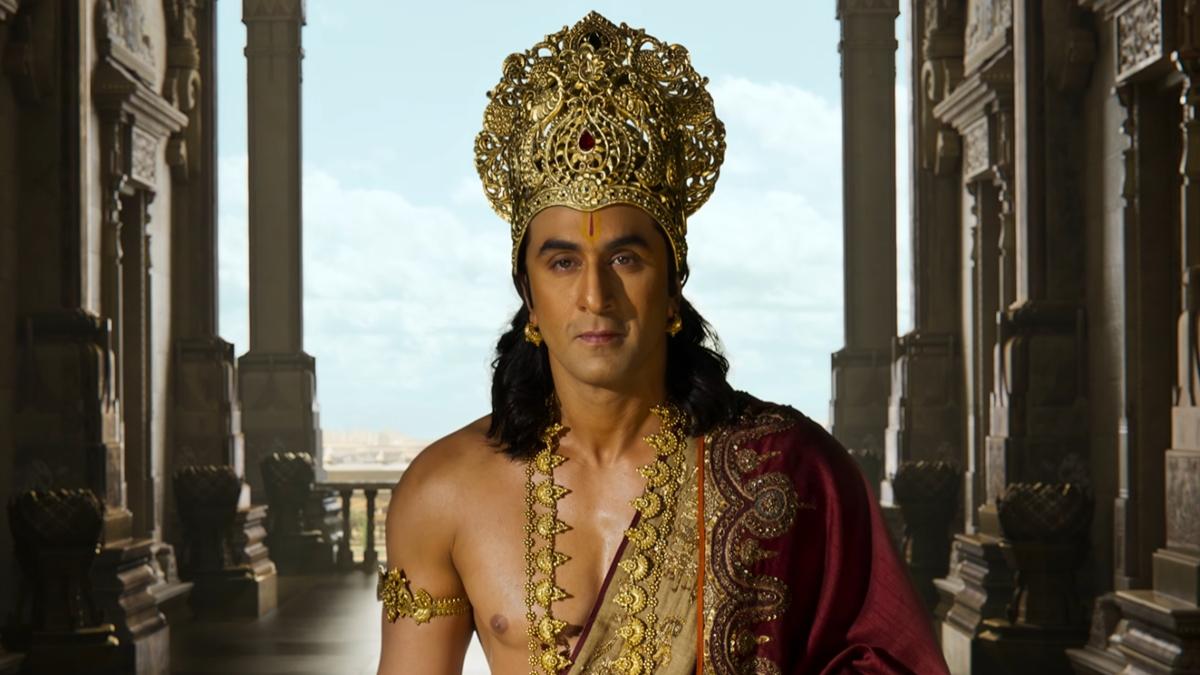
‘Ramayana’ Rama glimpse: Ranbir Kapoor holds sway as the Lord in Nitesh Tiwari’s magnum opus
The Hindu
The much-awaited first glimpse into Ranbir Kapoor’s Rama from Nitesh Tiwari’s Ramayana was unveiled by the makers on Thursday (April 2, 2026) on the occasion of Hanuman Jayanti.
The much-awaited first glimpse into Ranbir Kapoor’s Rama from Nitesh Tiwari’s Ramayana was unveiled by the makers on Thursday (April 2, 2026) on the occasion of Hanuman Jayanti.
The glimpse offers a vast look into the film, especially at Lord Rama. It opens with panoramic visuals from the battlefield, as we later see Rama standing against the rising sun. He is then seen walking as people offer flower petals on him. Ranbir’s look is then revealed as he is shown wearing gold ornaments, carrying a faint smile on his face. Featuring grand, epic-like visuals, the magnum opus, based on the mythological legend, promises to be a visual marvel. The teaser ends with the image of Ravana (Yash), seen walking towards his huge Pushpak Vimana.
Sharing the glimpse of Rama, the makers wrote in caption, “Rama is the greatest of all time because he lived a life where the choices he made were always in the benefit of the greater good, duty over desire, and sacrifice over self. His legacy continues to enhance and empower humanity over time and bring the belief in the goodness of the human spirit to resolve all conflict and bring peace to the world.”
The film features music by AR Rahman and Hans Zimmer and lyrics by Kumar Vishwas. Written by Sridhar Raghavan, the film also stars Sai Pallavi, Yash, Sunny Deol and Ravi Dubey in pivotal roles.
Ramayana is produced by produced by Namit Malhotra’s Prime Focus Studios along with DNEG and Yash’s Monster Mind Creations. The first part in the series will be released in theatres on Diwali 2026 followed by the second part in 2027.


Omar Abdullah emphasizes that Kashmiri Pandits can only return safely after restoring security and protecting Hindu shrines in J&K.

Residents of Egmore weigh infrastructure improvements against longstanding civic issues as they prepare for the upcoming T.N. Assembly elections.

Union Ministry approves ₹438.29 crore project to redevelop Berth No. 9 of New Mangalore Port for enhanced liquid bulk cargo handling.

PMK's manifesto demands a caste census, cash support for women, and accountability for Tamil Nadu's government amid alleged corruption.

India has 33 crore LPG connections, but domestic natural gas production could cater to 30 crore connections if households switch to piped natural gas (PNG). LPG is delivered in cylinders, while natural gas is transported through pipelines or as LNG and regasified, with PNG emerging as a drop-in replacement for cooking. The government is pushing PNG to reduce high LPG import dependence, but pipeline expansion, last-mile connectivity, and supply constraints remain key challenges.

A fire in Bidar kills 45 goats and a 62-year-old man, devastating the local community and prompting an investigation.

India's government offers incentives to foreign companies investing in coal gasification, highlighting its potential and seeking technological collaboration.

Discover how Tank Bund Shiva transforms his tragic past into a life-saving mission at Hyderabad's Hussainsagar lake.

Learn how to self-enumerate for Census 2027 with this step-by-step guide for convenient online data submission.

Congress and farmers criticize M.P. government for delaying wheat procurement, while BJP blames bag shortages on West Asia war.

Iran's President reassures Americans of goodwill, rejecting the portrayal of Iran as a threat in a recent letter.

A 7.4-magnitude earthquake off Indonesia's coast kills one, triggers tsunami warning, later lifted as aftershocks follow.

Samajwadi Party criticizes U.P. Government over IAS officer's resignation, questioning the treatment of efficient officials under BJP rule.