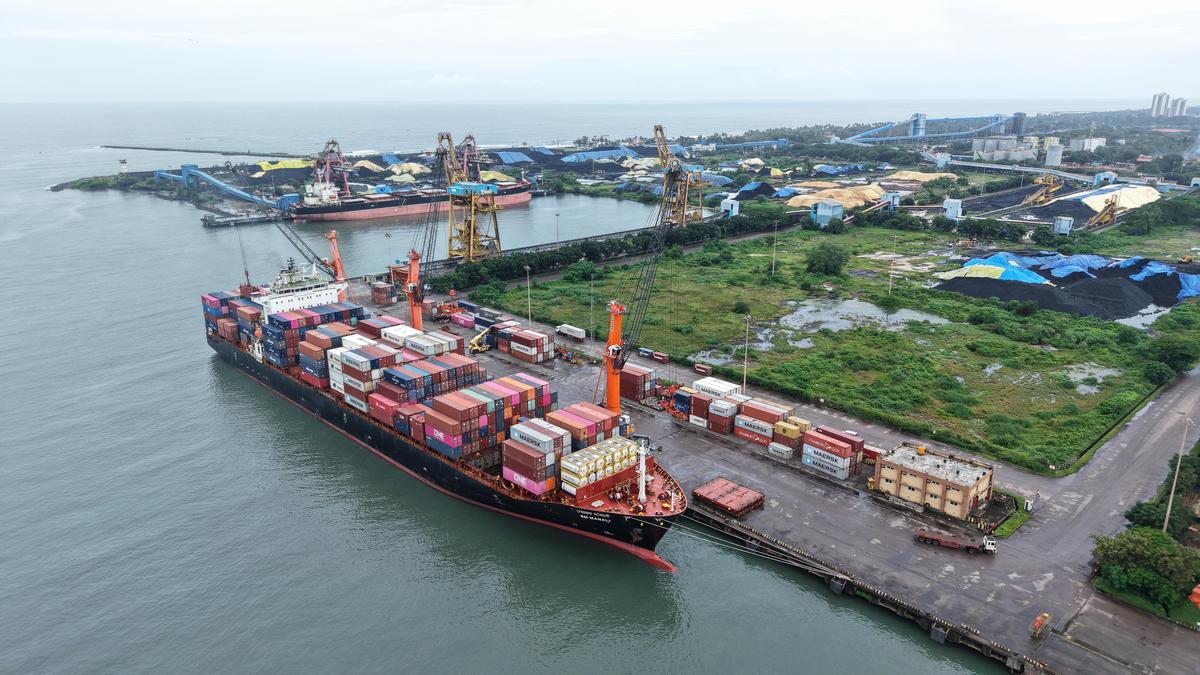
Centre approves ₹438.29 crore project to redevelop Berth No. 9 of New Mangalore Port
The Hindu
Union Ministry approves ₹438.29 crore project to redevelop Berth No. 9 of New Mangalore Port for enhanced liquid bulk cargo handling.
The Union Ministry of Ports, Shipping, and Waterways has approved a project worth ₹438.29 crore to redevelop Berth No. 9 at New Mangalore Port for handling liquid bulk cargo.
The project will be taken up on a Public-Private Partnership (PPP) basis under the Design, Build, Finance, Operate and Transfer (DBFOT) model.
A statement by the ministry said that the project envisages the dismantling of legacy infrastructure and comprehensive redevelopment of the berth to handle crude oil, petroleum products (POL), LPG and the like. As part of the modernization, the berth draft will be enhanced from the existing 10.5 metres to 14 metres, with a future-ready design provision up to 19.8 metres, enabling the port to accommodate vessels up to 2,00,000 Deadweight Tonnage (DWT), including Very Large Gas Carriers (VLGCs).
Highlighting the significance of the project, Union Minister of Ports, Shipping, and Waterways Sarbananda Sonowal said, “This transformative project is a reflection of the visionary leadership of Prime Minister Narendra Modi. We are positioning our ports to meet future energy and trade demands while strengthening India’s role as a global maritime leader”.
The project will have a capacity of 10.90 MTPA, and the concessionaire will commit to a Minimum Guaranteed Cargo (MGC) of 7.63 MTPA by the fifth year of operations. The construction period is two years, with a concession period of 30 years, inclusive of construction, the statement said.
The project is expected to deliver significant strategic and operational benefits. It will replace nearly 50-year-old structures with modern marine infrastructure designed for a 50-year structural life, ensuring long-term sustainability and resilience. The enhanced capacity will strengthen the port’s ability to meet the growing regional demand for liquid bulk cargo, particularly energy commodities.


Union Ministry approves ₹438.29 crore project to redevelop Berth No. 9 of New Mangalore Port for enhanced liquid bulk cargo handling.

PMK's manifesto demands a caste census, cash support for women, and accountability for Tamil Nadu's government amid alleged corruption.

India has 33 crore LPG connections, but domestic natural gas production could cater to 30 crore connections if households switch to piped natural gas (PNG). LPG is delivered in cylinders, while natural gas is transported through pipelines or as LNG and regasified, with PNG emerging as a drop-in replacement for cooking. The government is pushing PNG to reduce high LPG import dependence, but pipeline expansion, last-mile connectivity, and supply constraints remain key challenges.

A fire in Bidar kills 45 goats and a 62-year-old man, devastating the local community and prompting an investigation.

India's government offers incentives to foreign companies investing in coal gasification, highlighting its potential and seeking technological collaboration.

Discover how Tank Bund Shiva transforms his tragic past into a life-saving mission at Hyderabad's Hussainsagar lake.

Learn how to self-enumerate for Census 2027 with this step-by-step guide for convenient online data submission.

Congress and farmers criticize M.P. government for delaying wheat procurement, while BJP blames bag shortages on West Asia war.

Iran's President reassures Americans of goodwill, rejecting the portrayal of Iran as a threat in a recent letter.

A 7.4-magnitude earthquake off Indonesia's coast kills one, triggers tsunami warning, later lifted as aftershocks follow.

Samajwadi Party criticizes U.P. Government over IAS officer's resignation, questioning the treatment of efficient officials under BJP rule.

Rajya Sabha approves amendments to the Insolvency and Bankruptcy Code, enhancing investor confidence and strengthening the banking system.

Delhi HC highlights child trafficking crisis, calling the city a 'mandi' and demands police and railways’ response to petition.