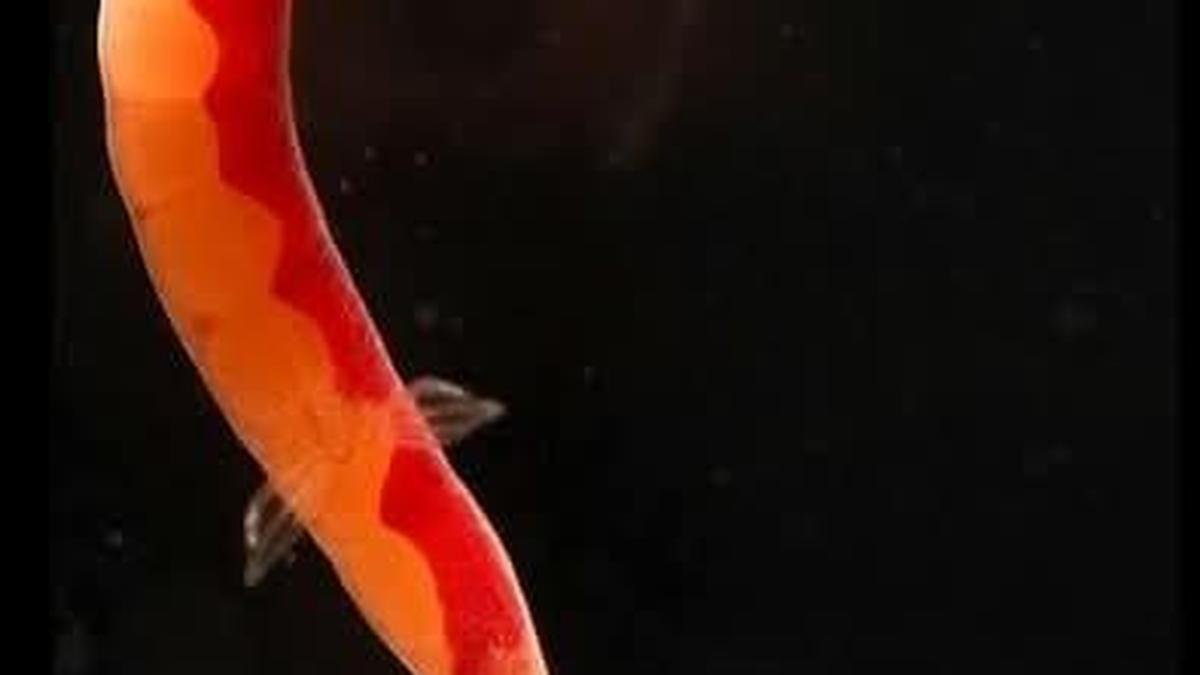
New genus and species of blind miniature fish discovered in Assam
The Hindu
A new blind fish species, Gitchak nakana, discovered in Assam, features a unique skull structure and translucent appearance.
An international team of researchers from Germany, India, and Switzerland has discovered a remarkably strange new species of fish living in a hand-dug well in a village in Assam. This discovery of Gitchak nakana is a major milestone for science, as it marks the first time an aquifer-dwelling fish has been documented in Northeast India or the Eastern Himalayan region.
The findings were published recently in Scientific Reports, a nature portfolio journal. The scientific team comprised of Ralf Britz and Amanda Pinion (Senckenberg Museum, Dresden, Germany), Rajeev Raghavan (Kerala University of Fisheries and Ocean Studies (KUFOS), Kochi), Wimarithy Marak and Kangjam Velentina (Assam Don Bosco University, Guwahati) Yumnam Lokeshwor (Dhanamanjuri University, Manipur) and Lukas Rüber (Natural History Museum, Bern, Switzerland).
The new species has been named Gitchak nakana, drawing from the Garo language to describe its appearance. “Gitchak” means red, while “na-tok” and “kana” refer to absence of eyes. This tiny fish, which grows no larger than two centimeters, belongs to a new genus within the loach family but differs from all other members of the family Cobitidae by a number of unique characters. Because it lives deep underground in water-bearing rock layers, it is completely blind with no visible eyes. Its body is translucent and lacks any skin pigment, which causes its blood to show through and gives the fish a striking, bright red appearance.
The most bizarre biological feature of this new species is the complete absence of a skull roof. In a departure from almost all other bony fish, the top of its brain is covered only by skin rather than bone. This structural rarity, combined with its miniature size, makes it an evolutionary enigma. Scientists believe this discovery proves that the groundwater systems of Northeast India harbor a highly specialised and hidden world of wildlife that was previously thought to exist only in the southern parts of the country.
Because the fish has only been found in a single well in very small numbers, the researchers are keeping its exact location a secret. They are concerned that disclosing the site could lead to illegal collection for the international aquarium trade, which has already threatened other rare cavefish in neighbouring Meghalaya. “Surprisingly, the cave mahseer from Meghalaya, Neolissochilus pnar, has recently been available in the international aquarium pet trade, although a better understanding of its population size, wider distribution and potential threats to its habitat is still lacking. However, such information would be essential to plan conservation prioritisation and action for a subterranean fish with such a restricted distribution,” said Dr. Raghavan, who is also the South Asia Chair of the IUCN SSC Freshwater Fish Specialist Group.
Experts believe that consistent, long-term study of these fascinating animals is certain to lead to the discovery of many more species currently unknown to science. “The subterranean fish research group led by Dr. Raghavan at KUFOS has been credited with some of the most interesting discoveries of groundwater-dwelling fishes of the Indian subcontinent, including Neolissochilus pnar – the world’s largest cavefish. The group has also described four subterranean fish species and one blind subterranean shrimp from various parts of Kerala. Subterranean fishes are one of the most enigmatic and evolutionary distinct groups of fishes worldwide. As a national hub for groundwater and subterranean fish research, KUFOS has made significant contributions to our understanding of these rare and poorly-known taxa, through an innovative citizen-science programme and extensive international collaborations,” said A. Biju Kumar, Vice-Chancellor of KUFOS.


Bengaluru East Corporation meeting addresses garbage management, building violations, and resident concerns amid growing public frustration.

NGO Poovulagin Nanbargal calls for mandatory environmental clearance for large solar projects to protect agricultural lands in Tamil Nadu.

Kollam district panchayat budget for 2026-27 fiscal year focuses on comprehensive development with a special emphasis on sustainable infrastructure, agriculture and health.

Researchers have discovered two new earthworm species in Silent Valley, highlighting its biodiversity significance in the Western Ghats.

The Khadi Utsava at Sahyadri College in Shivamogga successfully showcased handloom products, attracting enthusiastic visitors and fostering community engagement.

A new blind fish species, Gitchak nakana, discovered in Assam, features a unique skull structure and translucent appearance.

Tensions in West Asia disrupt perishable cargo exports from Tiruchi airport, with flights to Dubai and Sharjah suspended since February 28.

Karnataka CM Siddaramaiah supports Tamil Nadu's Stalin in advocating for cooperative federalism and renewed Centre-State relations.

A new Sericulture Experience Park inaugurated in Udhagamandalam to educate visitors on silk production and mulberry cultivation.

Multiple international flights remain cancelled at Mangaluru Airport on March 4 due to airspace closure amid regional conflict.

Tourism Minister R. Rajendran inaugurates stormwater drain projects in Salem Corporation to enhance local infrastructure and amenities.

Water level in Mullaperiyar dam on Tuesday stood at 116.50 feet (the maximum permissible level is 142 ft.) with nil inflow and a discharge of 444 cusecs.

Over 509 athletes from 115 universities competed in AU's All India Inter-University Best Physique Championship, celebrating the university's centenary.