NGO urges T.N. to make environmental clearance mandatory for large-scale solar projects
The Hindu
NGO Poovulagin Nanbargal calls for mandatory environmental clearance for large solar projects to protect agricultural lands in Tamil Nadu.
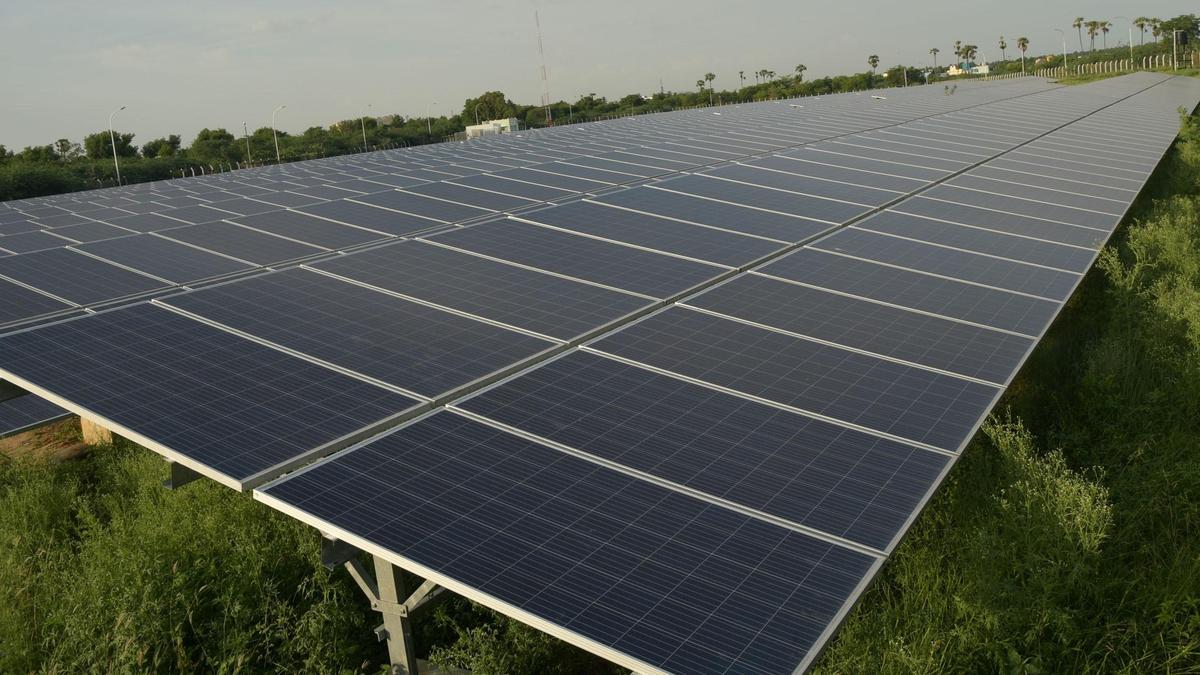
Environmental organisation Poovulagin Nanbargal has urged the Tamil Nadu government to make environmental clearance mandatory for large-scale solar power projects, stating that the rapid expansion of ground-mounted solar parks is increasingly encroaching on agricultural and grazing lands.
In a statement issued on Tuesday, the organisation referred to the Union Ministry of New and Renewable Energy’s September 2025 report, Solar PV Potential of India – Ground Mounted, which estimates that India can generate 3,343 GW of solar power by utilising 27,571 sq. km. of largely arid and wasteland areas.
The assessment excludes agricultural land, forests, and eco-sensitive zones. In Tamil Nadu, where 58.27% of land is under agriculture and only 10.44% is classified as wasteland or dry land, the report estimates a potential of 204.7 GW from non-agricultural lands alone. The State’s current installed solar capacity is 10.15 GW.
However, the organisation alleged that in practice, several large solar projects are being set up on fertile farmlands and grazing commons, triggering protests in districts including Ramanathapuram, Tenkasi, Tirunelveli, Pudukkottai, Theni, Thoothukudi, Dindigul, Mayiladuthurai, and Tiruvarur.
Poovulagin Nanbargal noted that under the Environmental Impact Assessment (EIA) Notification, 2006, solar projects initially required prior environmental clearance, but were exempted in 2011 by the Union Environment Ministry on the grounds of lower emissions and water use.
Even so, State Pollution Control Boards were expected to ensure that projects were not located on wetlands, agricultural land or eco-sensitive areas before granting consent. However, due procedures are often bypassed, the organisation said, adding that private companies are attempting to install large solar arrays on cultivable land without proper approvals.


Minister K. Venkatesh announces plans to open Koila Veterinary College next academic year, pending approval from the Veterinary Council of India.

Trump criticizes U.K. Prime Minister Starmer for strained U.S.-U.K. relations and delayed access to military bases amid Iran conflict.

Ethiraj College for Women launches a startup incubation centre to empower aspiring women entrepreneurs in Chennai.

Bengaluru East Corporation meeting addresses garbage management, building violations, and resident concerns amid growing public frustration.

NGO Poovulagin Nanbargal calls for mandatory environmental clearance for large solar projects to protect agricultural lands in Tamil Nadu.

Kollam district panchayat budget for 2026-27 fiscal year focuses on comprehensive development with a special emphasis on sustainable infrastructure, agriculture and health.

Researchers have discovered two new earthworm species in Silent Valley, highlighting its biodiversity significance in the Western Ghats.

The Khadi Utsava at Sahyadri College in Shivamogga successfully showcased handloom products, attracting enthusiastic visitors and fostering community engagement.

A new blind fish species, Gitchak nakana, discovered in Assam, features a unique skull structure and translucent appearance.

Tensions in West Asia disrupt perishable cargo exports from Tiruchi airport, with flights to Dubai and Sharjah suspended since February 28.

Karnataka CM Siddaramaiah supports Tamil Nadu's Stalin in advocating for cooperative federalism and renewed Centre-State relations.

A new Sericulture Experience Park inaugurated in Udhagamandalam to educate visitors on silk production and mulberry cultivation.

Multiple international flights remain cancelled at Mangaluru Airport on March 4 due to airspace closure amid regional conflict.