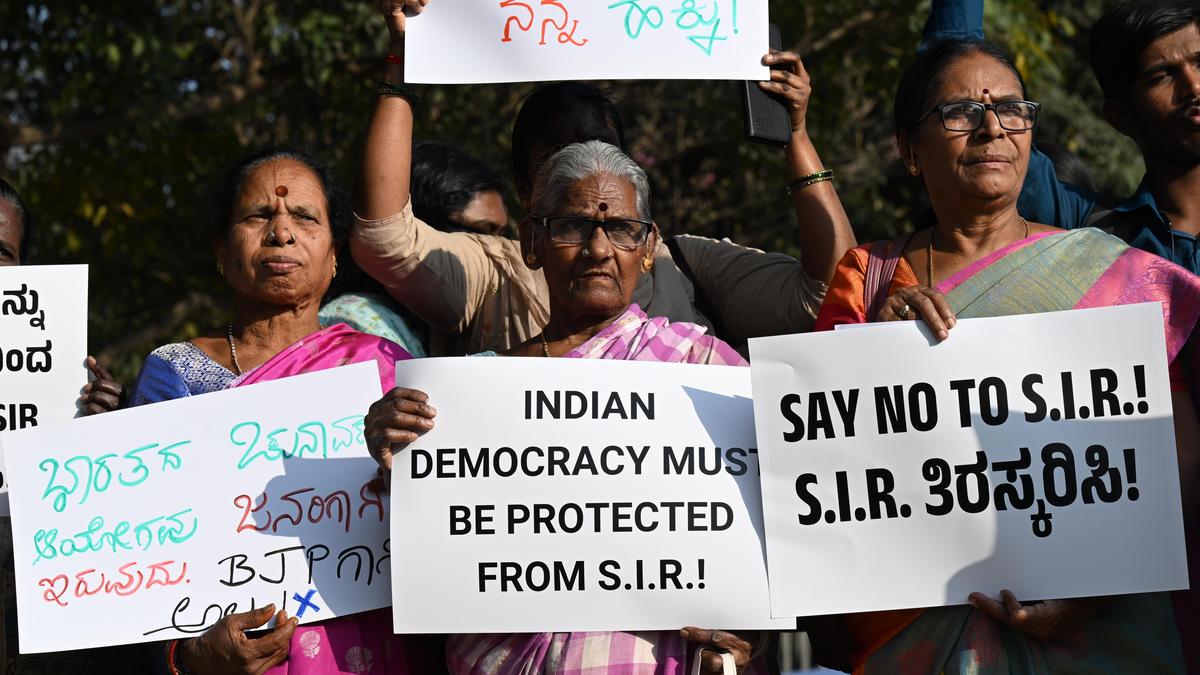
Karnataka: As SIR rolls out, women fear disenfranchisement
The Hindu
Karnataka women’s groups express concerns over disenfranchisement risks from the Special Intensive Revision of electoral rolls.
From fears that married women are being asked to trace their names in decades-old electoral rolls to concerns that daughters-in-law do not even find a place in the new forms, women’s groups in Karnataka warned that the Special Intensive Revision (SIR) of electoral rolls could end up pushing many women out of the voters’ list.
At a consultation held on Saturday, representatives of around 32 women’s organisations and social activists discussed the growing risk of disenfranchisement under the SIR being carried out by the Election Commission of India, which they argued has been designed places the burden on citizens to prove their eligibility.
Earlier, they said, officials conducted door-to-door verification. Under the SIR, however, voters are required to produce one among a prescribed list of documents. According to participants, many women, especially those who are married, migrant, economically dependent, or without formal education, may struggle to access such documents in their own name.
Concerns were raised about the structure of the SIR enumeration form. Aishwarya R. of the People’s Union for Civil Liberties said the form lists relationships such as father, mother, son, and daughter, but does not explicitly recognise daughters-in-law. In practice, she said, this could mean that married women are asked to return to their parental homes to verify that their parents’ names appeared in earlier electoral rolls, gather proof, and submit it to booth-level officers. For working women, migrant women and those living far from their natal homes, this process could be both time-consuming and costly.
Participants alleged that even before the formal rollout of the SIR in Karnataka, voter list mapping had been conducted in a hurried and non-transparent manner, leading to the deletion or omission of names of women, domestic workers, daily wage earners, Dalits, nomadic communities, slum residents, and young couples living away from their parental homes. They said there was little clarity on how those left out would be restored to the rolls.
Women and LGBTQI groups said they would strongly oppose the SIR in the coming days and announced that protests would be held across the State throughout March. It was also decided that this year’s Women’s Day programmes would focus on explaining the SIR and discussing how, in their view, it takes away rights that women have fought hard to win.


Karnataka women’s groups express concerns over disenfranchisement risks from the Special Intensive Revision of electoral rolls.

Cyberabad Police unveil tech-driven student mobility plan to ease congestion

Vice-President C.P. Radhakrishnan warmly welcomed in Kochi during his two-day visit to Kerala with notable dignitaries present.

Ivan D’Souza seeks ₹1,500 crore from CM Siddaramaiah for Mangaluru's underground drainage repairs and other development projects.

TTD announces major initiatives to enhance education, security and amenities for pilgrims at Tirumala, fostering modernisation and tradition.

A mound of concrete housing a manhole is in the middle of Pondicherry Salai in Sholinganallur; motorists, particularly motorcyclists, should watch out

Naidu announces completion of North Andhra irrigation projects and highlights Bhogapuram Airport's role in regional development and employment.

A report urges Karnataka to increase health spending, fill vacancies, and enhance facilities for improved public healthcare access.

Rioting charges filed against MLAs and an MP for breaching prohibitory orders during the Kambala Kare foundation event in Udupi.

Hyderabad police bust substandard pheni manufacturing unit in Jiyaguda, arresting one and seizing goods worth ₹3.98 lakh.

New roof shelters at Kumaran Kundram temples enhance facilities for devotees and traders, promoting spirituality across faiths in Chennai.

Sunil Kumar urges event claimants to cover Udupi Kambala costs, criticizing politicization of the traditional festival.

Chief Minister Chandrababu Naidu launches HPV vaccination campaign amid rising cancer cases in Andhra Pradesh, targeting 3.45 lakh girls.