Cyberabad Police unveil tech-driven student mobility plan to ease congestion
The Hindu
Cyberabad Police unveil tech-driven student mobility plan to ease congestion
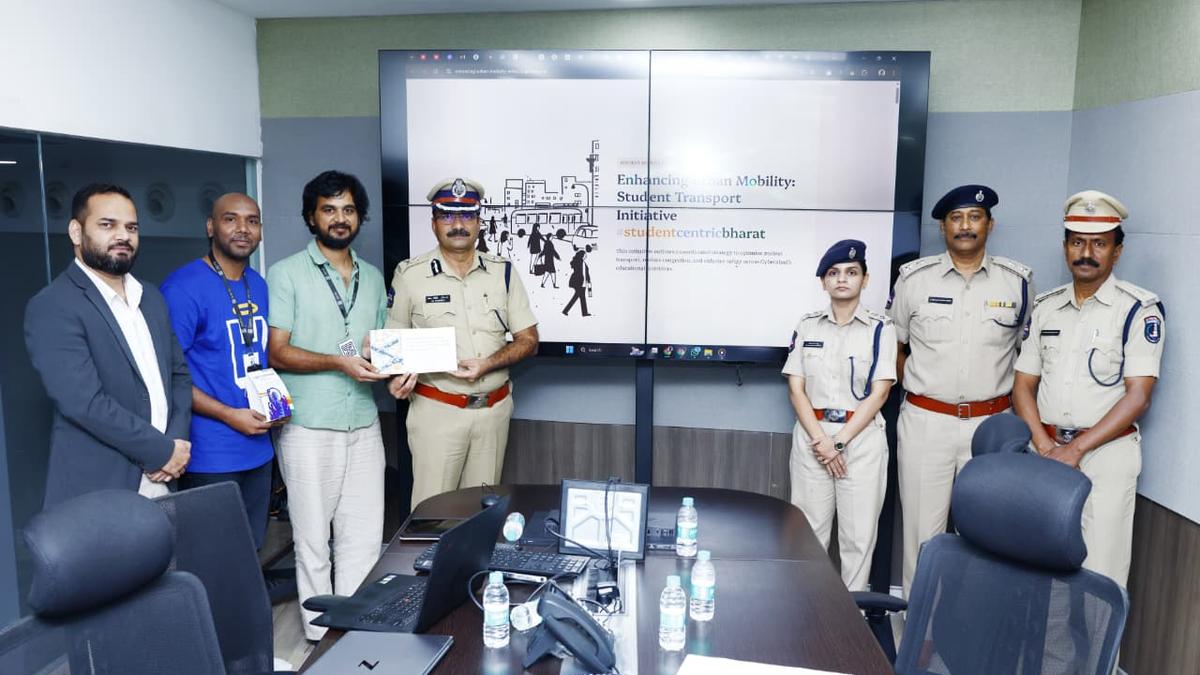
A city-scale digital public infrastructure initiative aimed at creating safer and more affordable student transport while reducing traffic congestion was discussed during a meeting of Cyberabad police and Society for Cyberabad Security Council (SCSC) on Friday.
Cyberabad Police Commissioner and SCSC Chairman M Ramesh chaired a meeting to outline the proposed Student Mobility framework, which seeks to build a technology-led, community-driven and law enforcement-verified ecosystem for children and youth commuting across the city.
The initiative proposes a structured coordination layer between parents, educational institutions, fleet operators and civic authorities. It aims to address congestion, non-compliant transport practices and underutilised fleet capacity by aggregating demand, ensuring police-verified fleet compliance and integrating RTC and private buses. The model also envisages engaging trained and verified gig workers, including ASHA and anganwadi workers, as attendants and mobility supervisors to generate supplementary income.
According to officials, the system is designed to reduce single-occupancy private drop-offs, optimise pooled routes and enable affordable, subsidised transport access for students travelling to academic and sports institutions. Vehicles under the framework will be equipped with CCTV cameras and monitored through a central command and control centre.
The official said traffic congestion was a symptom of deeper coordination gaps and emphasised that a shared data ecosystem involving parents, schools, service providers and civic authorities could offer a sustainable solution. He added that integrating underutilised public and private fleet capacity under police scrutiny and technological governance would enhance safer and more inclusive student mobilty system.
The model draws inspiration from the Transport for London system, with officials stating that a globally benchmarked, technology-driven mechanism would be adapted to local requirements.


Karnataka women’s groups express concerns over disenfranchisement risks from the Special Intensive Revision of electoral rolls.

Cyberabad Police unveil tech-driven student mobility plan to ease congestion

Vice-President C.P. Radhakrishnan warmly welcomed in Kochi during his two-day visit to Kerala with notable dignitaries present.

Ivan D’Souza seeks ₹1,500 crore from CM Siddaramaiah for Mangaluru's underground drainage repairs and other development projects.

TTD announces major initiatives to enhance education, security and amenities for pilgrims at Tirumala, fostering modernisation and tradition.

A mound of concrete housing a manhole is in the middle of Pondicherry Salai in Sholinganallur; motorists, particularly motorcyclists, should watch out

Naidu announces completion of North Andhra irrigation projects and highlights Bhogapuram Airport's role in regional development and employment.

A report urges Karnataka to increase health spending, fill vacancies, and enhance facilities for improved public healthcare access.

Rioting charges filed against MLAs and an MP for breaching prohibitory orders during the Kambala Kare foundation event in Udupi.

Hyderabad police bust substandard pheni manufacturing unit in Jiyaguda, arresting one and seizing goods worth ₹3.98 lakh.

New roof shelters at Kumaran Kundram temples enhance facilities for devotees and traders, promoting spirituality across faiths in Chennai.

Sunil Kumar urges event claimants to cover Udupi Kambala costs, criticizing politicization of the traditional festival.

Chief Minister Chandrababu Naidu launches HPV vaccination campaign amid rising cancer cases in Andhra Pradesh, targeting 3.45 lakh girls.