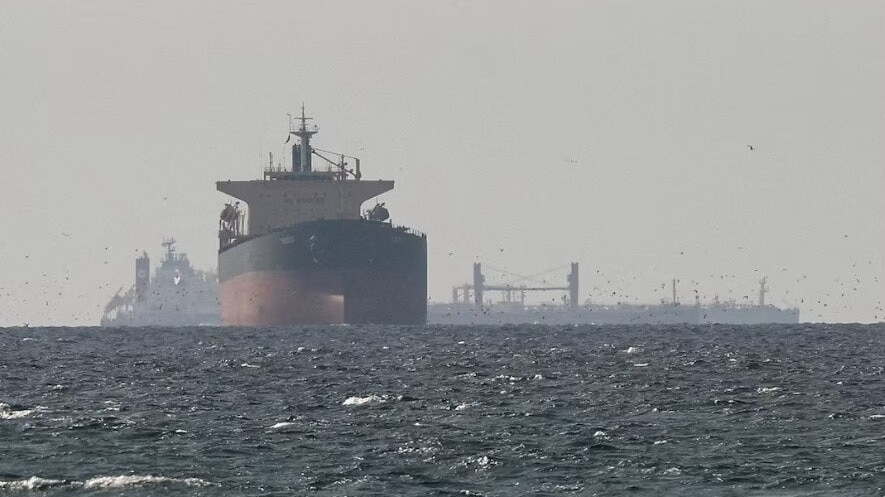
Iran may impose transit fees on ships to pass through Strait of Hormuz
India Today
Since the start of the US-Israeli war on Iran, Tehran has disrupted maritime transit through the strait for vessels it says are linked to its war adversaries and their allies.
Iran is considering a proposal to levy transit fees on vessels passing through the Strait of Hormuz, a lawmaker said on Thursday, a potential bid to monetise Tehran's newfound grip over the critical waterway through which a fifth of global oil and liquefied gas passes.
Since the start of the US-Israeli war on Iran, Tehran has disrupted maritime transit through the strait for vessels it says are linked to its war adversaries and their allies.
According to the Iranian Students' News Agency, the lawmaker said parliament was considering a bill under which countries using the strait for shipping, energy transit and food supplies would be required to pay tolls and taxes to Iran.
An adviser to Iran's supreme leader said "a new regime for the Strait of Hormuz" will follow the war's eventual end, allowing Tehran to apply maritime restrictions on states that have sanctioned it.
"By using the strategic position of the Strait of Hormuz, we can sanction (the West) and prevent their ships from passing through this waterway," Mohammad Mokhber said on Thursday, according to Mehr news agency.


The world is facing an energy crisis as Iran blocked supplies passing through the Strait of Hormuz after strikes by the US and Israel. Vital subsea cables that carry global internet traffic also pass through Hormuz. Any damage to them could trigger internet outages and hit financial systems across countries, including in India.

A techie used an immersion rod to cook curry after running out of gas, with the viral video showing an exaggerated version of people's realities amid the ongoing LPG crisis in India.

The bodies of the deceased were taken to the Civil Hospital and Jinnah Hospital for identification, the rescue members of Pakistan's largest non-profit social welfare organisation, The Edhi Foundation, told Reuters.

Following the detection of the drones, the US administration held high-level meetings with senior officials. In addition, a high alert was issued for the US Army, amid possibilities of Iranian retaliation.

Images of pre-Islamic Zoroastrian kings and warriors have been unveiled in Iran, evoking courage and resilience. Many say the Ayatollah regime in Iran revives the country's Persian identity during conflicts with Israel and the US. But this Persian heritage has always run deep, and is visible from time to time, in both dissent and unity.

Born of colliding continents and vanished seas, the Strait of Hormuz is the million‑year accident that turned buried oceans into oil, and a thirty‑mile gap in the rocks into the world's most dangerous chokepoint.

The US-Israel war was meant to decapitate Iran's hardline leadership, but the killing of the "pragmatic" Ali Larijani might have done the opposite. By eliminating consensus-builder Larijani, the Israelis might have removed any scope of talks and pushed Iran into deeper hardline control. This could be a ploy to keep the war going.

The newly launched Vande Bharat Sleeper train has sparked widespread commentary as passengers share initial experiences of its modernised amenities, particularly on the Howrah-Guwahati route inaugurated in January.

The assassination of Ali Larijani, one of Iran's most powerful decision-makers, marks a major escalation in the ongoing US-Israel-Iran war and comes amid a sustained campaign targeting the country's top leadership.

The assassination of Ali Larijani, one of Iran's most powerful decision-makers, marks a major escalation in the ongoing US-Israel-Iran war and comes amid a sustained campaign targeting the country's top leadership.

Expect Iran to become more hardline: Geopolitical expert and author Fareed Zakaria reflects on aftermath of US-Israel strikes

The newly launched Vande Bharat Sleeper train has sparked widespread commentary as passengers share initial experiences of its modernised amenities, particularly on the Howrah-Guwahati route inaugurated in January.

Gabbard said that the U.S. intelligence community assesses a sharp rise in the number of missiles capable of striking the United States. According to estimates, the figure is expected to grow to over 16,000 by 2035, a significant increase from the current assessed number of around 3,000.