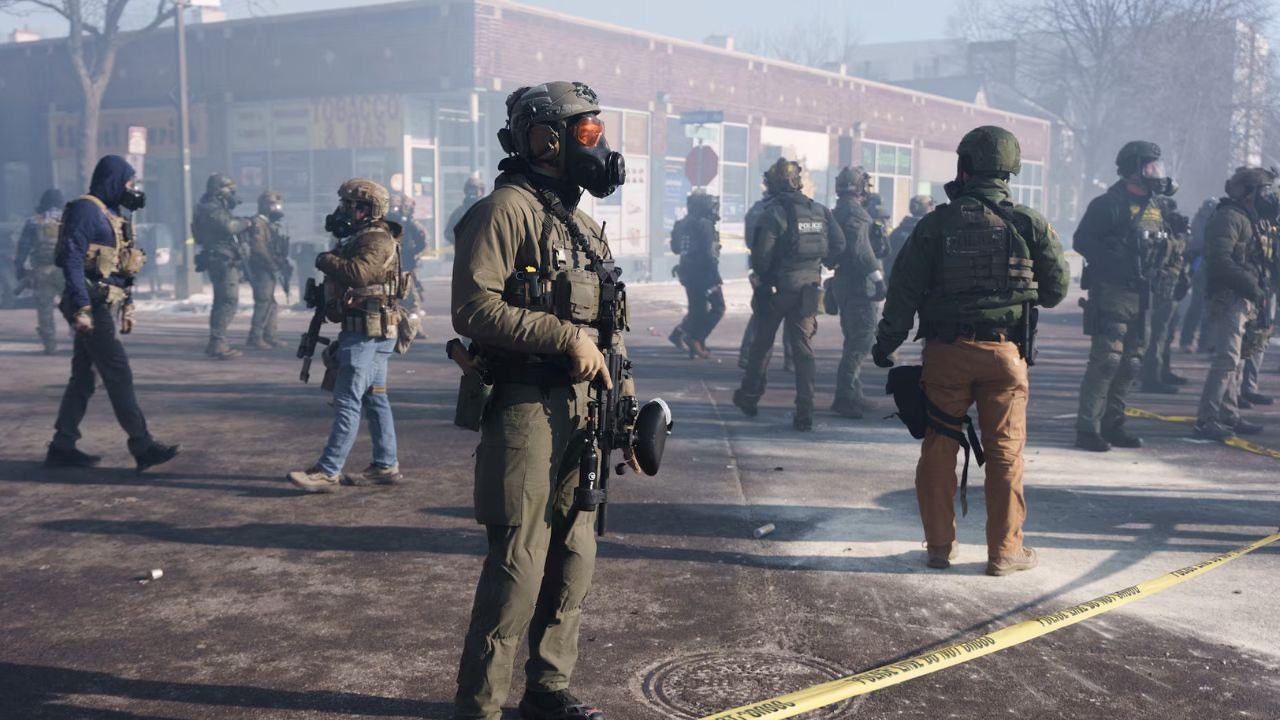
ICE agents roped in for security at Winter Olympics, Milan Mayor says not welcome
India Today
US Immigration and Customs Enforcement will play a limited security support role for the American delegation at the Milan-Cortina Winter Olympics, a move that has sparked political opposition in Italy and renewed debate over the agency's expanding reach under President Donald Trump.
US Immigration and Customs Enforcement (ICE) agents are set to play a limited security role during the Milan-Cortina Winter Olympics, according to sources at the US Embassy in Rome, reported The Associated Press quoting embassy officials.
Federal ICE personnel will support diplomatic security details for the US delegation, the officials said, and will not conduct immigration enforcement or operational security in Italy. Similar roles have been carried out by US federal agencies at previous Olympic Games, including Homeland Security Investigations (HSI), the investigative arm of ICE.
ICE’s participation falls under the broader framework of the US Department of Homeland Security providing security at major international events. The State Department’s Diplomatic Security Service also routinely deploys officers to events like the Olympics. For example, during the 2016 Rio Olympics, Transportation Security Administration officers helped with airport screening due to increased visitors and potential security threats.
Milan Mayor Giuseppe Sala voiced strong opposition to ICE’s deployment, citing images of masked agents in Minneapolis during protests. “This is a militia that kills, a militia that enters the homes of people, signing their own permission slips. It is clear they are not welcome in Milan, without a doubt,” Sala told RTL Radio 102. Milan will host most ice sports during the February 6–22 Winter Games.
The backlash in Italy has been amplified by recent incidents involving ICE in the United States. In recent weeks, footage aired by Italian state broadcaster RAI showed ICE agents threatening to break the window of a vehicle carrying journalists reporting on immigration enforcement in Minneapolis. The episode added fuel to criticism of the agency’s tactics and conduct.
The confirmation of ICE’s role sparked conflicting statements from Italian authorities. Interior Minister Matteo Piantedosi said he had not received formal confirmation of ICE’s deployment but added, “I don’t see what the problem would be.” The Interior Ministry later clarified that while U.S. officials have yet to confirm the makeup of the security detail, “at the moment there are no indications that ICE USA will act as an escort to the American delegation.”


Amid the ongoing Middle East war, Turkish authorities destroyed a US-made unmanned vessel in a controlled blast after it washed ashore on the country's Black Sea coast.

Ashu Ghai recreated the striking scene from Dhurandhar 2, where Ranveer Singh is introduced as Jaskirat Singh Rangi amid a cascade of fiery sparks.

Pakistan Army chief Asim Munir said Shias who "love Iran so much" should "go to Iran". His remarks triggered a row with prominent Shia clerics of Pakistan accusing Munir of insulting the community and the military establishment of serving America and Israel as a "servant".

Treasury Secretary Scott Bessent said the US may need to intensify strikes on Iran to end the conflict. This came soon after Trump threatened to hit Iran's energy plants amid soaring oil prices and Strait of Hormuz tensions.

The scooter rider rode into the pedestrian zone, collided with the car, and fell down. The man driving the car, however, did not react with anger and handled the situation with composure.

A minute-long ATC recording lays bare the confusion and urgency before a runway collision in New York. Controllers issued frantic warnings as a plane struck a vehicle, forcing a complete airport shutdown.

Tucker Carlson says he might cry listening to him. Millions call him a prophet. But who exactly is "Professor Jiang" — and what is he not telling you?

In a symbolic act of wartime messaging, Iran placed stickers carrying anti-war remarks by Spanish Prime Minister Pedro Sanchez on ballistic missiles bound for Israel as the Middle East conflict enters it fourth week.

The announcement was made a day after North Korea convened the first session of its Supreme People's Assembly. The assembly, the isolated nation's rubber-stamp legislature, formally approves state policy.


Indian Railway staff's swift action turned a medical emergency involving a toddler into relief aboard a train from Bengaluru to Gujarat.

Leon Panetta said Iran war was not an unexpected risk. He pointed out that for years, US security officials have known Iran could disrupt global oil supplies by blocking the Strait of Hormuz. According to him, this was a well-known danger, but one that appears to have been overlooked in the current conflict.

Sri Lanka raised fuel prices by about 25% for the second time in a week as the Gulf conflict disrupts global oil supplies via the Strait of Hormuz.