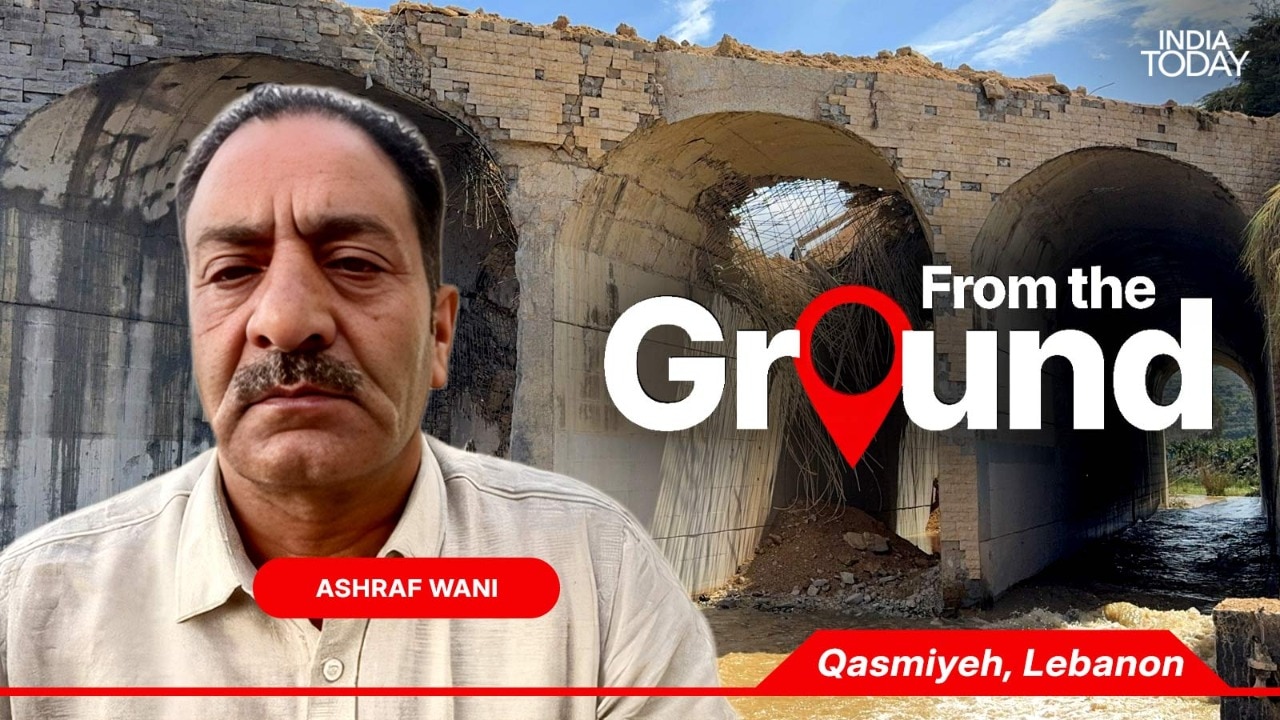
Ground report from Lebanon: Where a bridge once stood, silence now echoes the war
India Today
Hours after an airstrike destroyed the Qasmiyeh bridge over the Litani river in south Lebanon, India Today reporter Ashraf Wani reached the site to find an eerie, complete silence – no people, no rescue teams, only wreckage.
The smell of burnt concrete was still in the air when I reached the Qasmiyeh bridge in south Lebanon early Monday, hours after it was struck. What stayed with me was not the destruction, but the silence.
There were no rescue teams, no civilians, no movement. The roads leading up to the bridge were empty, homes nearby shut tight. It felt as if life had stepped away from the area. I had tried to get here the previous day but turned back amid uncertainty and the fear of further strikes. When I finally arrived, I was alone.
The bridge was gone. Steel rods jutted out of broken slabs, and large sections had collapsed into the river below.
This was not just any crossing. The Qasmiyeh bridge is a key route linking southern Lebanon with the rest of the country. Its loss is not only structural. It cuts access to farms, hospitals and daily life.
Standing there, the isolation was hard to ignore. If another strike came, there would be no immediate help. I began reporting, speaking into a silence that seemed to absorb every word.
Then, slowly, the stillness began to break. In the distance, I saw the first vehicles approaching. Other journalists, local and international, began arriving after word spread that access was possible. Cameras came out, voices returned, and life slowly edged back into a place gripped by fear.


Amid the ongoing Middle East war, Turkish authorities destroyed a US-made unmanned vessel in a controlled blast after it washed ashore on the country's Black Sea coast.

Ashu Ghai recreated the striking scene from Dhurandhar 2, where Ranveer Singh is introduced as Jaskirat Singh Rangi amid a cascade of fiery sparks.

Pakistan Army chief Asim Munir said Shias who "love Iran so much" should "go to Iran". His remarks triggered a row with prominent Shia clerics of Pakistan accusing Munir of insulting the community and the military establishment of serving America and Israel as a "servant".

Treasury Secretary Scott Bessent said the US may need to intensify strikes on Iran to end the conflict. This came soon after Trump threatened to hit Iran's energy plants amid soaring oil prices and Strait of Hormuz tensions.

The scooter rider rode into the pedestrian zone, collided with the car, and fell down. The man driving the car, however, did not react with anger and handled the situation with composure.

A minute-long ATC recording lays bare the confusion and urgency before a runway collision in New York. Controllers issued frantic warnings as a plane struck a vehicle, forcing a complete airport shutdown.

Tucker Carlson says he might cry listening to him. Millions call him a prophet. But who exactly is "Professor Jiang" — and what is he not telling you?

In a symbolic act of wartime messaging, Iran placed stickers carrying anti-war remarks by Spanish Prime Minister Pedro Sanchez on ballistic missiles bound for Israel as the Middle East conflict enters it fourth week.

The announcement was made a day after North Korea convened the first session of its Supreme People's Assembly. The assembly, the isolated nation's rubber-stamp legislature, formally approves state policy.


Indian Railway staff's swift action turned a medical emergency involving a toddler into relief aboard a train from Bengaluru to Gujarat.

Leon Panetta said Iran war was not an unexpected risk. He pointed out that for years, US security officials have known Iran could disrupt global oil supplies by blocking the Strait of Hormuz. According to him, this was a well-known danger, but one that appears to have been overlooked in the current conflict.

Sri Lanka raised fuel prices by about 25% for the second time in a week as the Gulf conflict disrupts global oil supplies via the Strait of Hormuz.