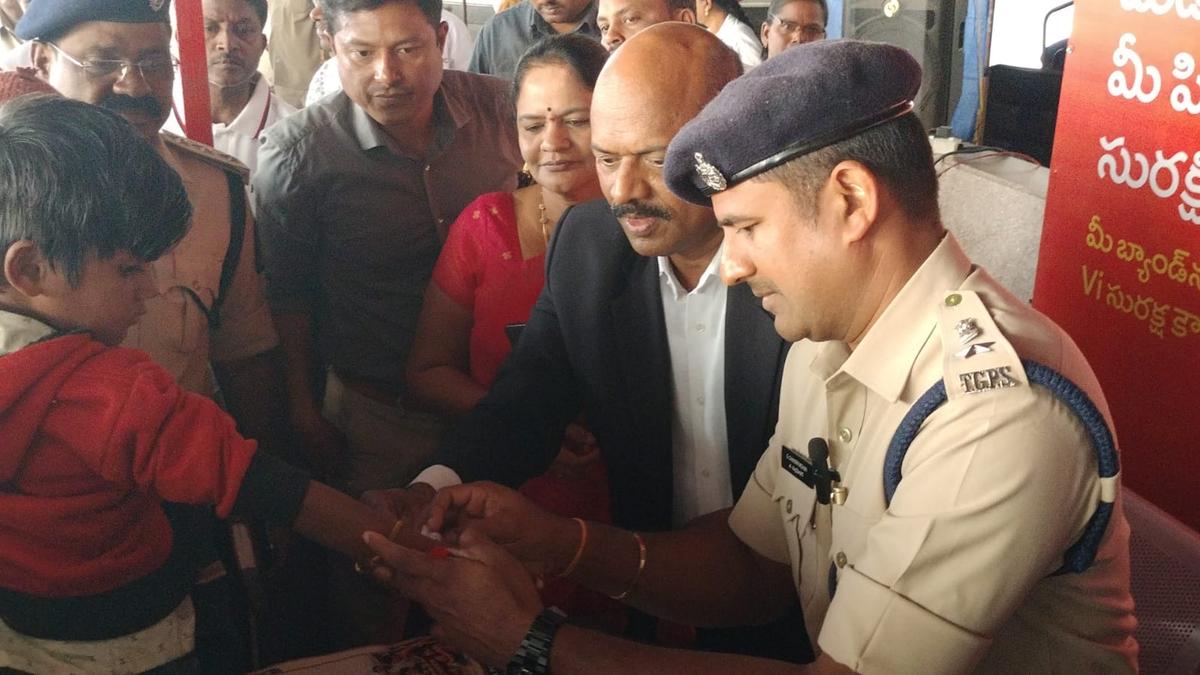
Hyderabad Police introduce QR wristbands for children’s safety at Medaram Jatara
The Hindu
Hyderabad police launch QR-based wristbands to prevent children from getting separated from their families amid dense crowds at the upcoming Medaram Jatara.
As lakhs of devotees prepare to head to the Medaram Jatara in Mulugu district, Hyderabad police on Tuesday rolled out a child safety initiative to prevent children from getting separated from their families amid the massive crowds expected at the biennial Adivasi festival.
A dedicated stall has been set up at the Mahatma Gandhi Bus Station (MGBS) in Afzalgunj here to issue special identification wristbands for children travelling to Medaram. The initiative is being implemented by the Afzalgunj police in association with Vodafone Idea.
Police said the wristbands are intended to enable quick identification and reunion of children with their parents or guardians during the pilgrimage. Each band carries a unique QR code generated after basic details are collected at the stall, including the child’s name, parent or guardian’s name, contact number and residential address.
If a child is separated from family members in the dense crowds at Medaram, police personnel or volunteers can scan the QR code to instantly access the information and help trace the child’s guardians without delay.
The stall was inaugurated by Deputy Commissioner of Police of Golconda Zone, G. Chandra Mohan. Senior police officers and officials from various departments were present, including Additional Deputy Commissioners Krishna Goud and Shyam Babu, Assistant Commissioner of Police S. Sudershan of Goshamahal Division, Afzalgunj Station House Officer N. Ravi and MGBS regional manager J. Srilatha.
Afzalgunj police have appealed to parents and guardians travelling through MGBS to ensure their children wear the wristbands.


The government plans to amend the FCRA, introducing new regulations for NGO asset management and accountability for key functionaries.

The draft policy for “Responsible Digital Use Among Students”, released on Monday by the Department of Health and Family Welfare, has recommended that parents set structured routines with clear screen-time rules and prioritise privacy, safety, and open conversation with children on digital well-being.

Police Observer Sushant Kumar Saxena conducts surprise inspection at Shencottai police station, reviewing warrants and security arrangements ahead of elections.

Andhra Pradesh government to launch key projects in April, focusing on industrial growth and infrastructure development, says Nara Lokesh.

Lok Sabha refers the Corporate Laws (Amendment) Bill to a JPC amid opposition concerns over CSR provisions dilution.

SHG members in Kanniyakumari use snakes and ladders to raise election awareness and boost voter turnout.

Government accelerates consultations for early implementation of the Women’s Reservation Act to ensure women’s representation in 2029 elections.

CM A. Revanth Reddy distributes ₹1 crore insurance cheques to families of deceased Electricity department employees, enhancing financial security for workers.

The Bengaluru Traffic Police (BTP) registered 634 cases of drunk driving during a week-long special enforcement drive conducted across the city between March 16 and March 22.

GHMC intensifies action against property tax defaulters, seizing properties and offering a One Time Settlement scheme for payments.

CCB arrests three drug peddlers in Mangaluru, seizing ₹2.5 lakh worth of MDMA and other valuables.

TVK's 28 candidates in Puducherry include former BJP MLAs, a sitting Independent, and a retired police IG.

BRS submits notice on private member bill to Speaker