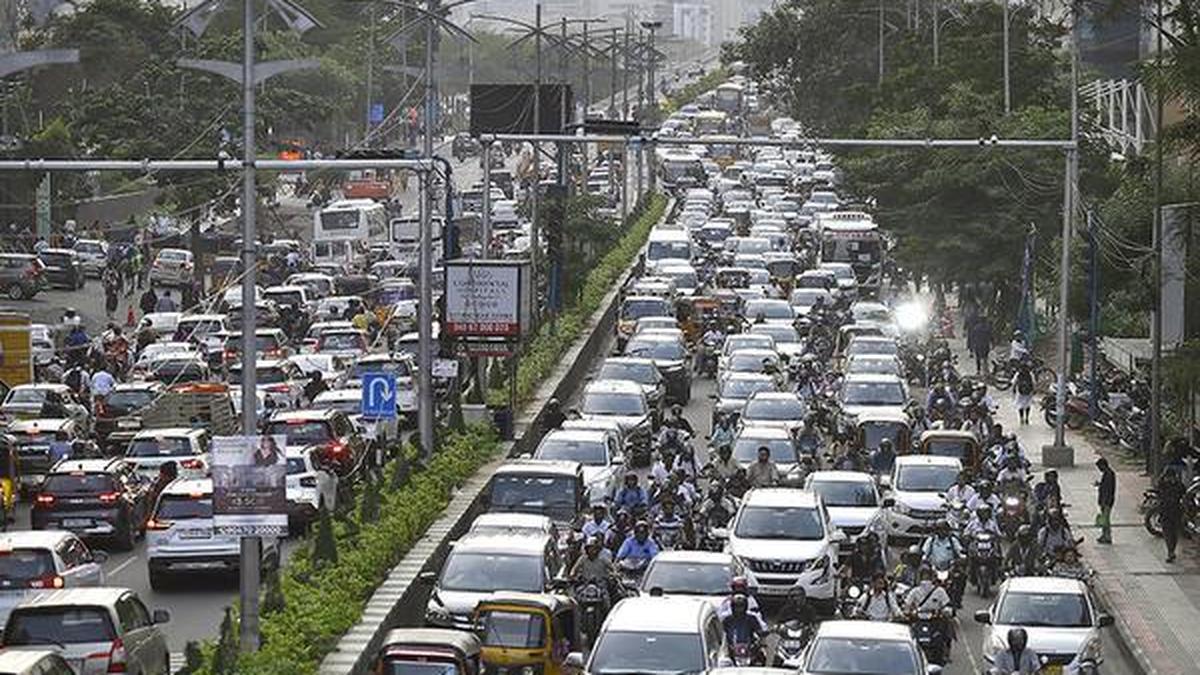
Has Hyderabad’s average travel speed gone up from 20.1 kmph in 2024 to 23.4 kmph in 2025?
The Hindu
Hyderabad's average travel speed increased from 20.1 kmph in 2024 to 23.4 kmph in 2025, analyzed through advanced data systems.
When the Telangana Socio Economic Outlook 2026 reported that Hyderabad’s average travel speed rose from 20.1 kmph in 2024 to 23.4 kmph in 2025, it appeared counterintuitive in a city where vehicle numbers continue to surge each year. But how exactly is a city’s ‘average speed’ calculated?
The answer lies not in a single data point, but in a layered system that blends technology, corridor-based analysis and constant monitoring of traffic behaviour across key stretches of the city.
At the centre of this system is Arcadis, a global design, engineering and consultancy firm tasked with managing traffic signal systems and analysing movement patterns in Hyderabad. Rather than relying on manual observations or isolated studies, the company works with large volumes of anonymised mobility data sourced from digital platforms.
“We basically take anonymised data from map-driven aggregators like TomTom, Google, ride hailing platforms and more,” said Srinivas Ganji, Director at Arcadis. “This gives us a continuous and realistic picture of how vehicles are moving across the city at different times of the day,” he said.
This raw data is then filtered through a carefully defined framework. Instead of attempting to measure speed across every street, planners identify between 25 major corridors that carry the bulk of Hyderabad’s traffic. These include arterial stretches such as Road No. 1, Road No. 10 and Road No. 44 in Banjara Hills, along with critical routes linking Punjagutta, Jubilee Hills, Mehdipatnam, Hitec City and Gachibowli.
Traffic jams in Punjagutta of Hyderabad. | Photo Credit: NAGARA GOPAL


Revanth launches legislators’ sports and cultural meet

Sri Venkateswara Veterinary University hosts its 13th Convocation on March 30, 2026, honouring 415 graduates and distinguished achievements.

Kerala increases hydel power generation to ensure electricity supply during elections as dam levels drop to 44%.

Kerala Assembly elections 2026 heat up as UDF, LDF, and NDA candidates showcase confidence and campaign strategies in Kochi.

Secunderabad MLA urges urgent borewell repairs and new drilling to combat water scarcity in the cantonment area.

St. Philomena’s College hosts Science Day model-making contest, showcasing creativity and awarding prizes for outstanding student innovations.

BIMS celebrates its golden jubilee with alumni association launch and honors retiring professor D. Anand for his impactful contributions.

A.P. Assembly passes resolution to declare Amaravati as the sole capital, seeking amendments to the A.P. Reorganisation Act.

A postgraduate in Kannada, N. Sandhya, whose father is a daily wage earner and mother who rolled beedis, was awarded with a gold medal and seven cash prizes at the 44th convocation of Mangalore University in Mangalagangotri on Saturday.

KPHB police arrest a repeat offender, recovering ₹2.8 lakh in stolen gold from a string of interstate burglaries.

Nepal’s history since 1950 has seen feudal rule, absolute monarchy, civil war, and a republic. The RSP’s 2026 landslide win after a massive but violent Gen Z movement faces the same test.

Sewage stagnation at Government Medical College and Hospital in Thoothukudi raises health concerns

Mohan Bhagwat emphasises that ego fuels conflict, urging selfless action for humanity's unity and Hinduism's inclusive nature.