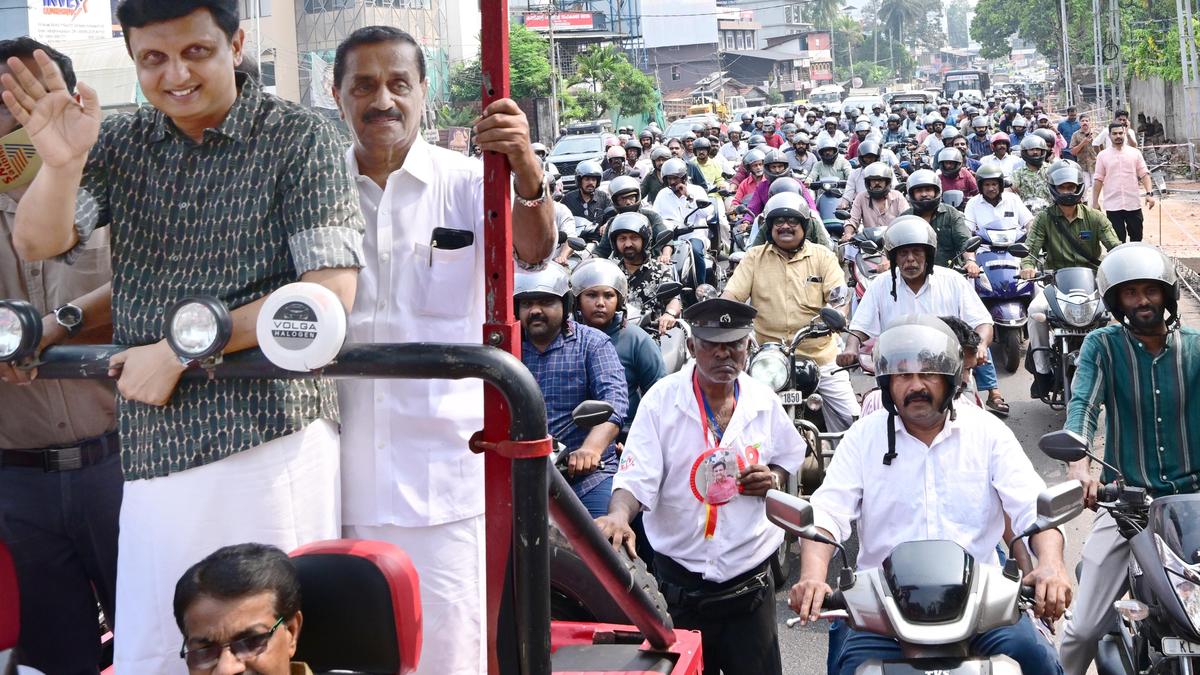
First phase of Mananchira-Vellimadukunnu road project opened to traffic
The Hindu
The first phase of the Mananchira-Vellimadukunnu road project in Kozhikode is now open, easing traffic congestion significantly.
After long delays and massive protests, the first phase of the four-lane Mananchira-Vellimadukunnu road in Kozhikode has finally been opened to traffic.
The Mananchira-Malaparamba stretch of the road project was inaugurated by Public Works Minister P.A. Mohamed Riyas at Malaparamba on Monday (March 9, 2026). He also launched the construction of the second phase, the Malaparamba-Vellimadukunnu reach.
Speaking at the function, Mr. Riyas said that the construction of 12 roads in Kozhikode would begin at a cost of over ₹1,000 crore.
He said the Malaparamba-Vellimadukunnu four-lane road project had initially faced technical hurdles related to the National Highways Authority of India. “However, instead of waiting for a No Objection Certificate (NOC) from the Union government, the State government decided to divide the project into two parts and begin construction. Work was started on one stretch while efforts continued to obtain the NOC for the other. With the obstacles now cleared, it is a major achievement that the entire stretch can be upgraded,” the Minister said.
Mr. Riyas said that once the entire Mananchira-Vellimadukunnu road was upgraded, it would significantly ease traffic congestion in Kozhikode city and save a considerable amount of travel time for the public. “The government’s goal is to transform Kozhikode into a New Calicut, just as Delhi became New Delhi. The Paris-model Canal City project, worth over ₹1,000 crore, along with BM&BC standard roads, will change the face of the city,” he said.
The proposal to widen the existing Mananchira-Vellimadukunnu road was announced in the 2008-09 State Budget. Though the draft declaration was issued in 2013, it took several years for completing land acquisition and the work on the first phase was launched only in June 2025.


BSF team of 36 arrives in Perambalur for election duty, ensuring security for the upcoming Assembly elections.

Two men were killed in an accidental encounter with a wild elephant in Nilgiris, prompting community protests and increased monitoring.

The first phase of the Mananchira-Vellimadukunnu road project in Kozhikode is now open, easing traffic congestion significantly.

BESCOM calls on Bengaluru RWAs to promote rooftop solar adoption under the PM Surya Ghar scheme, boosting local installations.

Opposition leaders consider impeachment motion against Chief Election Commissioner Gyanesh Kumar, following protests over electoral roll issues.

Kerala's daily power consumption exceeds 100 million units for the first time this summer, driven by rising temperatures and imports.

CPI(M) calls for single-phase assembly polls in West Bengal and inclusion of all genuine voters in the electoral rolls.

A 70-year-old man died in Bagepalli after his car caught fire, likely due to a short circuit, trapping him inside.

Bengaluru realtor abducted and murdered near Anekal; investigation reveals contract killing linked to business rivalry.

India today manufactures almost every type of railway rolling stock — locomotives, coaches, wagons, metro cars and modern trainsets — in large numbers and at competitive cost. Over decades, the railway manufacturing ecosystem has matured through dedicated Production Units of Indian Railways, PSUs and a large vendor base. Yet, despite this capacity and experience, India remains largely absent from the global market for railway vehicles.

T.N. physiotherapists welcome salary hike, urging timely payments and benefits for improved home-based care and support services.

Eminent historian K.N. Panikkar, a defender of secular historiography, has passed away, leaving a profound academic legacy.

Protesters demand the arrest of a marriage hall owner for denying venue access to a Scheduled Caste family in Erode.