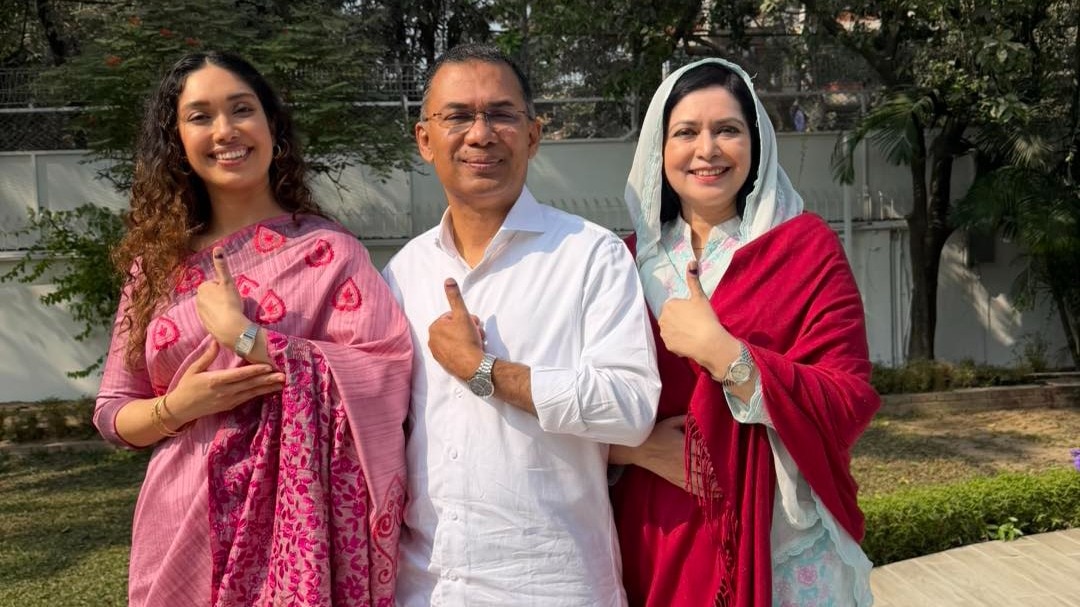
Dark Prince to Bangladesh PM: What Tarique Rahman 2.0 means for India
India Today
Tarique Rahman is set to become the next prime minister of Bangladesh after his BNP swept the elections. For Tarique, repairing relations with India will be a priority. But the Hasina factor may well be an irritant. In this article, we explore what a new version of Tarique means for India.
Tarique Rahman, once seen as the 'dark prince' of Bangladesh politics and heir to one of the country's most powerful dynasties, has finally got his moment to shine as his BNP swept the elections on Friday. India, which has been watching the polls closely, quickly congratulated Tarique even before the results were announced, indicating its eagerness to get Bangladesh ties back on track after it reached a nadir following the ouster of Sheikh Hasina in 2024. For India, Tarique's BNP has always been seen as a more liberal and democratic option than the ideologically rigid Jamaat-e-Islami.
With Tarique likely to be the next prime minister, will it usher in a reset in ties? Will the dark history between India and the BNP have a bearing on the future? Stay with us as we break down the factors that will shape whether the India-Bangladesh Maitree Express enjoys a smoother journey in the years ahead.
The posturing from Tarique, since his whirlwind return from exile after 17 years in London last December, has been somewhat positive. Fondly known as Tarique Zia in Bangladesh, he has pledged a 'Bangladesh First' agenda, modelled around US President Donald Trump's 'America First' narrative. Crucially, he has promised to keep Bangladesh equidistant from regional powers like India, China and Pakistan. This bodes well for India after the interim administration under Muhammad Yunus warmed up to Pakistan and China.
However, Tarique will take charge at a time when ties with India are running on two parallel tracks. On one hand, Tarique knows very well that India will remain indispensable due to its geography. The countries, which share a 4,000 km border, are closely linked through trade, electricity, and connectivity. On the other hand, the public mood in Bangladesh, especially among Gen Z, has turned sceptical of India since Hasina fled to India after the student-led protests.
Thus, repairing relations with India will no doubt be a priority for Tarique. India has already ramped up its outreach. In hindsight, India may have read the tea leaves early.
Last year, as Tarique's mother and former prime minister Khaleda Zia was battling health issues, Prime Minister Narendra Modi publicly expressed concern and offered India's support. The BNP was quick to respond with sincere gratitude.


Ashu Ghai recreated the striking scene from Dhurandhar 2, where Ranveer Singh is introduced as Jaskirat Singh Rangi amid a cascade of fiery sparks.

Pakistan Army chief Asim Munir said Shias who "love Iran so much" should "go to Iran". His remarks triggered a row with prominent Shia clerics of Pakistan accusing Munir of insulting the community and the military establishment of serving America and Israel as a "servant".

Treasury Secretary Scott Bessent said the US may need to intensify strikes on Iran to end the conflict. This came soon after Trump threatened to hit Iran's energy plants amid soaring oil prices and Strait of Hormuz tensions.

The scooter rider rode into the pedestrian zone, collided with the car, and fell down. The man driving the car, however, did not react with anger and handled the situation with composure.

A minute-long ATC recording lays bare the confusion and urgency before a runway collision in New York. Controllers issued frantic warnings as a plane struck a vehicle, forcing a complete airport shutdown.

Tucker Carlson says he might cry listening to him. Millions call him a prophet. But who exactly is "Professor Jiang" — and what is he not telling you?

In a symbolic act of wartime messaging, Iran placed stickers carrying anti-war remarks by Spanish Prime Minister Pedro Sanchez on ballistic missiles bound for Israel as the Middle East conflict enters it fourth week.

The announcement was made a day after North Korea convened the first session of its Supreme People's Assembly. The assembly, the isolated nation's rubber-stamp legislature, formally approves state policy.


Indian Railway staff's swift action turned a medical emergency involving a toddler into relief aboard a train from Bengaluru to Gujarat.

Leon Panetta said Iran war was not an unexpected risk. He pointed out that for years, US security officials have known Iran could disrupt global oil supplies by blocking the Strait of Hormuz. According to him, this was a well-known danger, but one that appears to have been overlooked in the current conflict.

Sri Lanka raised fuel prices by about 25% for the second time in a week as the Gulf conflict disrupts global oil supplies via the Strait of Hormuz.

Iran has warned it is ready to respond. Parliament Speaker Mohammad Baqer Qalibaf warned that if Iran's infrastructure is targeted, then key facilities across the region could be "irreversibly destroyed."