Conference explores AI’s role in policing and legal surveillance
The Hindu
Conference explores AI's impact on policing and legal surveillance, addressing ethical dilemmas and technological advancements in India.
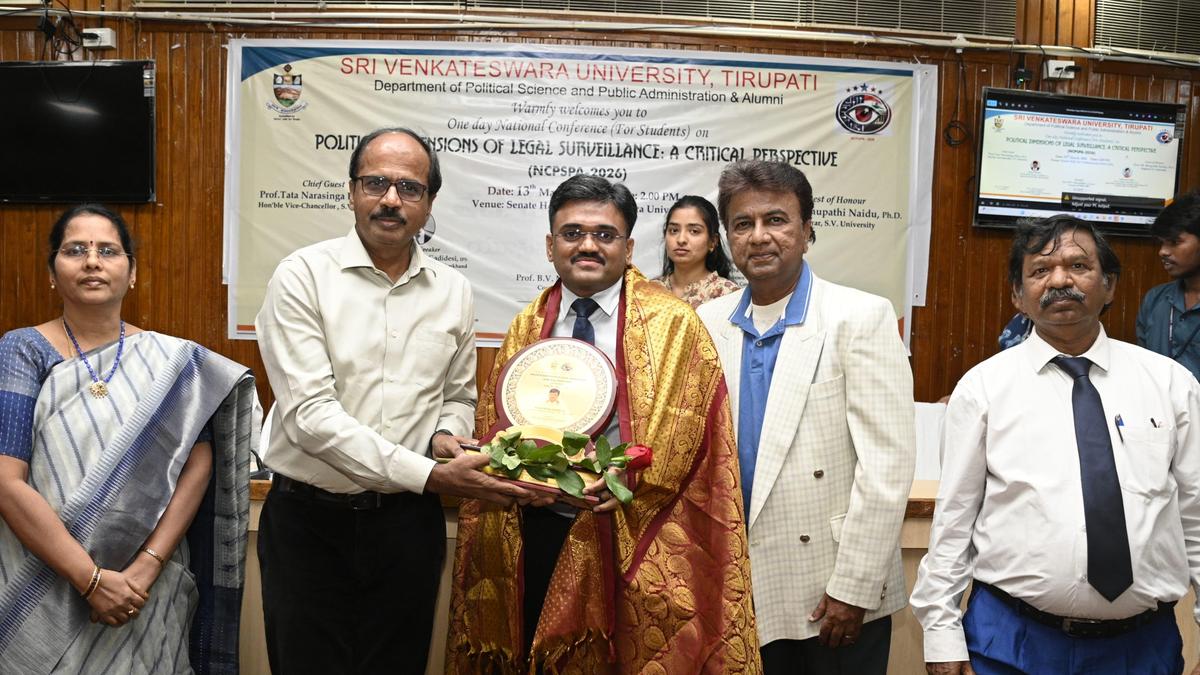
Speakers at the national conference on ‘Political dimensions of legal surveillance: A critical perspective’ deliberated upon the role of Artificial Intelligence (AL) in policing in India and the opportunities and risks involved in the process.
The one-day meet was organised by Sri Venkateswara University’s Department of Political Science and Public Administration here on Friday (March 13, 2026), where Kranthi Kumar Gadidesi, Inspector General of Police, Jharkhand, delivered the keynote address on ‘Combating negative impact of AI and Machine Learning (ML) police investigations’.
While AI had become an inevitable part of ‘Smart policing’, taking a paradigm shift from reactive policing to proactive policing and further to predictive policing, he pointed to the enhanced usage of technologies like facial recognition, crime mapping analytics, and anomaly detection systems to aid the decision-making process.
He made a specific mention of the ethical dilemmas concerning privacy, bias, and accountability due to the deployment of algorithmic systems, potentially risking action for breach of constitutional provisions.
Mr. Gadidesi’s presentation included the perceived benefits of AI as well as the barriers in adopting it in policing such as infrastructure gaps, organisational resistance, regulatory uncertainty, skill deficiency, financial constraints and dependence on vendors.
SVU Vice-Chancellor Prof. Tata Narasinga Rao called AI as the order of the day, notwithstanding its negative side. “Even universities and institutions have started offering courses on AI and hence it cannot be wished away,” he added.


Kerala Assembly polls 2026 | Roshy Augustine will contest from Idukki constituency, says Jose K. Mani

Andhra Pradesh plans to be a defence manufacturing hub, creating 1,000 jobs with Sagar Defence Engineering's new facility.

Bengaluru's towing operations may face delays despite the Commissioner's directive, owing to pending administrative work and finalising fines.

Supporters of the May 17 Movement defaced Hindi signage at Coimbatore's Singanallur railway station in protest against Hindi imposition.

Conference explores AI's impact on policing and legal surveillance, addressing ethical dilemmas and technological advancements in India.

Two individuals were arrested for posting abusive content against actress Anasuya Bharadwaj on social media, facing legal action.

Auto LPG scarcity in Tiruchi leaves 9,000 autorickshaw drivers struggling, facing fuel shortages and rising prices amid crisis.

Hyderabad Police urges citizens to join ‘Cyber Simba’ initiative to combat cybercrime and enhance community awareness on online safety.

Karnataka's Legislative Council to discuss Bill to protect gold borrowers from unfair practices by financial institutions.

105-year-old Palayamkottai school wins ‘Green Champion Award’; gets ₹1 lakh cash

A new bus shelter near Mannarpuram, funded by MP Durai Vaiko, aims to enhance comfort for commuters on the highway.

BRS accuses CM of misleading Assembly regarding ADB loan for the Musi River project, demanding clarification and accountability.

Collector chairs meeting with representatives of political parties