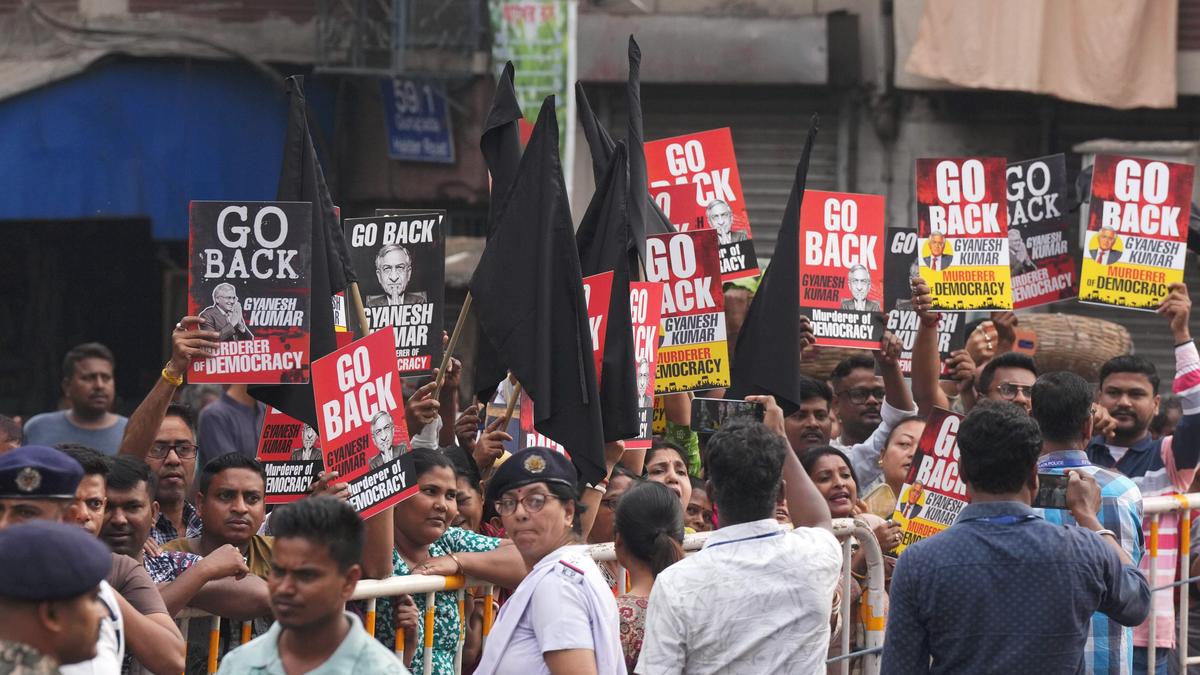
Chief Election Commissioner Gyanesh Kumar shown black flags, faces ‘go back’ slogans in Kolkata
The Hindu
Chief Election Commissioner Gyanesh Kumar encountered protests, including black flags and "go back" slogans, during his Kolkata visit.
The Chief Election Commissioner, Gyanesh Kumar was shown black flags and faced “go back” slogans in Kolkata on Monday (March 9, 2026) morning in Kolkata near the Kalighat temple. The ECI officials are on a two-day tour in Kolkata to assess the poll-preparedness of the State.
The full bench of the Election Commission of India (ECI) was at Kalighat to offer their prayers at the Kali temple, which is also close to the residence of Chief Minister Mamata Banerjee.
Mr. Kumar was accompanied by West Bengal’s Chief Electoral Officer Manoj Kumar Agarwal during his visit to the temple. Protests erupted outside the temple premises, but police present at the spot brought the situation under control. The protestors did not carry political flags and did not claim allegiance to any particular political party.
“CEC Shri Gyanesh Kumar sought divine blessings at Kalighat Temple and prayed for the well-being of the people of West Bengal, reaffirming the Commission’s resolve to ensure free, fair and festive elections in the state,” a statement from the ECI said after Mr. Kumar’s visit.
“May Kali Maa keep everyone well,” Mr. Kumar said after his temple visit as protests continued on one side. He did not comment on the protests.
Commenting on the issue, former Bharatiya Janta Party State president and MP Sukanta Majumdar said that the ruling Trinamool Congress only has fear as ammunition to intimidate people. “Either they threaten voters or police officials, now they are also trying to threaten the ECI. They think this will make ECI stop their work, but they will continue their work because they do not belong to any party but are an independent body,” Mr. Majumdar said.


BSF team of 36 arrives in Perambalur for election duty, ensuring security for the upcoming Assembly elections.

Two men were killed in an accidental encounter with a wild elephant in Nilgiris, prompting community protests and increased monitoring.

The first phase of the Mananchira-Vellimadukunnu road project in Kozhikode is now open, easing traffic congestion significantly.

BESCOM calls on Bengaluru RWAs to promote rooftop solar adoption under the PM Surya Ghar scheme, boosting local installations.

Opposition leaders consider impeachment motion against Chief Election Commissioner Gyanesh Kumar, following protests over electoral roll issues.

Kerala's daily power consumption exceeds 100 million units for the first time this summer, driven by rising temperatures and imports.

CPI(M) calls for single-phase assembly polls in West Bengal and inclusion of all genuine voters in the electoral rolls.

A 70-year-old man died in Bagepalli after his car caught fire, likely due to a short circuit, trapping him inside.

Bengaluru realtor abducted and murdered near Anekal; investigation reveals contract killing linked to business rivalry.

India today manufactures almost every type of railway rolling stock — locomotives, coaches, wagons, metro cars and modern trainsets — in large numbers and at competitive cost. Over decades, the railway manufacturing ecosystem has matured through dedicated Production Units of Indian Railways, PSUs and a large vendor base. Yet, despite this capacity and experience, India remains largely absent from the global market for railway vehicles.

T.N. physiotherapists welcome salary hike, urging timely payments and benefits for improved home-based care and support services.

Eminent historian K.N. Panikkar, a defender of secular historiography, has passed away, leaving a profound academic legacy.

Protesters demand the arrest of a marriage hall owner for denying venue access to a Scheduled Caste family in Erode.