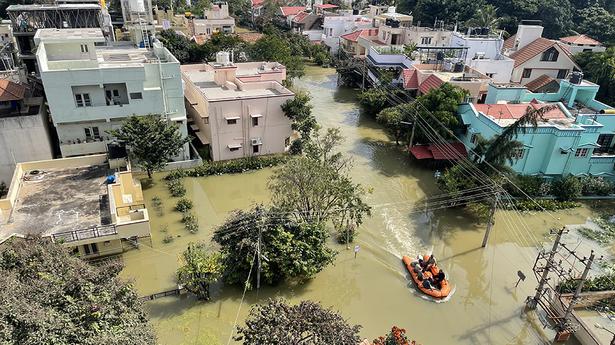
After the floods, Bengaluru needs to clean up its act
The Hindu
Everybody has a favourite villain to blame, yet the herd of restive elephants in the room is led by a particularly malevolent matriarch — corruption
The floods have abated in Bengaluru. As individuals struggle to clean their houses, the silt on the roads left behind by the receding water — now a fine dust that flies in the air choking us — is a reminder of those difficult times.
Various analyses now attribute Bengaluru’s flooding to more rainfall — in the future, it is expected to increase to an average of 1,000 mm per annum from the current 650 mm per annum — and unplanned, overcrowded growth that is destroying the greenery, tanks and wetlands.
Clearly, we must decongest the city, plant more trees, save wetlands, even reclaim them, desilt drains, enlarge sewers, deconcretise pavements and stop the clogging of waterways with unsegregated garbage. The State government announced tough measures such as the demolition of unauthorised encroachments impeding drainage streams in the city, but quickly backed away. It now plans to divert drains to avoid already built-up areas. This is not a solution because nature will carry on inundating encroachments until people abandon them of their own volition.
Everybody has a favourite villain to blame — from the builder mafia to the migrant, from the lack of spatial planning to uncontrolled violations of building bye-laws. Yet, the herd of restive elephants in the room is led by a particularly malevolent matriarch: corruption.
Everybody decries corruption outwardly, but submits to it meekly. Fear apart, it is also a matter of convenience, of time saved and of benefits, often through the violation of rules. Some justify corruption as the grease that keeps the fast-growing economic engine of Bengaluru whirring smoothly. However, corruption cripples economic growth in ways not readily apparent. Apart from transferring inordinate wealth to the undeserving, it creates a slew of vested interests, who resist anti-corruption process reforms. Understanding how corrupt officials, politicians, regulators and private players act in concert is essential to successfully implementing corruption-reducing strategies. Further, we must understand that the corrupt often use the honest to further their subversive agendas. Examples abound.
Most game theories concerning the dynamics of corruption reveal that the original sinner is often, paradoxically, a well-intentioned government. A good, but misguided government could make narrowly rigid rules, thus giving venal politicians and bureaucrats the leeway to bend them. For example, building bye-laws are so labyrinthine that the strictest law-abiding citizen cannot comply with them. That provides opportunities for agents who bypass the system’s rigidities. Ironically then, corruption actually reduces red tape. Hence, not many complain about resorting to bribing to get work done through a parallel, ‘efficient’ system.
One could also have a good government that aims to reduce red tape, making overly lax rules capable of being interpreted differently. In this ‘anything goes’, system, frontline officials invent discretionary practices to create impediments and seek bribes. ‘You show me your face, and I’ll show you the rule,’ is an old and cynical adage.


A humorous exchange in the Legislative Assembly highlights CM Siddaramaiah's choice of a Mysore silk shawl over a towel.

Karnataka's fiscal deficit is under control, better than neighboring states, says Chief Minister Siddaramaiah amid revenue challenges.

Capt. S. Divakar takes charge as MD and CEO of Dredging Corporation of India, following board approval for his appointment.

Nara Bhuvaneswari inaugurates a job mela in Kuppam, promoting job creation and welfare initiatives for local youth and women.

Walajah residents protest by hoisting black flags, threatening to boycott elections over poor civic amenities and infrastructure issues.

The Railway Ministry has decided to regularise the services of Surat-Mangaluru Junction-Surat bi-weekly Special Express along with nine other special trains.

Training held for zonal election officers in Thoothukudi

Defence Minister highlights BRO's vital role in enhancing border infrastructure, national security, and socio-economic growth in India.

Andhra University celebrates its 91st and 92nd convocations, honoring graduates and distinguished personalities for their contributions and achievements.

Coimbatore students receive earthen bowls to provide water for birds, promoting conservation on World Sparrow Day.

Residents of Hosahundi village in Kasaba hobli of Mysuru taluk have opposed the proposed construction of a flyover at Devalapura Cross on National Highway 275-K (Outer Ring Road), urging the authorities to drop the project and adopt alternative measures to improve road safety.

A brain-dead head constable’s family consented to organ donation under the Jeevandan programme, giving two patients a new lease of life through kidney transplants.

A-G informs Madras High Court no govt. sanction needed for FIR in K.N. Nehru's cash-for-jobs scam case.