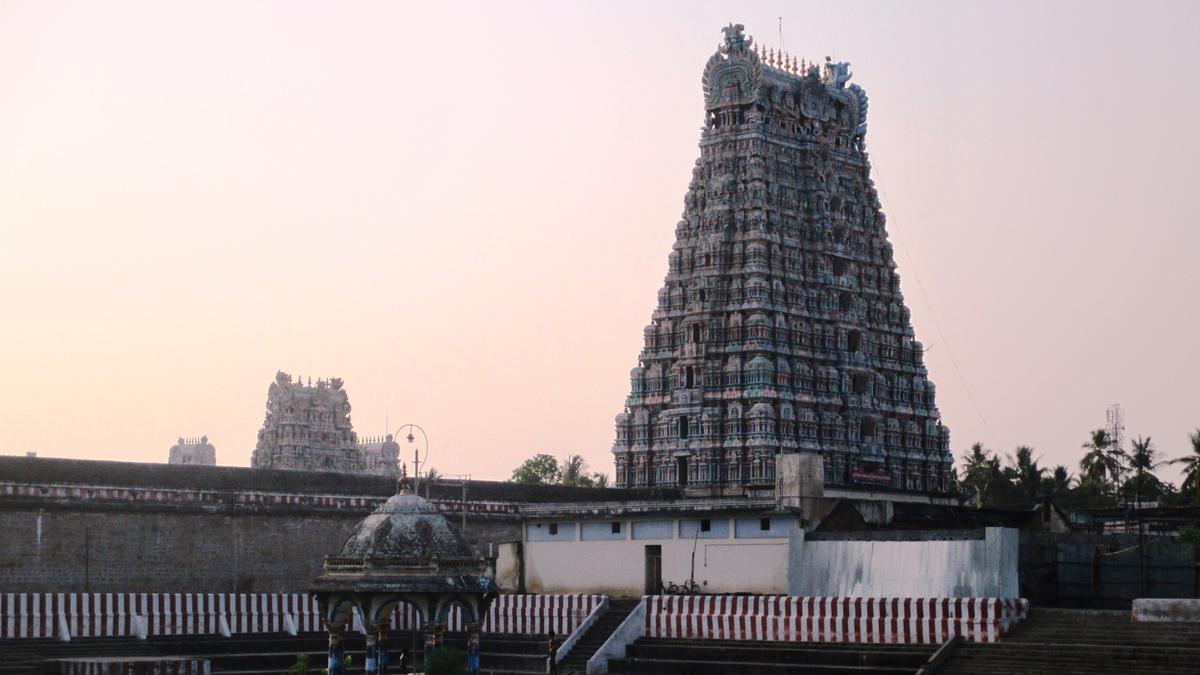
A Kodandarama temple that may have inspired Muthuswami Dikshitar’s raganga composition
The Hindu
How Dikshitar was inspired by Vaduvur Rama to come up with a composition in a raganga raga
Sometime in the early 19th century, Muthuswami Dikshitar arrived in Thanjavur for an extended stay. Legend suggests he may have visited even earlier, going by his composition ‘Nabhomani chandragni nayanam’ (Nabhomani raga, Triputa tala), which is believed to have been created on the occasion of the Brihadiswara temple’s consecration during the reign of Serfoji II. The ‘Sarabhendra samsevita charanam’ seems to indicate this. As per the Thanjavur Saraswathi Mahal Library records, the consecration took place in 1801, evidencing Dikshitar’s presence in the region.
The composer’s more prolonged stay was to teach music to the Thanjavur Quartet. According to Subbarama Dikshitar’s Sangita Sampradaya Pradarsini, only two of the four brothers, Ponniah and Vadivelu, were disciples of Muthuswami Dikshitar. Today, however, scholars accept that all four trained under him. Since Vadivelu was born in 1810 and would have been around five when he began learning from Dikshitar, we can assume that the composer came to Thanjavur around 1815.
During his stay, Dikshitar embarked on what may be described as raganga raga project. As is well known, he followed the asampurna mela/raganga raga scheme, where in a raga can be considered a parent scale if it has all seven notes, not necessarily in linear order or in both ascent and descent. It was scholar V. Raghavan who identified most of the compositions in this set, and the temples in and around Thanjavur mentioned in the lyrics. Of the 72 raaganga ragas, 69 have songs, all of them based on Thanjavur temples. Many of them are on the Big Temple and the Bangaru Kamakshi shrine.
The entrance to the Vaduvur Kodandarama temple. | Photo Credit: Special Arrangement
One of the compositions is on Lord Rama — ‘Kodandaramam’ in raga Kokilaravam (the 11th raganga raga in Adi tala). In keeping with most of the raganga compositions, this too is set in the pallavi/anupallavi format, and therefore has no charanam. In recent times, this song has been attributed to the Rama temple at Vaduvur, renowned for its beautiful utsava deity. But V. Raghavan clearly states that it was composed on the Kothandarama temple on the banks of the Vennar in Thanjavur.
There is logic in what he says, because the farthest temple to have a composition in the raganga raga scheme is the Dharmasamvardhini shrine in Tiruvarur. All the temples featured in the set come under the administration of the Thanjavur Palace Devasthanam. However, the Vaduvur shrine has never been a part of it, making its association with the song unlikely. Having accepted V. Raghavan’s premise, the task then is to identify the temple he meant.


Karnataka Dalit Sangharsha Samiti (DSS) has urged the State government to begin the process of filling up 56,432 posts only after rectifying the mistakes in fixing the roster and implementing the internal reservation among Scheduled Castes.

Rebel nominations in Karaikal expose tensions within electoral alliances, risking voter fragmentation ahead of the Puducherry Assembly elections.

CCPA prohibits restaurants and hotels from imposing unfair LPG charges, labeling them as unjustified and against consumer protection guidelines.

Andhra Pradesh receives ₹19.47 crore for 44 handloom clusters, benefiting over 10,000 weavers under the National Handloom Development Programme.

Stay updated with The Hindu’s on-ground Tamil Nadu Assembly election coverage and voter insights across key constituencies.

Mettur dam water level reaches 82.770 feet, with inflow at 361 cusecs and discharge at 801 cusecs.

Udhagamandalam faces challenges in tourism and tea sectors due to poor infrastructure, pollution, and urbanization ahead of summer season.

Social activists and journalists from Shivamogga, who placed the demand for a strict law to stop honour killings, have thanked the State government for tabling the Bill and getting it passed in both Houses of the legislature with the support of all other parties.

Erode (East) voters prioritize pollution control, traffic solutions, and urban infrastructure as key issues ahead of upcoming elections.

T. Jeevan Reddy resigns from Congress after 42 years, criticizing party leadership and the influence of defectors.

Kanniyakumari Collector inspects vulnerable and sensitive polling stations

Westbrook: Opening Doors to your Child’s Best Start

The Mangaluru Chapter of the Indian National Trust for Art and Cultural Heritage (INTACH) organised a special lecture in memory of Rashtrakavi Manjeshwara Govinda Pai on Monday.