Why has Karnataka banned certain colouring agents? | Explained Premium
The Hindu
Karnataka bans harmful colouring agents in cotton candy and gobi manchurian, following Tamil Nadu and Goa, to ensure food safety.
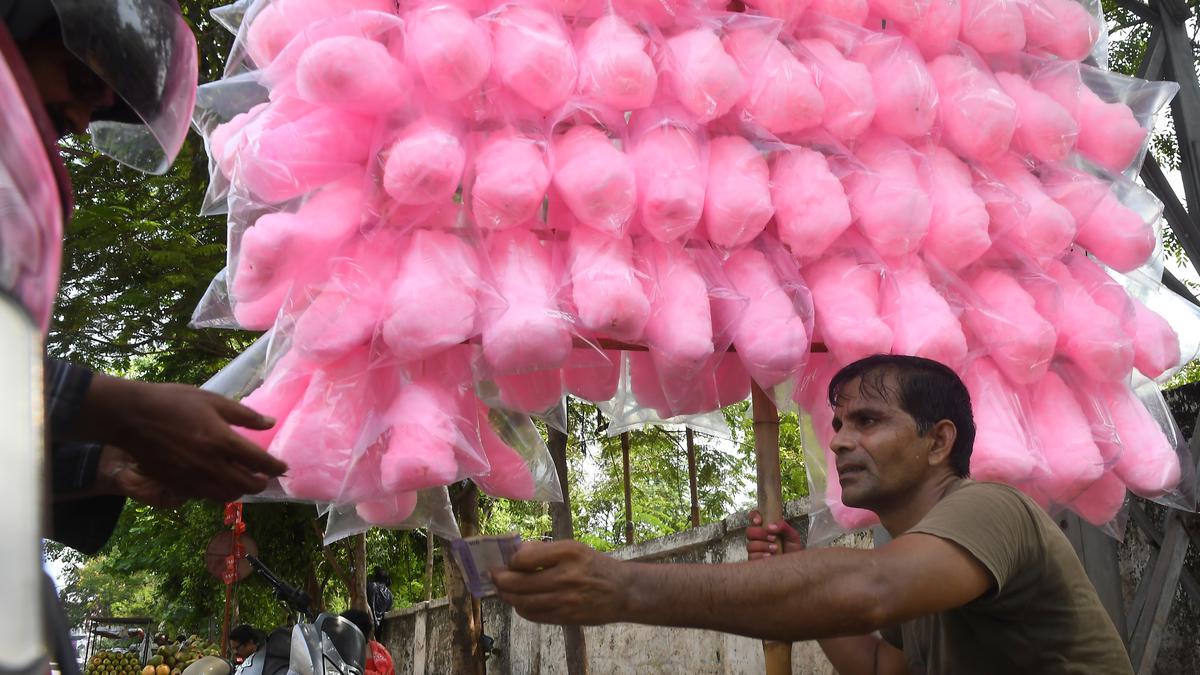
The story so far: Karnataka became the third State in South India to ban the use of certain colouring agents in cotton candy and gobi manchurian that are found to be harmful. The decision follows similar steps taken in Tamil Nadu and Goa, and came after a survey by the Public Health Department that showed the presence of harmful chemicals present in the food samples, making them unsafe for consumption. The government has also clarified that there is no ban on making cotton candy as long as these colouring agents are not used.
Samples in the State were collected from February 12 and submitted for laboratory tests, which then revealed the presence of harmful chemicals in many samples. Of the 25 cotton candy samples collected, 15 were termed as unsafe as they contained colours, while the rest were safe samples as they were made without added colours. Among the 171 samples of gobi manchurian collected, 107 samples were declared unsafe due to added colours, while 64 were declared safe as they did not contain added colours.
The unsafe samples with added colours showed traces of sunset yellow, tartrazine and rhodamine-b in cotton candy. Similarly, the unsafe samples of gobi manchurian had tartrazine, sunset yellow and carmoisine. A ban is already in place over the use of colouring agent rhodamine-b, a suspected carcinogenic substance. In the case of tartrazine, Health Minister Dinesh Gundu Rao said that although it is an approved artificial food colour, there are restrictions on its usage. There is a list of food items in which it can be used, with the amount to be used also prescribed. However, these conditions are only for packed food items; tartrazine cannot be used for food items which are freshly prepared, he said.
While notifying the ban of harmful chemicals, the Food Safety Commissioner said that the prolonged use of snacks that contain artificial colours can lead to deadly diseases such as cancer.
As per Rule 16 of the Food Safety and Standards Act, 2006 (Food Products Standards and Food Additives Regulation 2011), no artificial colours should be used in the preparation of gobi manchurian. The same rules allow certain food colours to be used within the approved limits, while non-permitted colours, including rhodamine-b, should not be used in the preparation of cotton candy.
The cancellation of licence for commercial activities, hefty fines and jail term have been threatened against the offenders. The Food Safety and Standards Act stipulate a fine of not less than ₹10 lakh and a jail term of a minimum of seven years, extending to life imprisonment, against those using banned chemical substances in food products.
Health safety officials assert that the ban on the use of harmful chemicals has come into effect immediately. While the Government plans to create awareness among manufacturers, it has also urged consumers to be aware of what they are consuming. The notification advised the public not to use, or use minimally, food items prepared with artificial colours. Random checks will be conducted to ascertain adherence to the legal provisions.


Parliament Budget Session LIVE: Follow The Hindu's latest updates on the Parliament Budget Session on March 18, 2026.

Severe storms cause over 1,100 flight cancellations and 7,300 delays across the U.S., exacerbating travel chaos amid a government shutdown.

Three MBBS students tragically died in a scooter accident in Kozhikode, Kerala, early Wednesday morning.

Microsoft said on Tuesday it is reorganising its Copilot teams by unifying its commercial and consumer versions, as the tech giant rushes to improve its artificial intelligence assistant to drive better adoption.

Poco has launched the new X8 Pro series smartphones in India, consisting three phones: the Poco X8 Pro Max, Poco X8 Pro, and the special edition Poco X8 Pro Iron Man Edition

Morocco is crowned African football champion after Senegal forfeits the final due to a controversial walk-off protest.

Israeli tank fire reportedly hit a U.N. base in Lebanon, wounding Ghanaian peacekeepers amid rising tensions with Hezbollah.

LPG shortages in India force schools to revert to firewood, increasing burdens on women workers in mid-day meal schemes.

Discover the dramatic history and significance behind Tamil Nadu's name change from Madras on January 14, 1969.

Researchers found that interbreeding between Neanderthals and early modern humans favoured male Neanderthals mating with female modern humans.

BRICS functions as a collaborative force aimed at establishing a multipolar world system. Cooperation in science, technology and innovation has been a key agenda for the grouping

Assembly polls 2026: Follow live updates from The Hindu on the upcoming elections in five States, on March 18, 2026

Iran-Israel war: Follow live updates from The HIndu on the West Asia conflict on Marh 18, 2026