On scientific collaborations in BRICS
The Hindu
BRICS functions as a collaborative force aimed at establishing a multipolar world system. Cooperation in science, technology and innovation has been a key agenda for the grouping
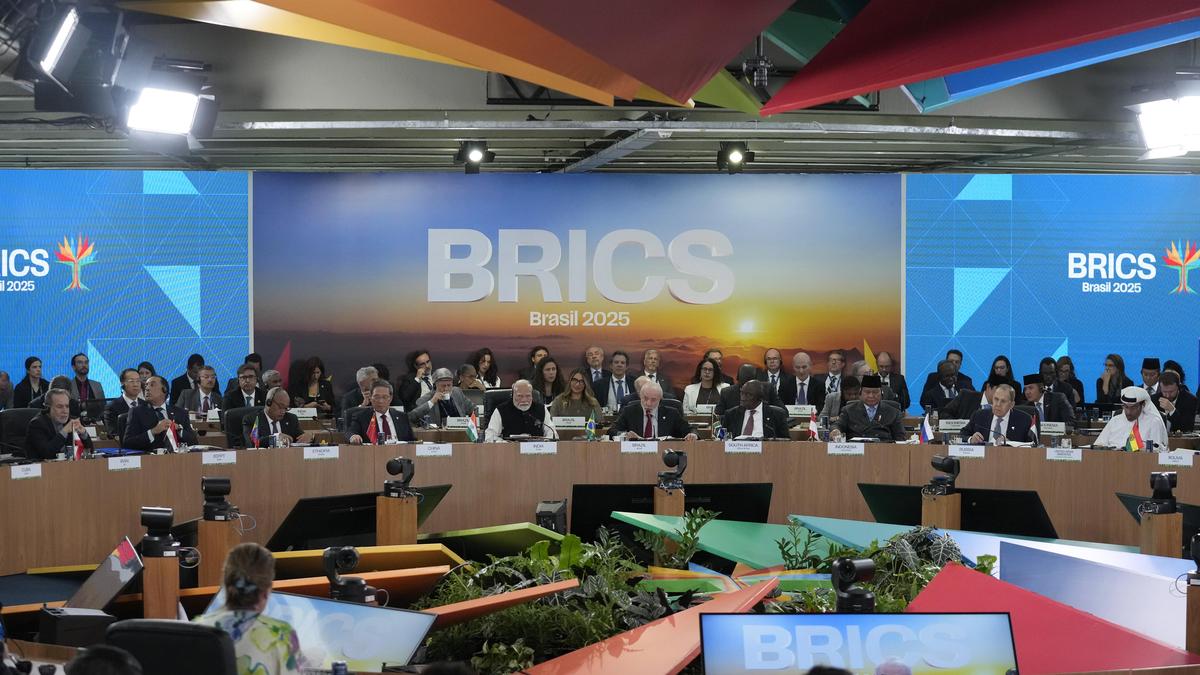
The BRICS grouping, comprising Brazil, Russia, India, China, and South Africa, is a globally significant collective defined by its substantial contributions to global GDP, scientific and technological capacity, natural resources, and total population. Since its formation, the group has evolved into a prominent international voice, representing countries that seek to challenge and provide an alternative to Western hegemony. BRICS functions as a collaborative force aimed at establishing a multipolar world system. While the group’s positions on global finance and macro-economic issues are widely recognised, the depth of cooperation among member states regarding science, technology, and innovation (STI) remains less publicised.
At a time in which global scientific collaboration is increasingly dictated by geopolitical tensions, techno-nationalism, and strategic competition, often manifesting as sanctions and export controls, BRICS assumes a critical role in the global STI landscape. Through this platform, member nations coordinate their strategies, amplify their collective voice in global economic governance, and influence development finance through institutions like the New Development Bank.
These members are also vital contributors to global trade, energy production, and the supply of essential natural resources. The 2022 launch of BRICS+ signaled a move towards a more inclusive forum, fostering development and political cooperation across the Global South to reduce technological dependencies. This collaboration is now a concrete effort to build shared capacities through various framework programmes. The group’s current membership has expanded to include Saudi Arabia, Egypt, the UAE, Ethiopia, Indonesia, and Iran.
Cooperation in STI has been a part of the BRICS agenda since its early years. It was formally recognised in 2011 and later consolidated in meetings between senior officials and the BRICS Ministers of Science, Technology, and Innovation. A pivotal 2015 memorandum of understanding established STI as a core strategic pillar, providing the necessary institutional framework and operational signals for collaborative research and capacity-building. This framework has since expanded the scope of cooperation, allowing members to leverage their complementary strengths to address shared development challenges and advance frontier sciences.
The first BRICS Action Plan for Innovation Cooperation (2017-2020) tasked the Science, Technology, Innovation, and Entrepreneurship Partnership (STIEP) Working Group with implementing various programmes. These initiatives focused on entrepreneurship networks, the role of youth and women in STI, and collaborations regarding technology transfer and business incubators. Over time, BRICS has moved from early joint research calls focused on fundamental science toward prioritising innovation and technology transfer.
These priorities are formally identified in annual ministerial declarations. The BRICS Ministers of Science, Technology, and Innovation meet once a year to approve and sign strategic documents. Within each member country, one or two lead agencies coordinate these activities, issue calls for proposals, and prepare project lists for approval during the respective country’s presidency. For example, during India’s chairmanship, the Council of Scientific and Industrial Research (CSIR) and the Department of Biotechnology (DBT) serve as the lead agencies.


51 couples take thebig plunge at Udaipur mass wedding event

A bridge collapse in Roop Nagar kills a woman; Delhi government forms a probe panel amid rising safety concerns.

Tribunal halts Colonel Purohit's retirement, pending promotion decision after his acquittal in the 2008 Malegaon blast case.

Pinarayi Vijayan launches his election campaign in Dharmadam, aiming for a third consecutive term amid tightening competition.

Delhi Speaker Vijender Gupta has written to Lieutenant-Governor Taranjit Singh Sandhu seeking directions to instal audible signals at traffic intersections across the city to ensure the safety of mobility-impaired individuals and senior citizens.

GVMC council concludes its five-year term, highlighting significant development projects and global events that enhanced Visakhapatnam's recognition.

Karnataka SC/ST Commission discusses internal reservation issues amidst confusion over reduced quotas for Scheduled Castes and Tribes.

President Droupadi Murmu serves Akshaya Patra’s 5 billionth meal, highlighting child nutrition and education at Rashtrapati Bhavan.

PM Modi and UAE President agree on ensuring safe navigation through the Strait of Hormuz amid regional tensions.

JNU student leaders face severe repercussions for activism, risking their academic futures amid allegations and online abuse.

India Post launches 24-hour and 48-hour Speed Post services in Bengaluru, ensuring urgent delivery across major metro cities.

A 24-hour control room in Krishnagiri monitors the Model Code of Conduct and manages election-related complaints ahead of polls.

Madurai Collector inaugurates voter awareness campaign