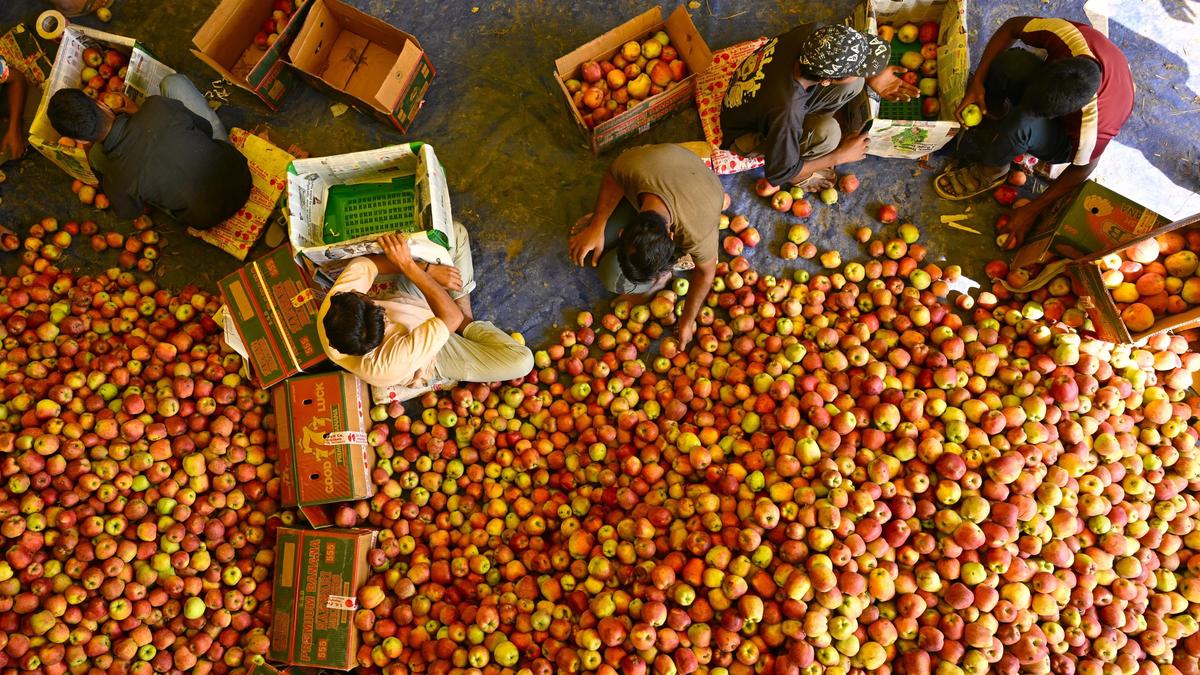
Why are apple traders in J&K worried? | Explained
The Hindu
Apple traders in J&K express concerns over trade deals threatening local production and market stability amidst rising competition from the West.
The story so far: Jammu and Kashmir Chief Minister Omar Abdullah and Leader of the Opposition in J&K Mehbooba Mufti have termed the India-U.S. trade deal as a death knell for the horticulture sector, especially for apple production in Kashmir. The criticism has grown shriller in the backdrop of India’s decision to reduce basic customs duty on apples imported from the U.S. from 50% to 25%, even though the Minimum Import Price (MIP) was set at ₹80 per kilogram. Under the new India-European Union trade deal, import duty on fresh fruits was reduced to 20% under a Tariff Rate Quota (TRQ) system. Only 50,000 tonnes per year of apples will be allowed from the EU at this reduced duty, to avoid the sudden flooding of Indian markets. However, the deal agrees to increase the quota to 1,00,000 tonnes over the next 10 years.
According to the J&K Economic Survey 2025-26, apple production comprises 50% of the total horticulture production of J&K against pear, apricot, peach, plum, cherry, citrus, mango, walnut, almond etc. The horticulture sector produces roughly ₹10,000 crore in revenue and employs about 35 lakh individuals, either directly or indirectly, thereby supporting approximately seven lakh families, the official survey suggested.
In 2024, apple production in J&K stood at 21 lakh metric tonnes. Over 173.07 lakh hectares of land in J&K are under apple orchards. J&K contributes to over 70% of the total apple production in the country.
The apple is the fourth most important fruit crop in India.
Besides J&K, Tamil Nadu, Himachal Pradesh, Uttarakhand, Nagaland, and Sikkim also produce apples.
Kashmir cannot compete with apples produced in Western countries due to their farming practices, favourable government policy and technological intervention. One estimate suggests that orchardists in New Zealand, the U.S., and in the EU on an average operate on 50-plus hectare farms against an average of 0.40 hectares in J&K. Only 7-8 tonnes of apples per hectare can be produced in India, whereas 40-70 tonnes per hectare are produced in countries like the U.S., Iran, New Zealand and China owing to better geography, advanced technology and mechanisation, says Nasir Hamid Khan, former vice-president of the Kashmir Chamber of Commerce and Industries (KCCI), a pan-Valley traders body. Moreover, Western countries have already introduced AI system technologies for pruning, pollination, harvesting, infield-sorting and bagging.


Transport Special Chief Secretary Vikas Raj urged experts at the National Mobility Summit to explore CNG as a public transport fuel amid West Asia tensions, and also to lower air pollution.

New Belagavi Mayor and Deputy Mayor elections are set for today, with BJP expected to secure both positions.

Fire at Thiruvananthapuram Medical College Hospital was swiftly controlled with no injuries, ensuring patient safety during the incident.

Sunil Bose, Chamarajanagar MP, has drawn the attention of the Lok Sabha to the stalled railway projects in the district, including the Hejjala-Chamarajanagar line and urged the government to restart the projects to strengthen the railway network in the region for the benefit of the common people.

KIA records the fewest laser interference incidents among major airports, ensuring enhanced aviation safety and security.

Hyderabad Metro Rail Limited is planning an elevated pod-based transit system to improve last-mile connectivity to metro stations, with a pilot proposed along the Raidurg-Kukatpally stretch.

Over 22 lakh job seekers in Rajasthan face no government placements in five years, reveals RTI data.

Conservationists urge the government to halt eco-park development at Ooty Race Course to protect the wetland ecosystem.

Kollam court convicts Sandeep for the murder of Dr. Vandana Das, sentencing expected on March 18, 2026.

Couple arrested for drugging hospital patients and stealing gold by posing as medical professionals in Hyderabad.

United People’s Party Liberal exits NDA, citing ideological differences with BJP, as it prepares for Assam Assembly elections 2026.

Convict Yuvaraj petitions to reopen DSP Vishnupriya's death case, alleging improper investigation by police officials in Namakkal.

Railway recruitment exam postponed due to Karnataka Rakshana Vedike protests demanding inclusion of Kannada language for local candidates.