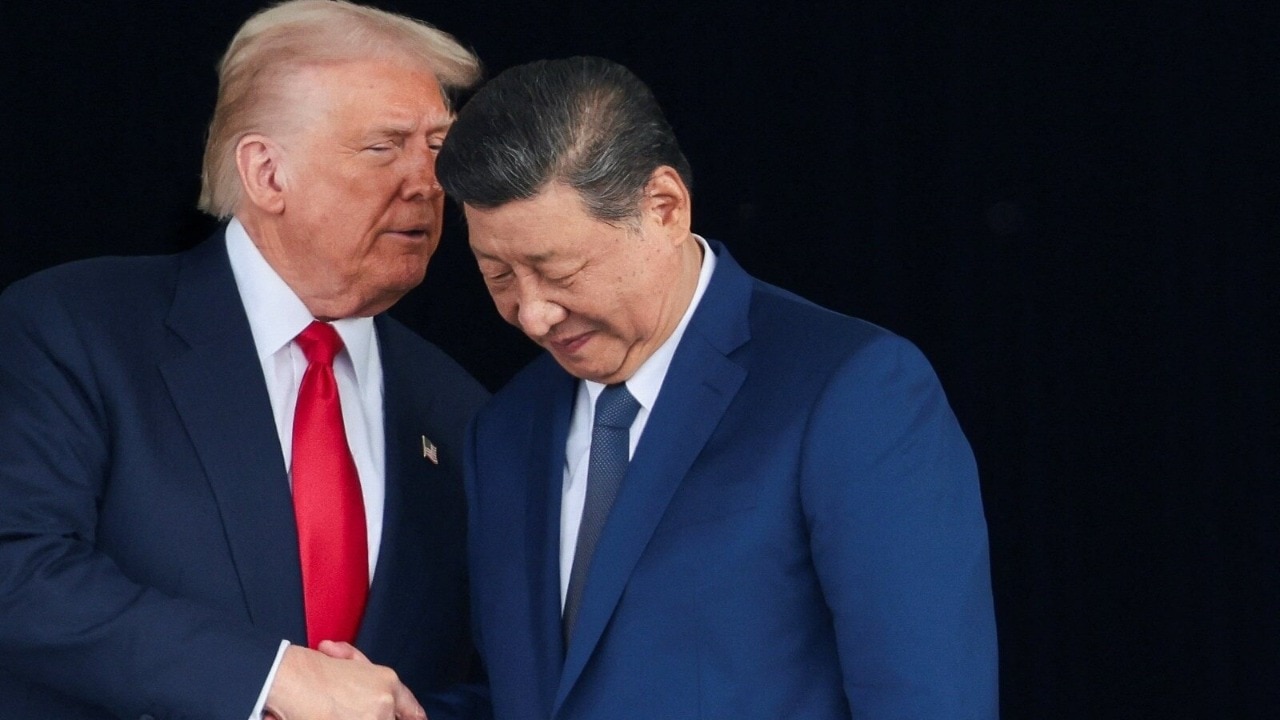
Trump does to Xi what he did to Modi, with a preemptive post
India Today
A familiar pattern is emerging in US President Donald Trump's claims on social media after calls with leaders. Trump posted preemptively on his talks with Chinese President Xi Jinping like he did after a call with Indian PM Narendra Modi. The posts disregarded protocol and facts.
US President Donald Trump has been consistent at least on one thing — preemptive posts. Trampoline Trump wants to be the first to make announcements after talking to readers, factually right or not, mutually decided or not. Chinese President Xi Jinping became the latest leader to get a taste of Trump's preemptive posts, just after Indian Prime Minister Narendra Modi. That divergence was clearly visible as Trump took to Truth Social to post about his telephonic conversation with Xi and the readout by Beijing.
Trump and Xi had what the US President described as an "excellent telephone conversation" on February 4. The US President, in his usual breakneck style, posted on Truth Social about the topics both the presidents had talked about, including discussions on Chinese agreements to purchase American agricultural, aviation and energy products. However, a readout of the talks published by the state-owned Chinese news agency, Xinhua, didn't mention most of what Trump claimed, only stating that Trump "values China's concerns over Taiwan", and that the entire conversation was dominated by Xi.
Trump's latest action following his talks with Xi, is, in many ways, similar to what he did after speaking with PM Modi on Sunday. He went ahead and announced that the India-US trade deal had been finalised.
We had written that despite India and the US yet to ink a proper trade deal, or even announce the conclusion of negotiations for the same, Trump, like a kid jumping up and down on a trampoline, jumped the gun and stated on Truth Social India that New Delhi would stop buying Russian oil, invest in US infrastructure and industrial projects, buy American agricultural goods, and eliminate all tariffs on US imports.
India's Commerce and Industry Minister, Piyush Goyal, said on Thursday that a joint statement on the India-US trade deal would be made "in the next four-five days".
However, Trump's post on the trade deal on Sunday immediately put the Modi government in a spot, giving ample ammunition to many in India who argued that Trump's terms amounted to India "surrendering" to "US bullying". In the absence of any concrete deal to fall back on, Goyal was compelled to post multiple reassurances that any deal, when signed, would be in India's best interests and would not compromise on the welfare of India's farmers by exposing them to US agricultural imports.


Iran's Foreign Minister mocked the US for the mounting expenditures and said that the citizens have to pay the cost due to Israel.

In an Instagram post titled, "The metro comparison nobody talks about," she described an experience that caught her off guard.

The world is facing an energy crisis as Iran blocked supplies passing through the Strait of Hormuz after strikes by the US and Israel. Vital subsea cables that carry global internet traffic also pass through Hormuz. Any damage to them could trigger internet outages and hit financial systems across countries, including in India.

A techie used an immersion rod to cook curry after running out of gas, with the viral video showing an exaggerated version of people's realities amid the ongoing LPG crisis in India.

The bodies of the deceased were taken to the Civil Hospital and Jinnah Hospital for identification, the rescue members of Pakistan's largest non-profit social welfare organisation, The Edhi Foundation, told Reuters.

Following the detection of the drones, the US administration held high-level meetings with senior officials. In addition, a high alert was issued for the US Army, amid possibilities of Iranian retaliation.

Images of pre-Islamic Zoroastrian kings and warriors have been unveiled in Iran, evoking courage and resilience. Many say the Ayatollah regime in Iran revives the country's Persian identity during conflicts with Israel and the US. But this Persian heritage has always run deep, and is visible from time to time, in both dissent and unity.

Born of colliding continents and vanished seas, the Strait of Hormuz is the million‑year accident that turned buried oceans into oil, and a thirty‑mile gap in the rocks into the world's most dangerous chokepoint.

The US-Israel war was meant to decapitate Iran's hardline leadership, but the killing of the "pragmatic" Ali Larijani might have done the opposite. By eliminating consensus-builder Larijani, the Israelis might have removed any scope of talks and pushed Iran into deeper hardline control. This could be a ploy to keep the war going.

The newly launched Vande Bharat Sleeper train has sparked widespread commentary as passengers share initial experiences of its modernised amenities, particularly on the Howrah-Guwahati route inaugurated in January.

The assassination of Ali Larijani, one of Iran's most powerful decision-makers, marks a major escalation in the ongoing US-Israel-Iran war and comes amid a sustained campaign targeting the country's top leadership.

The assassination of Ali Larijani, one of Iran's most powerful decision-makers, marks a major escalation in the ongoing US-Israel-Iran war and comes amid a sustained campaign targeting the country's top leadership.

Expect Iran to become more hardline: Geopolitical expert and author Fareed Zakaria reflects on aftermath of US-Israel strikes