Tangaliya weaving finds new life in Gujarat — with a boost from Brad Pitt
The Hindu
In Surendranagar, Gujarat, where only a handful of families continue to practise tangaliya weaving, we visit artisanal communities working with brands like Jaypore to revive the intricate craft for contemporary wardrobes
Jahabhai with his latest collection of saris | Photo Credit: Special Arrangement
Jahabhai Laxmanbhai Rathod is certain he will not lose his job to a machine.
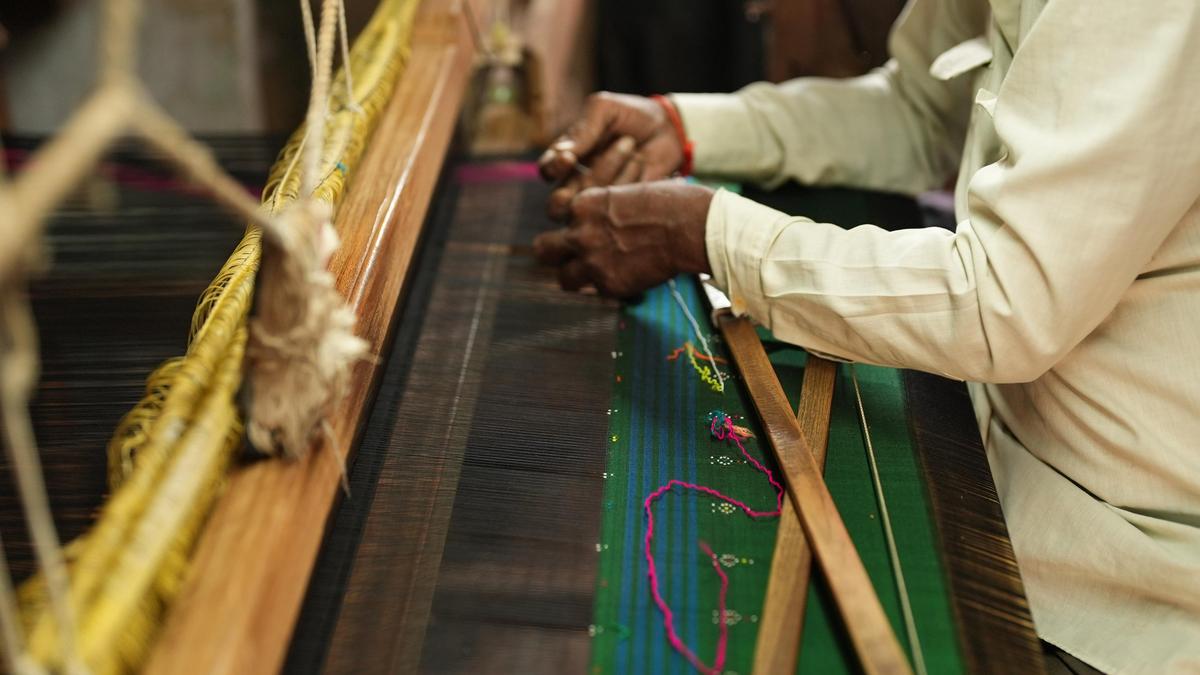
“My work is handmade and it will continue to be done that way,” says Jahabhai, who has been creating tangaliya weaves for 48 years. Made on looms, the craft is known for its trademark dots or danas which form patterns that range from peacock and navagraha to the more modern deer and flowers. Earlier, it was typically done on cotton and wool, with handmade yarn made from sheep’s wool. Now mill-made yarn is used. And the fabric extends to silk, khadi, eri silk and kala cotton.
“I was 15 when I started working with tangaliya. My father, his father and ancestors have been doing this for more than 700 years. My 32-year-old son Baldev has now joined in,” says the 63-year-old.
I am in Surendranagar district in Gujarat, known for its tangaliya weaves, with the Jaypore team, to learn more about the craft, which is primarily practised by the Dangasiya community. We visit the village of Vastadi first. Narrow alleys dotted with cows lead us to Jahabhai’s house.
An artisanal lifestyle brand, Jaypore works with Jahabhai and his weavers for tangaliya woven kurtas and pants that are retailed out of its stores and website. For the forthcoming season the brand is exploring tangaliya saris, as part of its ongoing effort to expand the craft into new product categories. Manu Gupta, vice president and brand head, Jaypore, says the brand placed its first order with this weaving community in 2025, commissioning 100-plus pieces. He adds that it is important to them that the narrative around tangaliya also highlights the people, traditions, and cultural legacy that sustain it.


In Surendranagar, Gujarat, where only a handful of families continue to practise tangaliya weaving, we visit artisanal communities working with brands like Jaypore to revive the intricate craft for contemporary wardrobes

Madras High Court allows police to arrest YouTuber 'Savukku' Shankar if needed, dismissing claims of solitary confinement.

Lula leads Brazil's largest-ever business delegation to India, aiming for trade deals and global governance reforms amidst geopolitical challenges.

AIADMK reveals its first candidate list for Tamil Nadu Assembly election, featuring familiar names and few surprises.

A study reveals antibiotic resistance causes 87% of India's typhoid economic burden, significantly impacting children and families.

How Dikshitar was inspired by Vaduvur Rama to come up with a composition in a raganga raga

Lok Sabha passes Finance Bill 2026 with amendments, completing its budgetary approval before Rajya Sabha's consideration.

Karnataka government to consult legal experts on pursuing action against Adani Group's ACC Ltd. over ₹850 crore in disputed dues.

The FCRA amendment bill aims to create an authority for managing NGO assets after license loss, addressing misuse of foreign funds.

Telangana Minister assures adequate petroleum stocks for three months, warns against illegal fuel carrying amid panic buying rumors.

TMC calls for the removal of Bhabanipur returning officer, citing alleged ties to BJP and concerns over neutrality.

Kerala CM Pinarayi Vijayan condemns UDF's misogynistic attacks on CPI(M) legislator U. Prathibha, highlighting political degeneration.

Selected from 9,400 submissions across 37 countries, the 100 photographs on display traverse intimate and political terrains. In MRC Nagar, photographer Swastik Pal captures life in the Sundarbans, where severe climate change has brought humans and wildlife into closer contact. Shane Hynan’s Beneath Beofhod reflects on Ireland’s boglands as sites of memory and restoration, while Mateo Trevisan’s More than the Sun examines the impact of coal-driven industrialisation in the Western Balkans.