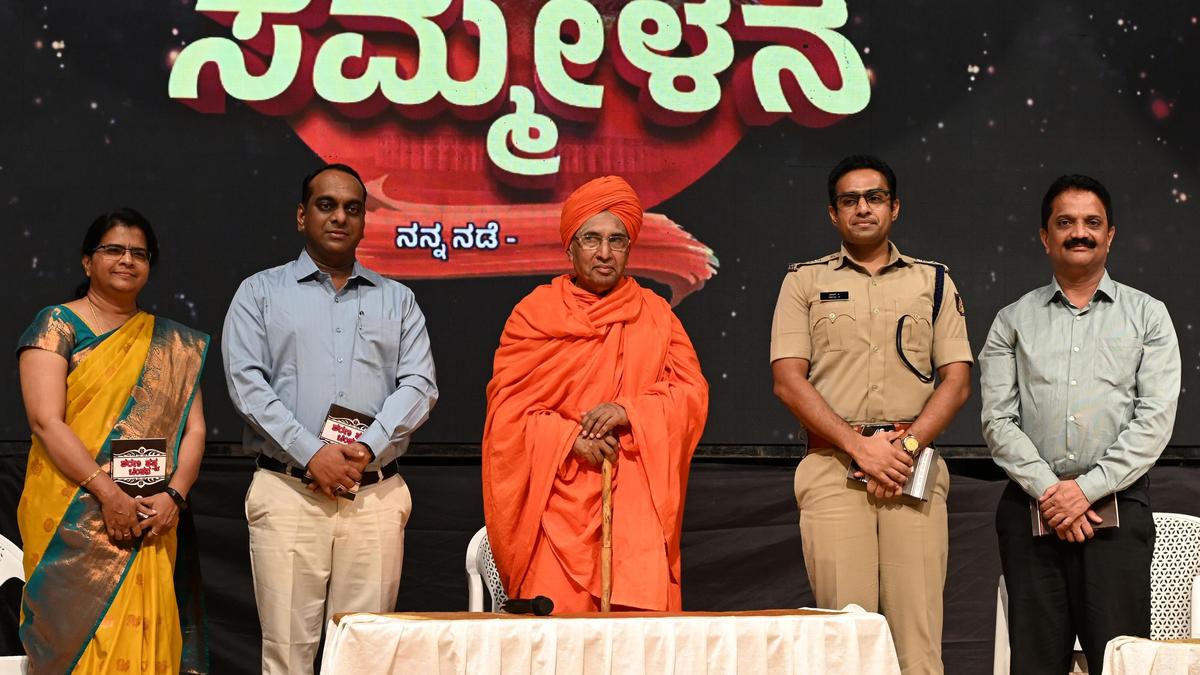
Shivamogga officers discuss Vachanas and how they influence their administration
The Hindu
Shivamogga Deputy Commissioner Prabhulinga Kavalikatti stated that the philosophy of the 12th-century Vachanas has served as a daily guiding principle in his role as an officer.
Shivamogga Deputy Commissioner Prabhulinga Kavalikatti stated that the philosophy of the 12th-century Vachanas has served as a daily guiding principle in his role as an officer.
Speaking at an interaction as part of the two-day Sharana Sahitya Sammelana in Shivamogga on Wednesday, Mr. Kavalikatti said that he studied Vachanas as a student of literature and he had been influenced by the movement led by Basavanna, the social reformer of the 12th century. “If we had followed the ideals of Basavanna and other Sharanas, the society would have been far better than it is today,” he remarked.
Referring to Basavanna’s teaching “work is worship”, the DC stressed that officers must deliver duties with complete impartiality, while ensuring rational and rule-based administration.
Recalling a personal incident, the DC said he once faced pressure from a section to take a decision that violated rules. He refused to yield and stood firmly by the law, and he was transferred from the post within a week. “I wish to state that a public servant is not anybody’s private servant,” he maintained.
Shivamogga Superintendent of Police B. Nikhil stated that Anubhava Mantap of the 12th century represented the true model of democracy, where people from different sections of society received due representation. He noted that the Vachana movement fostered the culture of discussion and its principles closely align the fundamentals of the Indian constitution.
Referring to an excerpt from a well-known Vachana of Basavanna, i.e., “Things standing shall fall, but the moving ever shall stay,” the SP said that the officer who remains at one place for too long tends to “fall”, while those who accept transfers and keep moving stay “firm”.


Plaque unveiled in Bengaluru honors 11 victims of RCB stampede, emphasizing safety responsibility for future events.

India and the U.S. reaffirm commitment to enhance strategic defense cooperation at the 18th Defence Policy Group meeting in New Delhi.

Chhattisgarh's Deputy CM reports only 30-40 Maoists remain in Bastar, highlighting recent surrenders and future development plans.

Explore the historical and industrial significance of Ariyalur constituency, highlighting its challenges, agriculture, and political landscape.

Dindigul and Madurai Collectors conduct joint inspection

In this episode, Kalki Subramaniam speaks to us about why the Transgender Persons Amendment Bill has sparked protests, and how these amendments threaten to push a marginalised community back into the shadows.

India's EU FTA is poised to attract more German companies, boosting bilateral trade and investment opportunities.

“Judicial time is a valuable public resource. Every frivolous or misconceived invocation of constitutional jurisdiction results in diversion of time from genuinely deserving litigants,” said the Madurai Bench of the Madras High Court while imposing a cost of ₹50,000 on a man from Theni district who filed a petition with an unusual prayer: permission to conduct daily protests till the ‘World War’ ends.

The Mangaluru city police on Wednesday, arrested Pavan Acharya, 22, of Moodubelle village in Kaup Taluk in Udupi district, on the charge of posting inflammatory content on the social media.

Bengaluru corporations will present five separate budgets on March 27-28, focusing on infrastructure and community funding.

A humorous exchange in the Legislative Assembly highlights CM Siddaramaiah's choice of a Mysore silk shawl over a towel.

Karnataka's fiscal deficit is under control, better than neighboring states, says Chief Minister Siddaramaiah amid revenue challenges.

Capt. S. Divakar takes charge as MD and CEO of Dredging Corporation of India, following board approval for his appointment.