Scientists search for a female partner for world’s ‘loneliest’ plant Premium
The Hindu
Scientists search for a female partner for world’s ‘loneliest’ plant
“Surely this is the most solitary organism in the world,” wrote palaeontologist Richard Fortey in his book about the evolution of life.
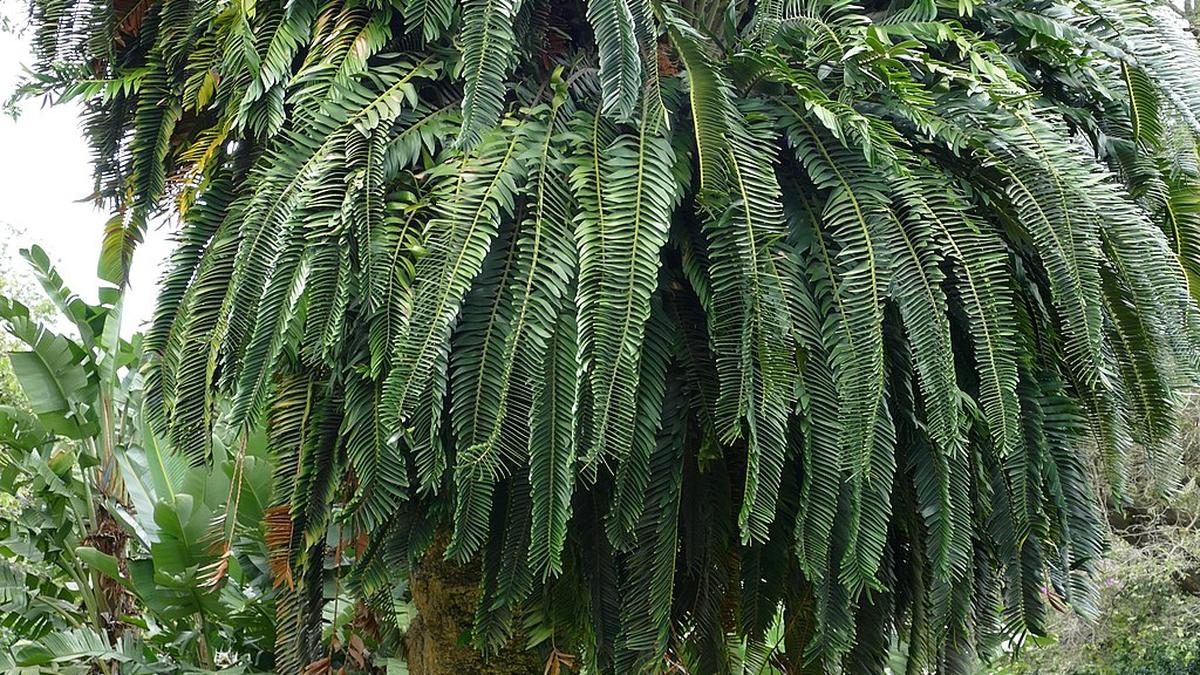
He was talking about Encephalartos woodii (E. woodii), a plant from South Africa. E. woodii is a member of the cycad family, heavy plants with thick trunks and large stiff leaves that form a majestic crown. These resilient survivors have outlasted dinosaurs and multiple mass extinctions. Once widespread, they are today one of the most threatened species on the planet.
The only known wild E. Woodii was discovered in 1895 by the botanist John Medley Wood while he was on a botanical expedition in the Ngoye Forest in South Africa. He searched the vicinity for others, but none could be found. Over the next couple of decades, botanists removed stems and offshoots and cultivated them in gardens.
Fearing that the final stem would be destroyed, the Forestry Department removed it from the wild in 1916 for safekeeping in a protective enclosure in Pretoria, South Africa, making it extinct in the wild. The plant has since been propagated worldwide. However, the E. woodii faces an existential crisis. All the plants are clones from the Ngoye specimen. They are all males, and without a female, natural reproduction is impossible. E. woodii’s story is one of both survival and solitude.
My team’s research was inspired by the dilemma of the lonely plant and the possibility that a female may still be out there. Our research involves using remote sensing technologies and artificial intelligence to assist in our search for a female in the Ngoye Forest.
Cycads are the oldest surviving plant groups alive today and are often referred to as “living fossils” or “dinosaur plants” due to their evolutionary history dating back to the Carboniferous period, approximately 300 million years ago. During the Mesozoic era (250-66 million years ago), also known as the Age of Cycads, these plants were ubiquitous, thriving in the warm, humid climates that characterised the period.
Although they resemble ferns or palms, cycads are not related to either. Cycads are gymnosperms, a group that includes conifers and ginkgos. Unlike flowering plants (angiosperms), cycads reproduce using cones. It is impossible to tell male and female apart until they mature and produce their magnificent cones.


Explore the concept of 'snowball earth' and recent findings on climate variability during this ancient icy period.

A riot of capes, corsets, and carefully crafted armour took centrestage as Chennai Comic Con wrapped up at the Chennai Trade Centre, with cosplay emerging as the undisputed showstopper. From anime icons and gaming legends to beloved Indian comic characters, over 500 fans transformed the venue into a living, breathing multiverse, showcasing how Chennai’s fandom culture has evolved, placing the city on India’s pop culture map.

Warmer oceans and depleting food have affected the ubiquitous loggerhead turtle’s reproductive and migratory patterns — and even its size.

Toyota Urban Cruiser Ebella review: Explore design, range, features, ride comfort and safety of Toyota’s new electric SUV for India. Expected price ₹14–18 lakh, with up to 500 km claimed range and practical urban usability.

Explore India's potential in bio-based chemicals and enzymes, highlighting industry leaders and challenges in sustainable manufacturing.

Astronomers discover an unusual planetary system with a rocky planet formed outside its gaseous neighbors, challenging existing formation theories.

Four new astronauts arrive at the ISS to replace a crew evacuated due to a serious health issue.

Neurobehavioural therapy can transform brain connectivity in functional neurological disorders, highlighting the link between cognition, emotion, and behavior.

The centuries-long quest for synthetic diamonds, also known as lab-grown diamonds or human-made diamonds, came to an end in 1954-55. On February 15, 1955, the creation of the first synthetic diamonds were announced, and it was quickly picked-up by newspapers around the world. A.S.Ganesh tells you more about these diamonds and the man who first made it happen…

Kadhambari S. Viswanathan highlights online education's evolution and its coexistence with traditional methods at The Hindu Tech Summit 2026.

The Hindu science quiz on Charles Darwin on February 13 2026

Explore the immersive art exhibit "A Story in Red" in Fort Kochi, featuring 13 installations celebrating memory, culture, and emotion.

Explore why different animals have varying litter sizes based on reproduction strategies and survival adaptations.