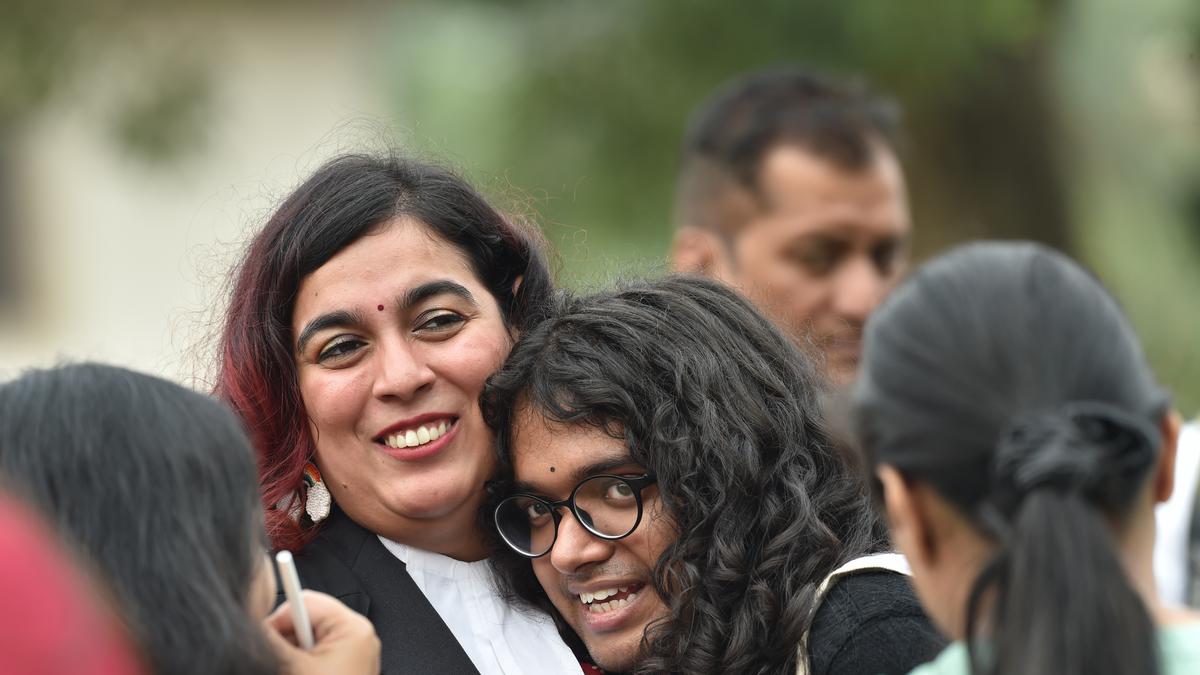
SC’s same-sex marriage verdict acts as a formidable document upholding the Indianness of homosexuality and gender queerness
The Hindu
Supreme Court affirms queerness is Indian, not foreign; CJI D.Y. Chandrachud notes how prejudice is a remnant of colonial past. Five judges agree that queerness is not limited to urban, elite few. CJI says demand to legalise same-sex marriage should not be dismissed as foreign idea. Colonial laws heaped indignity on trans-persons.
Though the Supreme Court has refused to legalise same-sex marriage, the Constitution Bench judgment is a formidable step to silence hostile voices who claim that homosexuality and gender queerness are un-Indian.
“It is not queerness which is of foreign origin but the many shades of prejudice in India which are remnants of a colonial past,” Chief Justice of India (CJI) D.Y. Chandrachud observed.
The judgment bells the cat on how atypical gender identity or sexual orientation is still considered alien, urban and elite – a view put forward in court even by the Union government during the arguments of the same-sex marriage case. The Constitution Bench’s comments highlighting societal and even state discrimination on the basis of sexual orientation comes five years after the apex court decriminalised homosexuality.
Why did the Supreme Court not allow same-sex marriage? | Explained
Justice Sanjay Kishan Kaul accepted non-heterosexual relationships as part of the “pluralistic social fabric” and an “integral part of Indian culture”.
All the five judges on the Bench agreed that queerness was not a phenomenon limited to the few and English-speaking urban rich. Expressions of queerness are more visible in urban centres as cities afford a degree of anonymity and access to resources, the Chief Justice reasoned. Queerness is not urban or elite. Persons of any geographic location or background may be queer, the court said in one voice.


Pinarayi Vijayan launches his election campaign in Dharmadam, aiming for a third consecutive term amid tightening competition.

Delhi Speaker Vijender Gupta has written to Lieutenant-Governor Taranjit Singh Sandhu seeking directions to instal audible signals at traffic intersections across the city to ensure the safety of mobility-impaired individuals and senior citizens.

GVMC council concludes its five-year term, highlighting significant development projects and global events that enhanced Visakhapatnam's recognition.

Karnataka SC/ST Commission discusses internal reservation issues amidst confusion over reduced quotas for Scheduled Castes and Tribes.

President Droupadi Murmu serves Akshaya Patra’s 5 billionth meal, highlighting child nutrition and education at Rashtrapati Bhavan.

PM Modi and UAE President agree on ensuring safe navigation through the Strait of Hormuz amid regional tensions.

JNU student leaders face severe repercussions for activism, risking their academic futures amid allegations and online abuse.

India Post launches 24-hour and 48-hour Speed Post services in Bengaluru, ensuring urgent delivery across major metro cities.

A 24-hour control room in Krishnagiri monitors the Model Code of Conduct and manages election-related complaints ahead of polls.

Madurai Collector inaugurates voter awareness campaign

MLC Kishore Kumar Puttur criticizes the State for poor implementation of the Centre's health scheme for senior citizens.

Karnataka's Health Minister announces redeployment of specialists to taluk hospitals to reduce neonatal mortality rates effectively.

Celebrate IPL's start and Polly Umrigar's legacy, reflecting on cricket's evolution and the enduring impact of its pioneers.