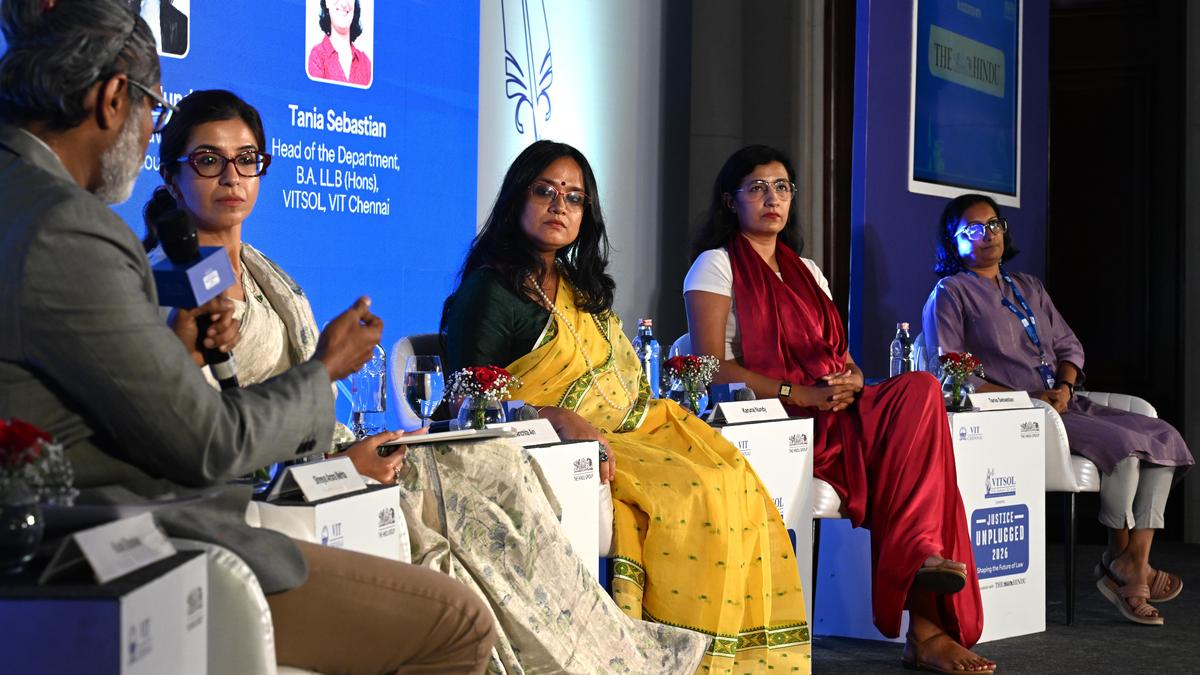
‘Making justice accessible requires a systemic approach beyond formal equality‘
The Hindu
Explore how systemic reforms and diverse representation can enhance access to justice for marginalized communities, beyond mere formal equality.
For Sanchita Ain, Advocate-on-Record at the Supreme Court, the struggle for access to justice began with her own right to practise law.
“I myself have a disability — a chronic neurological condition — and at one point I believed I was unfit for litigation because I could not work the long hours the profession demands,” she said. “What made the difference was accommodation — not sympathy, but institutional accommodation. If systems are not put in place, inclusion depends on individual goodwill.”
Speaking at Justice Unplugged 2026, a daylong legal conclave, Ms. Ain recounted how she had to repeatedly push the Supreme Court administration to provide a sign language interpreter for Sarah Sunny, a lawyer with hearing disability she represented in September 2023. “She did not need permission for an interpreter. It was her right,” she said, pointing to persistent “court bureaucracy” that forces litigants and lawyers with disabilities to “run from pillar to post”.
Moderating the discussion, Kunal Shankar, Deputy Business Editor, The Hindu, framed the broader structural question: whether greater representation on the Bench — across gender, caste, disability and other identities — could meaningfully expand access to justice. He noted that empirical studies have repeatedly pointed to the under-representation of marginalised communities in higher judicial appointments, and asked whether reform of the appointments process was integral to improving access.
Karuna Nundy, Senior Advocate, Supreme Court, responded by turning the focus to diversity within the judiciary. “What is the essential problem with having mostly upper-caste, able-bodied men as judges across the board?” she asked. “Representation is a good in and of itself. It must not be that if you are a woman, or Dalit, or queer person, you must be 10 times more brilliant than the next person to deserve a place.”


SNR Sons Charitable Trust celebrated Founder’s Day, honoring its legacy in healthcare and education with inspiring speeches and awards.

Canada and India aim to double trade by 2030 through a new economic partnership, says PM Carney in Mumbai.

Nepali parties unveil ambitious election promises, but skepticism remains regarding their ability to deliver real change and governance.

Kapil Sibal advocates for a purposive interpretation of the Constitution to achieve justice and address societal needs at a law conclave.

AAP leader Arvind Kejriwal to address a public rally at Jantar Mantar, outlining AAP's future direction and addressing recent controversies.

MCEME Secunderabad's seminar focuses on robotics and autonomous systems to enhance India's future-ready defense capabilities.

Shorts News:Watch: Donald Trump says U.S. launches major combat operations in Iran targeting missiles and navy

Chief Minister Naidu announces ₹20 lakh ex gratia for firecracker blast victims, suspends officials, and plans safety reforms.

Explore the traditional "pazhancher" method for effective weed control in organic farming, enhancing soil fertility and reducing costs.

Bihar police implement enhanced security measures for Holi, deploying additional forces and warning against hooliganism and communal disturbances.

Karnataka launches a HPV vaccination drive for 1.15 crore girls to prevent cervical cancer, enhancing health protection for adolescents.

SLBC tunnel work resumes at Devarakonda, with 20 meters excavated in a week, aiming for completion by June 2028.

Karnataka women’s groups express concerns over disenfranchisement risks from the Special Intensive Revision of electoral rolls.