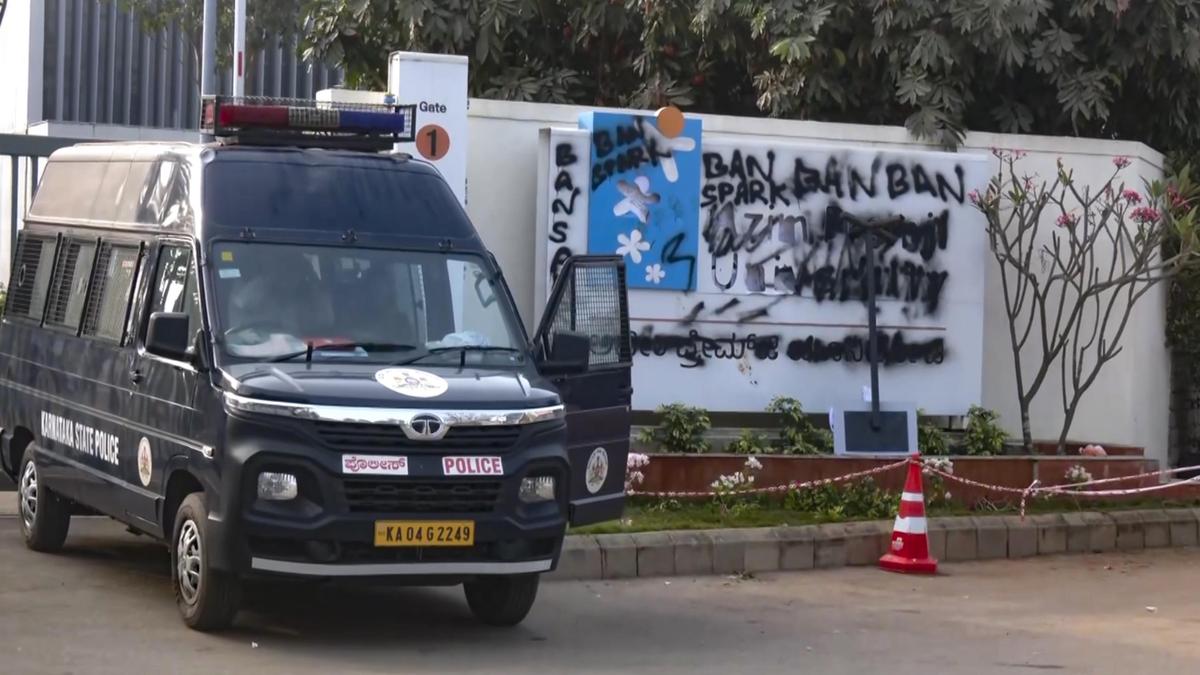
APU protest: Students question university response, point to shrinking space for open debate
The Hindu
Students at APU protest the university's response, citing shrinking space for open debate and academic discourse.
In the wake of a violent incident on the campus, where members of the Akhil Bharatiya Vidyarthi Parishad (ABVP) vandalised the property of Azim Premji University (APU), objecting to a discussion on Kashmir that was scheduled but did not take place, students of the University said they will intensify their protests against the university’s FIR against the student-run Spark Reading Circle at APU, affiliated with the All India Students Association.
The FIR, based on a complaint by the university’s Registrar, became the centre of debate and unrest on campus, with students insisting that the FIR must be quashed.
Students, who wished to stay anonymous, told The Hindu that the administration defended the FIR by pointing to an earlier time when the university had asked who managed the social media page (Spark Reading Circle) for student events, and nobody had answered. The administration’s argument, they say, is that if the page was not run by the students, it should not be their responsibility, and the FIR should not be quashed. Students, however, argue that this ignores their concerns about being penalised for an event they organised.
Students, on the condition of anonymity, said that the administration has framed the decision of filing the FIR against the student run page as a “protective measure” taken in the interest of campus safety and to prevent further escalation. They allege that apart from a late-night email sent at 1 a.m. stating that classes would resume the next day, the administration has not provided any detailed written response to the concerns they raised in person, including discrepancies in the official timeline and questions about communication and venue decisions.
Students further argue that the issue is not only legal but also reflects a “bigger change” in how things work on campus. Over the past few years, they feel that organising discussions has become more bureaucratic, with layers of approvals and rules that make even simple events complicated. Each new batch of students, they allege, faces stricter protocols that slowly become the norm, leaving less room for conversations on politically sensitive topics.
The social media post that led to the FIR had announced a discussion on a disputed historical event in Kashmir. Students argued that engaging with complex political and historical questions is integral to academic life and does not, in itself, amount to unlawful activity. They argue that invoking criminal law in response to such a post risks creating a chilling effect on campus discourse.


SNR Sons Charitable Trust celebrated Founder’s Day, honoring its legacy in healthcare and education with inspiring speeches and awards.

Canada and India aim to double trade by 2030 through a new economic partnership, says PM Carney in Mumbai.

Nepali parties unveil ambitious election promises, but skepticism remains regarding their ability to deliver real change and governance.

Kapil Sibal advocates for a purposive interpretation of the Constitution to achieve justice and address societal needs at a law conclave.

AAP leader Arvind Kejriwal to address a public rally at Jantar Mantar, outlining AAP's future direction and addressing recent controversies.

MCEME Secunderabad's seminar focuses on robotics and autonomous systems to enhance India's future-ready defense capabilities.

Shorts News:Watch: Donald Trump says U.S. launches major combat operations in Iran targeting missiles and navy

Chief Minister Naidu announces ₹20 lakh ex gratia for firecracker blast victims, suspends officials, and plans safety reforms.

Explore the traditional "pazhancher" method for effective weed control in organic farming, enhancing soil fertility and reducing costs.

Bihar police implement enhanced security measures for Holi, deploying additional forces and warning against hooliganism and communal disturbances.

Karnataka launches a HPV vaccination drive for 1.15 crore girls to prevent cervical cancer, enhancing health protection for adolescents.

SLBC tunnel work resumes at Devarakonda, with 20 meters excavated in a week, aiming for completion by June 2028.

Karnataka women’s groups express concerns over disenfranchisement risks from the Special Intensive Revision of electoral rolls.