Lutyens and the politics of symbolism Premium
The Hindu
Edwin Lutyens ultimately secured near-exclusive credit for New Delhi’s design not just because he was talented, but because he was an exceptional public-relations strategist
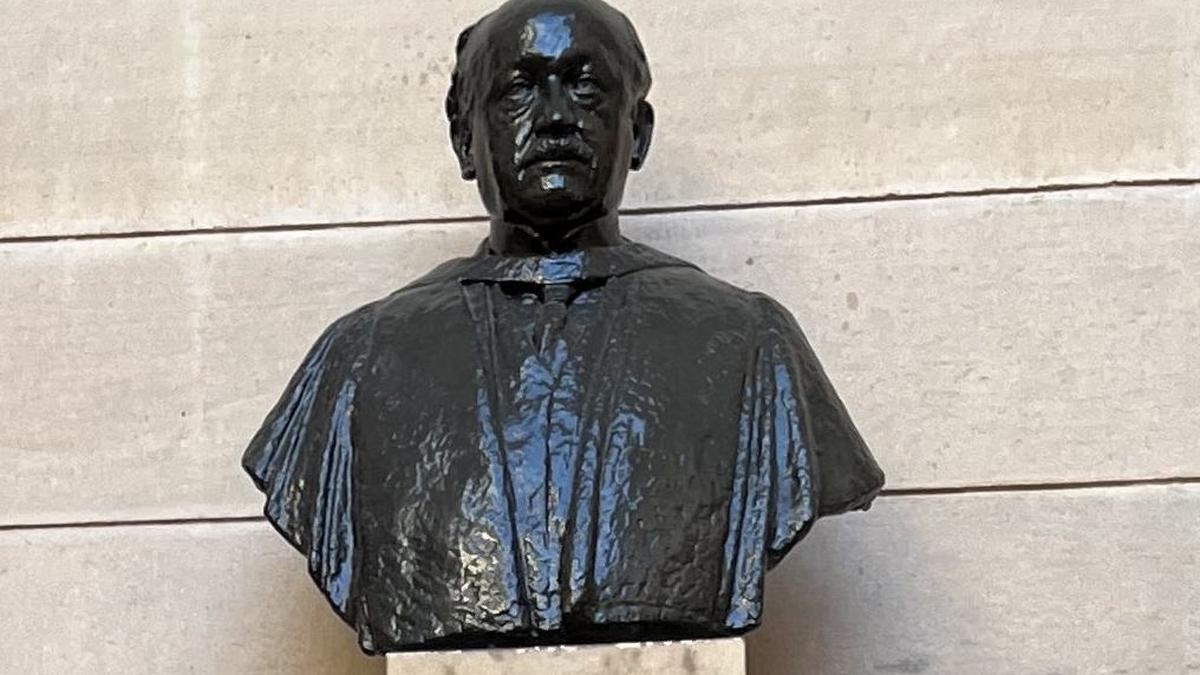
On February 23, 2026, Edwin Lutyens’s bust was removed as part of the government’s ongoing decolonisation drive. In its place now stands the bust of C. Rajagopalachari, the first Indian Governor-General of independent India. Prime Minister Narendra Modi framed the move as an act of “leaving behind symbols of slavery,” while the Opposition, predictably, criticised it in familiar and unimaginative terms. This is not the first time a statue — or in this case, a bust— has been taken down. Such acts are attempts to wreak vengeance on the past and rewrite the future.
There is no need to shed tears for Lutyens or what he represented. He is perhaps the only architect in modern history whose name has, for nearly a century, been synonymous with an entire city. Pierre Charles L’Enfant, who designed Washington D.C., has a handful of city landmarks named after him, such as a plaza, a metro station and promenades, in the city he shaped. His name as the city’s architect was erased and resurrected only a century later. Today he lies buried in the Arlington cemetery overlooking the city, where he was interred 84 years after his death. Walter Burley Griffin, the Chicago architect who planned Canberra has a lake and a 276-km road named for him, but not a city.
Lutyens was an ambitious man. At 19, with little architectural training, he struck out on his own. He was convinced of his talent; he was also aided by his social connections. His wife, Lady Emily, was the daughter of the Earl of Lytton, the former Viceroy of India. Lutyens had to turn to India because England was changing; an assertive middle class was elbowing the aristocracy out of power. High taxes on the wealthy introduced in 1909 meant fewer and fewer country houses to build. However, he hated India and was uncharitable towards Indians. An unrepentant racist, he wrote to his wife Emily: “The Taj by moonlight becomes so bald and indefinite... It is wonderful but it is not architecture, and its beauty begins where architecture ceases to be.” This was hardly an isolated remark. In another letter, Lutyens complaining about the ineptitude of Indian craftsmen, wrote mockingly, “... It will be difficult to find the men — Government ought to breed them! A job for the Eugenic societies!”
British architect Sir Edwin Lutyens and his Madras connection
Hidden histories: A little bit of Lutyens
Lutyens was one of a three-member committee sent from London to select the site for New Delhi and later design it. When he arrived in Delhi, he had no experience in town planning. He was, fundamentally, a country-house architect who rose to prominence partly through brilliance and partly through influential social connections. He was not the sole architect of the capital; he shared responsibility with his friend-turned-rival Herbert Baker. He did not design the bungalows currently occupied by Parliamentarians that bear his name. Lord Hardinge, who spent months negotiating with Lutyens and the London bureaucracy on Delhi’s design, has been erased from the city — Hardinge Avenue became Tilak Marg in the 1960s.


Karur inaugurates a new ₹2.4 crore swimming pool at Government Higher Secondary School, enhancing local sports infrastructure for aspiring swimmers.

Protests in West Bengal escalate over electoral roll issues, prompting Chief Minister Mamata Banerjee to plan a dharna against the SIR.

Palestinian envoy criticizes military dominance in Iran-U.S. conflict, calling it "jungle law" that undermines future for vulnerable nations.

AIADMK renominates veteran Thambi Durai for Rajya Sabha; PMK receives an additional Upper House seat allocation.

Karnataka faces trade challenges due to the West Asia crisis, impacting industries, logistics, and MSMEs, warns FKCCI.

FERA members detained in Dindigul

NABARD's potential-linked credit plan estimates ₹25,779.38 crore credit potential for Krishnagiri district, boosting agriculture and MSMEs for 2026–27.

R&B Minister inaugurates a rehabilitation colony for displaced families in Prakasam district amid ongoing Ramayapatnam port construction.

Hyderabad police conduct midnight drill at Masab Tank to enhance emergency response readiness and coordination among personnel.

Experience the rich interfaith tradition of Masi Magam in Killai, where Hindu and Muslim communities celebrate harmony annually.

Social activist Shabnam Hashmi highlights alarming forest fires in Magadi taluk, linking them to potential mining activities.

Labour Minister urges companies to prioritize safety and achieve zero accidents in factories during National Safety Day event.

Andhra Pradesh's Family Benefit Management System aims for 90% data integration by April 30 to enhance welfare delivery.