Kadakkavoor in Thiruvananthapuram is home to a four-decade-old family-run halwa business
The Hindu
broken wheat halwa made by a family in kadakkavoor in thiruvananthapuram has many takers
Does Thiruvananthapuram have a signature halwa? Yes, it has. It was a social media post that took me to Kadakkavoor, nearly a one-hour drive from the city, where a family has been making and selling homemade halwa for over four decades now.
At Chekkalavilakom junction, behind the now-defunct Kadakkavoor market, is Sheeja Nivas, where Shibu Sudevan is carrying forward the legacy of the halwa business started by his maternal grandfather, Gopalan Natarajan.
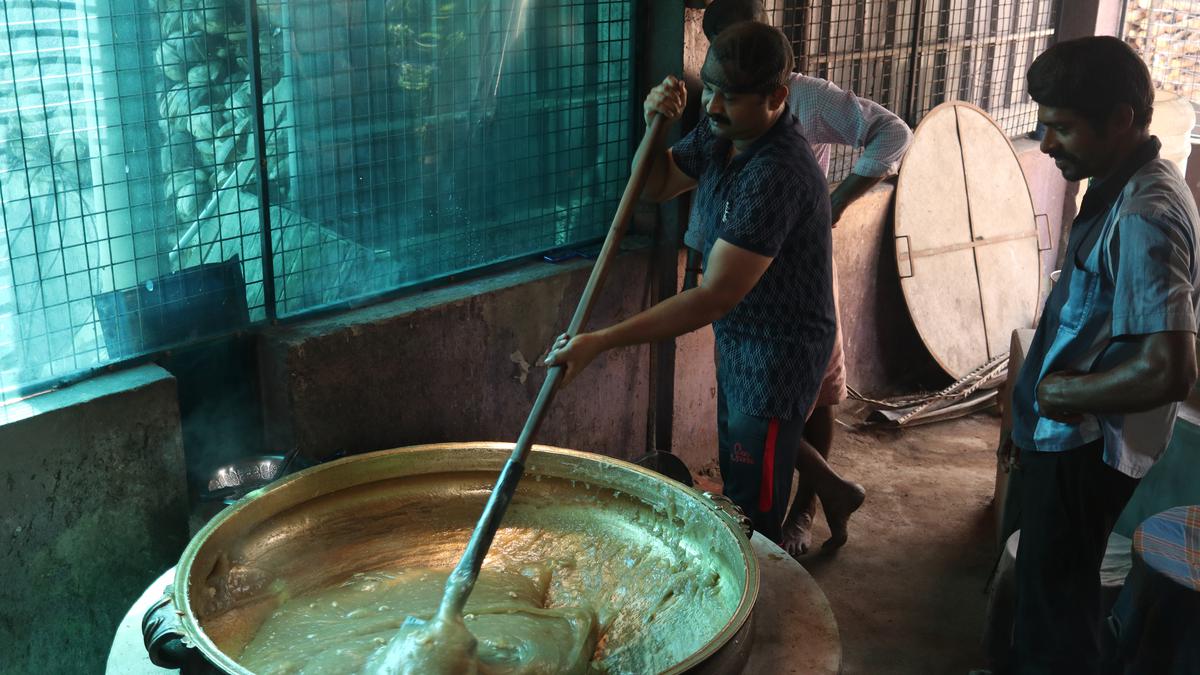
With a huge ladle, two men are taking turns to stir the halwa in an uruli (huge brass vessel) when we reach Halwa Veedu, as Shibu calls it now. “This is the first batch of the day. Usually, we start by 5am and it takes at least five hours to get the halwa in the right consistency. Today, we are running late. Once we take this out, we will start preparing the second batch,” says Shibu.
Gopalan, who ran a hotel and had a catering business, used to prepare this halwa for functions, including weddings. When he passed away, his wife, Premalatha Natarajan, and their daughter, Sheeja Sudevan, took over. “It was difficult to continue the catering business and so we decided to concentrate on the halwa. That was in 1995,” says Premalatha. In 2013, her younger son, Shajan, took over. A few months ago, he moved on to start a separate halwa outlet. That is when Shibu, the elder one, who was working in Dubai, came back to run the business.
“I have been watching my grandfather at work since I was 12 and I couldn’t just let it go. That’s why I decided to return home and keep the business afloat,” says the 46-year-old Shibu.
The halwa has two variants — the dark chocolate-coloured halwa with jaggery and the light brown variety with white sugar. The rest of the ingredients are the same — broken wheat, rice flour, cashew nuts, ghee, oil and cardamom. “There is no refined flour, which is commonly used to make halwa,” he explains.
Broken wheat is soaked for two hours in the evening. Then it is ground well and strained to get the milk, which is kept aside for six hours. “It is then mixed with rice flour and sugar or jaggery syrup and cooked in the uruli. We keep stirring it without a break to prevent it from sticking to the bottom of the uruli. Coconut oil, ghee and nuts are added at different stages of the preparation. Cardamom is added just before it is taken off the stove,” Shibu explains.


51 couples take thebig plunge at Udaipur mass wedding event

A bridge collapse in Roop Nagar kills a woman; Delhi government forms a probe panel amid rising safety concerns.

Tribunal halts Colonel Purohit's retirement, pending promotion decision after his acquittal in the 2008 Malegaon blast case.

Pinarayi Vijayan launches his election campaign in Dharmadam, aiming for a third consecutive term amid tightening competition.

Delhi Speaker Vijender Gupta has written to Lieutenant-Governor Taranjit Singh Sandhu seeking directions to instal audible signals at traffic intersections across the city to ensure the safety of mobility-impaired individuals and senior citizens.

GVMC council concludes its five-year term, highlighting significant development projects and global events that enhanced Visakhapatnam's recognition.

Karnataka SC/ST Commission discusses internal reservation issues amidst confusion over reduced quotas for Scheduled Castes and Tribes.

President Droupadi Murmu serves Akshaya Patra’s 5 billionth meal, highlighting child nutrition and education at Rashtrapati Bhavan.

PM Modi and UAE President agree on ensuring safe navigation through the Strait of Hormuz amid regional tensions.

JNU student leaders face severe repercussions for activism, risking their academic futures amid allegations and online abuse.

India Post launches 24-hour and 48-hour Speed Post services in Bengaluru, ensuring urgent delivery across major metro cities.

A 24-hour control room in Krishnagiri monitors the Model Code of Conduct and manages election-related complaints ahead of polls.

Madurai Collector inaugurates voter awareness campaign