Jaishankar cautions against dangers of concentrated critical minerals supply chains
India Today
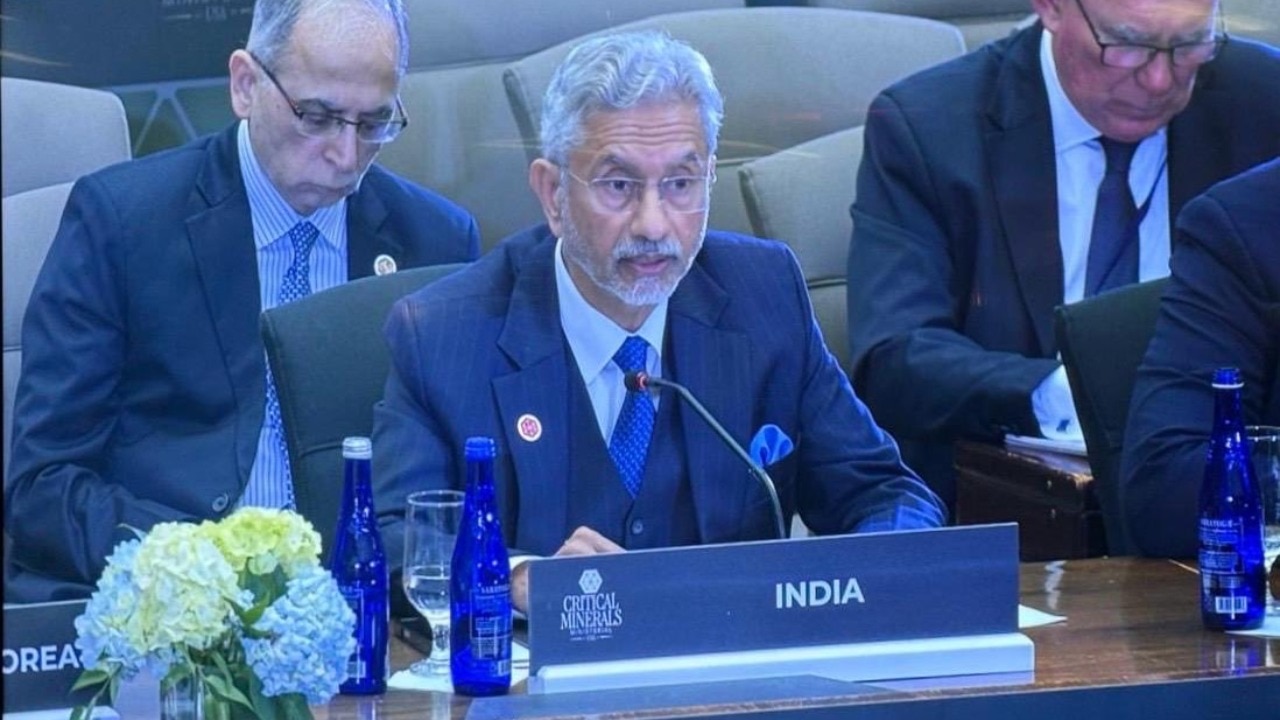
External Affairs Minister S Jaishankar addressed the Critical Minerals Ministerial in Washington DC. He highlighted the risks of mineral concentration and the need for structured international cooperation to secure supply chains.
External Affairs Minister S Jaishankar on Wednesday underlined the challenges of "excessive concentration" of critical minerals and the importance of de-risking supply chains through structured international cooperation.
Addressing the inaugural Critical Minerals Ministerial convened by US Secretary of State Marco Rubio in Washington DC, Jaishankar also conveyed India's support to the FORGE initiative on critical minerals.
"Spoke at the Critical Minerals Ministerial in Washington DC today. Underlined challenges of excessive concentration and the importance of de-risking supply chains through structured international cooperation," the minister said in a post on X.
In his address, he also highlighted India's efforts towards greater resilience through initiatives including the National Critical Minerals Mission, Rare Earth Corridors and responsible commerce.
Before the start of the ministerial, Jaishankar met with several global counterparts, including Canadian Foreign Minister Anita Anand and Singapore's Vivian Balakrishnan. He also interacted with his counterparts from the Netherlands, Italy, Malaysia, Bahrain, Mongolia, Poland, Romania, Israel and Uzbekistan.


Iran's Foreign Minister mocked the US for the mounting expenditures and said that the citizens have to pay the cost due to Israel.

In an Instagram post titled, "The metro comparison nobody talks about," she described an experience that caught her off guard.

The world is facing an energy crisis as Iran blocked supplies passing through the Strait of Hormuz after strikes by the US and Israel. Vital subsea cables that carry global internet traffic also pass through Hormuz. Any damage to them could trigger internet outages and hit financial systems across countries, including in India.

A techie used an immersion rod to cook curry after running out of gas, with the viral video showing an exaggerated version of people's realities amid the ongoing LPG crisis in India.

The bodies of the deceased were taken to the Civil Hospital and Jinnah Hospital for identification, the rescue members of Pakistan's largest non-profit social welfare organisation, The Edhi Foundation, told Reuters.

Following the detection of the drones, the US administration held high-level meetings with senior officials. In addition, a high alert was issued for the US Army, amid possibilities of Iranian retaliation.

Images of pre-Islamic Zoroastrian kings and warriors have been unveiled in Iran, evoking courage and resilience. Many say the Ayatollah regime in Iran revives the country's Persian identity during conflicts with Israel and the US. But this Persian heritage has always run deep, and is visible from time to time, in both dissent and unity.

Born of colliding continents and vanished seas, the Strait of Hormuz is the million‑year accident that turned buried oceans into oil, and a thirty‑mile gap in the rocks into the world's most dangerous chokepoint.

The US-Israel war was meant to decapitate Iran's hardline leadership, but the killing of the "pragmatic" Ali Larijani might have done the opposite. By eliminating consensus-builder Larijani, the Israelis might have removed any scope of talks and pushed Iran into deeper hardline control. This could be a ploy to keep the war going.

The newly launched Vande Bharat Sleeper train has sparked widespread commentary as passengers share initial experiences of its modernised amenities, particularly on the Howrah-Guwahati route inaugurated in January.

The assassination of Ali Larijani, one of Iran's most powerful decision-makers, marks a major escalation in the ongoing US-Israel-Iran war and comes amid a sustained campaign targeting the country's top leadership.

The assassination of Ali Larijani, one of Iran's most powerful decision-makers, marks a major escalation in the ongoing US-Israel-Iran war and comes amid a sustained campaign targeting the country's top leadership.

Expect Iran to become more hardline: Geopolitical expert and author Fareed Zakaria reflects on aftermath of US-Israel strikes