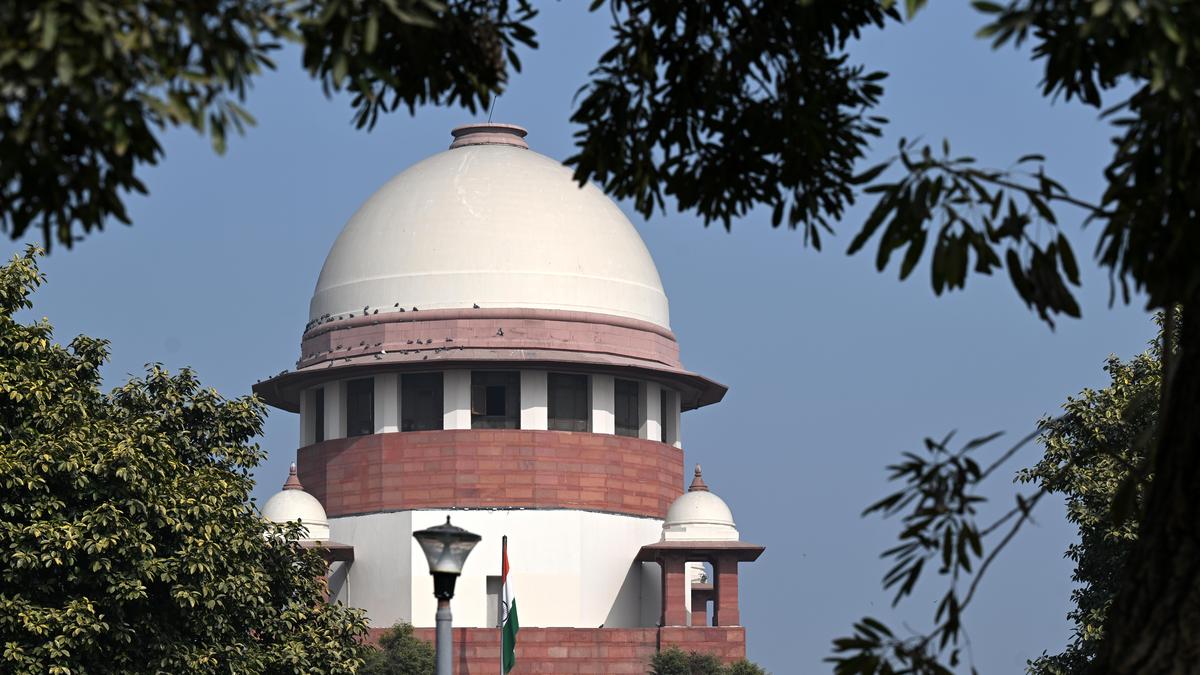
IBC represents legislative choice to privilege speed over exhaustive judicial scrutiny: Supreme Court judgment
The Hindu
Supreme Court affirms IBC's priority on speed and creditor-driven decisions over extensive judicial review in insolvency matters.
The Insolvency and Bankruptcy Code (IBC) represented a conscious legislative choice to privilege speed, certainty, and creditor-driven decision-making over “exhaustive” judicial scrutiny, the Supreme Court said.
“Experience shows that unsuccessful bidders will always try to spin commercial decisions of the Committee of Creditors (CoC) as procedurally faulty in order to secure a second shot through litigation… However, courts need to remain vigilant against any temptation to expand the scope of review beyond the narrow boundaries prescribed by the IBC,” a Bench of Justices B.V. Nagarathna and R. Mahadevan wrote in a recent judgment.
The judgment was based on appeals filed against a National Company Law Appellate Tribunal (NCLAT) order in a matter pertaining to the approval of a resolution plan submitted by a firm.
“The IBC represents a conscious legislative choice to privilege speed, certainty and creditor-driven decision-making over exhaustive judicial scrutiny,” Justice Nagarathna observed.
The court reiterated the settled law that the commercial wisdom of the CoC enjoyed primacy and could not be supplanted by judicial review.
“Neither the National Company Law Tribunal nor the NCLAT nor even this court is empowered to substitute its assessment in place of the commercial decision arrived at by a requisite majority of the CoC,” Justice Nagarathna observed.


Mamata Banerjee champions secularism amid Suvendu Adhikari's Hindutva push, highlighting the political divide ahead of Bengal Assembly polls.

Meta removes social media accounts of Jammu and Kashmir news outlets, raising concerns over censorship and freedom of expression.

Health Minister inaugurates ₹285.31 crore Mother and Child Super Speciality Block at Ernakulam MCH, enhancing healthcare for women and children.

Deputy Chief Minister inaugurates Thiranagam skill centre in Dindigul to enhance youth employability through training and guidance.

Workers report issues with the updated NMMS app for marking attendance under MGNREGS, raising concerns about its effectiveness.

Hundreds of stranded passengers return to Hyderabad from West Asia on special flights amid escalating tensions and airspace closures.

DMK councillor Jeganathan protests in Corporation meeting over delayed road repairs, prompting Mayor's assurance for swift action.

Karnataka High Court rules that Child Care Leave can be used for exam preparation, not just the exam period.

PIL filed to remove 'Kerala' from 'The Kerala Story 2' title, citing concerns over negative depiction of the state.

D. Vedavyas Kamath accuses MLCs of claiming credit for BJP-sanctioned projects, highlighting ongoing developmental works in Mangaluru.

DMK allocates a Rajya Sabha seat to DMDK, marking the party's first representation in the Upper House.

Srisailam temple reopens post-lunar eclipse after purification rituals, allowing devotees darshan from 9 p.m. to 10:30 p.m.

Hyderabad police arrest three for selling counterfeit tea, detergent, and mosquito repellent, warning consumers to verify product authenticity.