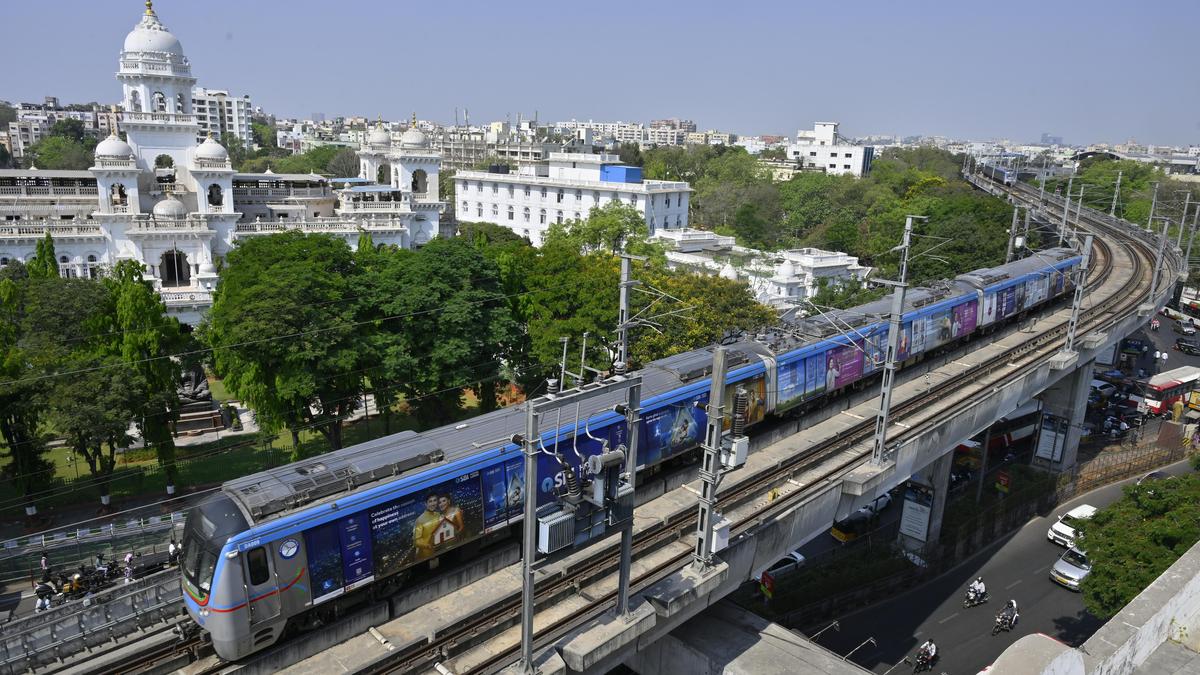
Grey areas persist as key audit gaps surface in Hyderabad Metro Phase‑I buyout
The Hindu
Uncertainty surrounds Hyderabad Metro Phase I buyout amid preliminary audit gaps, impacting future expansion plans and financial viability.
The last word may not have been spoken on the Telangana government’s plan to take over the 69.2‑km Phase I of the Hyderabad Metro Rail (HMR) from the PPP (Public–Private Partnership) concessionaire L&T Metro Rail Hyderabad (L&TMRH) by the end of next month.
Though the State government has announced its commitment to a ₹15,000‑crore payout — ₹13,000 crore towards debt and ₹2,000 crore in equity — to acquire the first phase across the high‑traffic Red (29 km, LB Nagar to Miyapur), Blue (29 km, Nagole to Raidurg), and Green (11 km, JBS to MGBS) corridors from L&TMRH, several grey areas remain.
To begin with, the two consultants appointed by the government’s special-purpose vehicle, Hyderabad Metro Rail Limited (HMRL), have so far submitted only preliminary reports. IDBI Capital has been tasked with conducting a non-technical sovereign audit of the financial and accounting aspects of HMR Phase I, while Delhi Metro International Limited (DMIL), a subsidiary of Delhi Metro Rail Corporation (DMRC), has been examining the technical aspects of the project. Their final reports are expected by mid-March.
“A preliminary report is just that. The final reports may contain far more intricate details. The government’s decision will depend on these findings. Both consultants are public-sector entities of high repute, chosen to ensure that public interest remains paramount since thousands of crores of taxpayers’ money is involved,” top official sources said, requesting anonymity.
The consultants have also been asked to examine the numerous short- and long-term contracts signed by L&TMRH to ensure none become future legal hurdles.
On the technical side, DMIL’s preliminary findings reportedly indicate that the government may need to infuse up to ₹1,000 crore or more to compensate for wear and tear and maintain the current operating capacity without expanding HMR Phase I. The agency has been examining the rolling stock, power-traction systems, CBTC (Communication-Based Train Control) technology, depots, stations, maintenance practices, safety standards, and other operational components.


CM M. K. Stalin visits the family of Venba, an eight-year-old organ donor, honoring her legacy and parents' humanitarian choice.

Nikhil Kumaraswamy emphasizes JD(S) as Karnataka's sole regional party dedicated to protecting the state's identity and interests.

The Tribal Affairs Ministry plans to revamp forest rights cells into unified project monitoring units for improved policy coordination.

Allahabad High Court grants interim protection to Swami Avimukteshwaranand in POCSO case; further hearing set for March 12.

Join the Tollywood Celebrity Cricket League in Vizag on February 28, featuring 110 celebrities and free entry for all!

Researchers warn that climate change may drastically limit habitats for the Nilgiri Wood Pigeon in the Western Ghats.

The restoration of Domakonda palace revitalizes weaving, literature, and community life, transforming it into a vibrant cultural hub.

Uncertainty surrounds Hyderabad Metro Phase I buyout amid preliminary audit gaps, impacting future expansion plans and financial viability.

Need for enhanced vigilance and stronger supervision at the branch level

ASHA workers protest in Bengaluru, demanding honorarium hike and job security ahead of the State Budget.

Farmers in Theni raise concern over decrease in sugarcane yield

Karnataka's new action plans aim to halve snakebite deaths and eliminate dog-mediated rabies fatalities by 2030, enhancing healthcare access.

Direct flights between Mangaluru and Muscat resume March 1, operated by Air India Express, enhancing connectivity for NRIs.