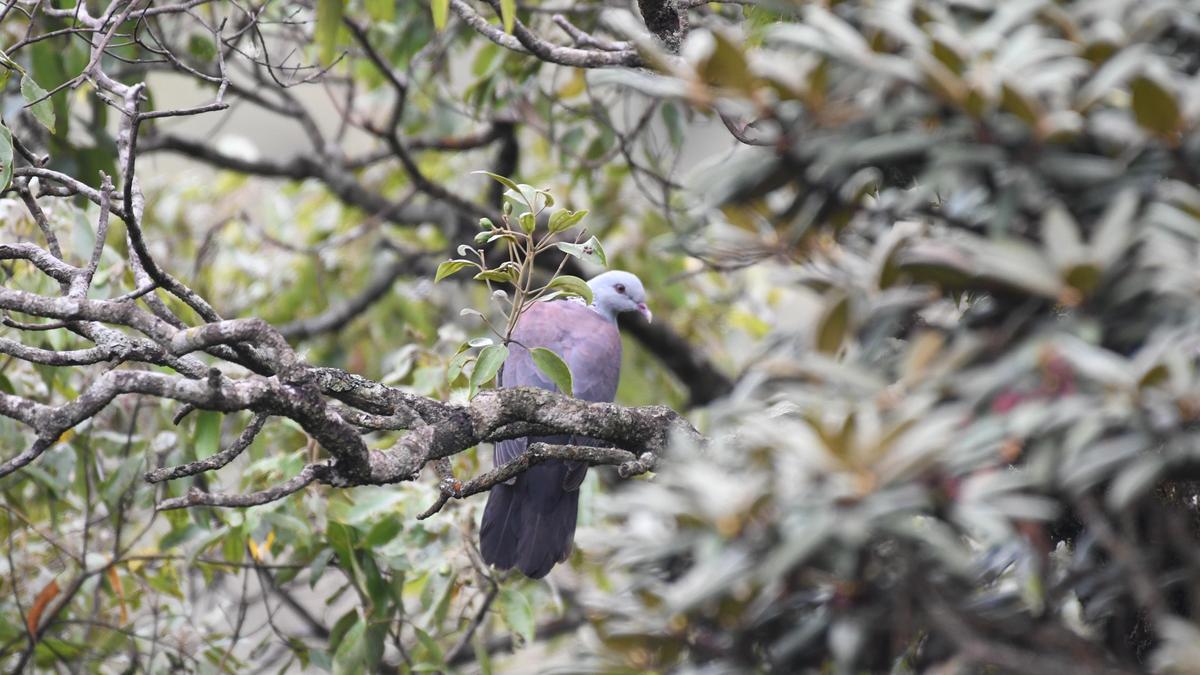
Climate change could restrict habitat availability for Western Ghats birds such as The Nilgiri Wood Pigeon, warn researchers
The Hindu
Researchers warn that climate change may drastically limit habitats for the Nilgiri Wood Pigeon in the Western Ghats.
Climate change could lead to the habitat of Western Ghats endemic species such as the Nilgiri Wood Pigeon (Columba elphinstonii) become extremely limited to a few isolated pockets by the end of the century, a recent research paper warns.
The study, titled “Biogeography and habitat suitability of the Nilgiri Wood Pigeon using MaxEnt”, published in the “Proceedings of the Indian National Science Academy” used MaxEnt, a machine-learning method to model habitat suitability for species, and estimates that the Nilgiri Wood Pigeon (NWP) faces a bleak future marked by “sharp declines in high-suitability areas and marked range contractions.”
The natural habitat of the pigeon comprises high-elevation wet evergreen and adjoining moist deciduous forests, particularly in regions such as The Nilgiris and Anamalai Hills in Tamil Nadu and Kerala. Isolated populations are also reported from locations such as the Biligirirangan Hills, Nandi Hills, and northern Maharashtra.
These ecosystems, often described as “sky islands”, are recognised for their high levels of endemism and ecological specialisation. The pigeon’s restricted elevational range, patchy distribution, and dependence on undisturbed canopy conditions make it a highly specialised species, the authors of the paper — Phillmon Smart Edward, Jeyasubashini Reghupathikannan, and Arockianathan Samson — note adding that Western ghats specialists such as the NWP are particularly vulnerable to anthropogenic pressures such as deforestation, agricultural and infrastructure expansion, plantation development and climate change.
The researchers used 9,757 occurrence records for the species from the eBird database – a citizen-science project that allows users to record bird sightings. Using the occurrence records, the researchers identified 117 presence points for the species and modelled environmental projections using nine bioclimatic variables.
The model predicts that while habitat suitability for the species would initially witness an increase, due to lower montane areas becoming more suitable for the species between the years 2021 to 2040, that this trend would begin reversing by 2081-2100, with “sharp declines in high suitability areas.”


CM M. K. Stalin visits the family of Venba, an eight-year-old organ donor, honoring her legacy and parents' humanitarian choice.

Nikhil Kumaraswamy emphasizes JD(S) as Karnataka's sole regional party dedicated to protecting the state's identity and interests.

The Tribal Affairs Ministry plans to revamp forest rights cells into unified project monitoring units for improved policy coordination.

Allahabad High Court grants interim protection to Swami Avimukteshwaranand in POCSO case; further hearing set for March 12.

Join the Tollywood Celebrity Cricket League in Vizag on February 28, featuring 110 celebrities and free entry for all!

Researchers warn that climate change may drastically limit habitats for the Nilgiri Wood Pigeon in the Western Ghats.

The restoration of Domakonda palace revitalizes weaving, literature, and community life, transforming it into a vibrant cultural hub.

Uncertainty surrounds Hyderabad Metro Phase I buyout amid preliminary audit gaps, impacting future expansion plans and financial viability.

Need for enhanced vigilance and stronger supervision at the branch level

ASHA workers protest in Bengaluru, demanding honorarium hike and job security ahead of the State Budget.

Farmers in Theni raise concern over decrease in sugarcane yield

Karnataka's new action plans aim to halve snakebite deaths and eliminate dog-mediated rabies fatalities by 2030, enhancing healthcare access.

Direct flights between Mangaluru and Muscat resume March 1, operated by Air India Express, enhancing connectivity for NRIs.