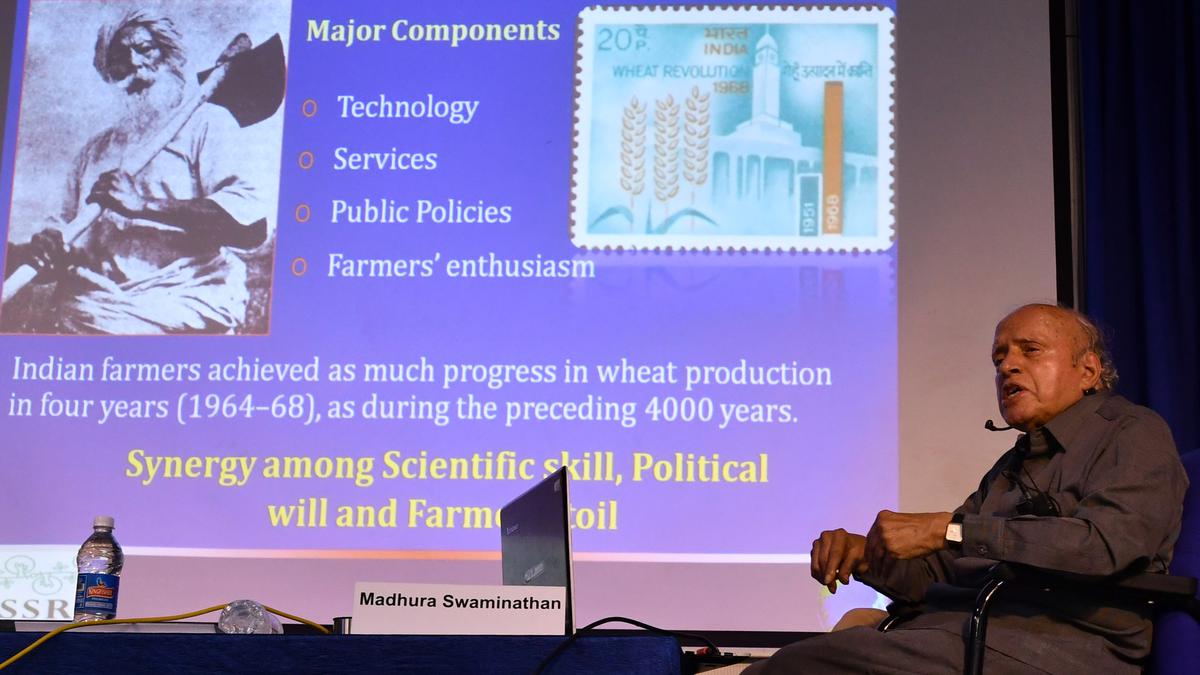
Dr. M.S. Swaminathan guided Karnataka in agriculture policies
The Hindu
Eminent agriculture scientist and Father of Green Revolution in India M.S. Swaminathan had worked with Karnataka government in various capacities. He was a frequent visitor to Bengaluru where he took part in agriculture-related engagements and delivered lectures.
Eminent agriculture scientist and Father of Green Revolution in India M.S. Swaminathan, who passed away in Chennai on Thursday, had worked with Karnataka government in various capacities. He was a frequent visitor to Bengaluru where he took part in agriculture-related engagements and delivered lectures.
Dr. Swaminathan, the then Chairman of National Commission on Farmers had visited Karnataka on three different occasions before the State’s second Agriculture Policy 2006 was finalised by the Janata Dal (Secular)- BJP alliance led by H.D. Kumaraswamy. He had held extensive discussions and gave valuable ideas and suggestions specific to Karnataka and had detailed discussions with former Prime Minister H.D. Deve Gowda.
“The mainstay of the 2006 Agriculture Policy, which is the most comprehensive document and continues to be in vogue had major inputs coming from the Dr. Swaminathan-headed National Commission on Farmers,” said Janata Dal (Secular) leader and the then Agriculture Minister Bandeppa Kashempur. Recalling the formulation of the report, he said experts and officials had detailed discussions with the scientist before the report was finalised.
The Agriculture Policy document states that Dr. Swaminathan appreciated the proactive approach of the State government and the fact that Karnataka was the first State not only to constitute the committees but also to make a detailed presentation before the National Commission of Farmers.
In 2015, the Siddaramaiah–led Congress government appointed him to chair a Vision Group for the agriculture sector for Karnataka. “During our tenure he was instrumental in guiding us in dryland farming or the rain-fed agriculture, and encouraged us to start using bio tech and funding bio tech to develop advanced varieties of seeds. He was also guiding the work when we set up the Karnataka Agricultural Price Commission (KAPC),” remembered Revenue Minister Krishna Byre Gowda, who was Agriculture Minister in the erstwhile Congress government. He said: “Despite his advanced age, he was always available for consultation, willing to share his time and knowledge. He was appreciative of Karnataka’s work on millets and Krishi Bhagya (farm pond.) It was a great learning experience working with him.”
In July 2018, he had also visited the then Chief Minister H.D. Kumaraswamy at Vidhana Soudha. “Dr. Swaminathan maintained a close relationship with State. He used to frequently visit Bengaluru both for personal reasons as well as academic and official purposes. He maintained a close relationship with governments,” said former chairman of KAPC Prakash Kammaradi, who worked closely with the eminent scientist. “We recommended implementing the Dr. Swaminathan report on Minimum Support Price through legal recourse,” he said.
The Universities of Agriculture Sciences (UAS)-Bengaluru and Dharwad on separate occasions conferred on him the honorary doctorates, recognising his contribution to the growth of agriculture in India. “When the UAS-B celebrated its golden jubilee, we found it was apt to invite him to deliver the convocation address considering his depth of knowledge and contribution to field of agriculture,” recalled former UAS-B Vice Chancellor K. Narayana Gowda during whose tenure the agriculture scientist was invited to deliver the convocation address.


51 couples take thebig plunge at Udaipur mass wedding event

A bridge collapse in Roop Nagar kills a woman; Delhi government forms a probe panel amid rising safety concerns.

Tribunal halts Colonel Purohit's retirement, pending promotion decision after his acquittal in the 2008 Malegaon blast case.

Pinarayi Vijayan launches his election campaign in Dharmadam, aiming for a third consecutive term amid tightening competition.

Delhi Speaker Vijender Gupta has written to Lieutenant-Governor Taranjit Singh Sandhu seeking directions to instal audible signals at traffic intersections across the city to ensure the safety of mobility-impaired individuals and senior citizens.

GVMC council concludes its five-year term, highlighting significant development projects and global events that enhanced Visakhapatnam's recognition.

Karnataka SC/ST Commission discusses internal reservation issues amidst confusion over reduced quotas for Scheduled Castes and Tribes.

President Droupadi Murmu serves Akshaya Patra’s 5 billionth meal, highlighting child nutrition and education at Rashtrapati Bhavan.

PM Modi and UAE President agree on ensuring safe navigation through the Strait of Hormuz amid regional tensions.

JNU student leaders face severe repercussions for activism, risking their academic futures amid allegations and online abuse.

India Post launches 24-hour and 48-hour Speed Post services in Bengaluru, ensuring urgent delivery across major metro cities.

A 24-hour control room in Krishnagiri monitors the Model Code of Conduct and manages election-related complaints ahead of polls.

Madurai Collector inaugurates voter awareness campaign