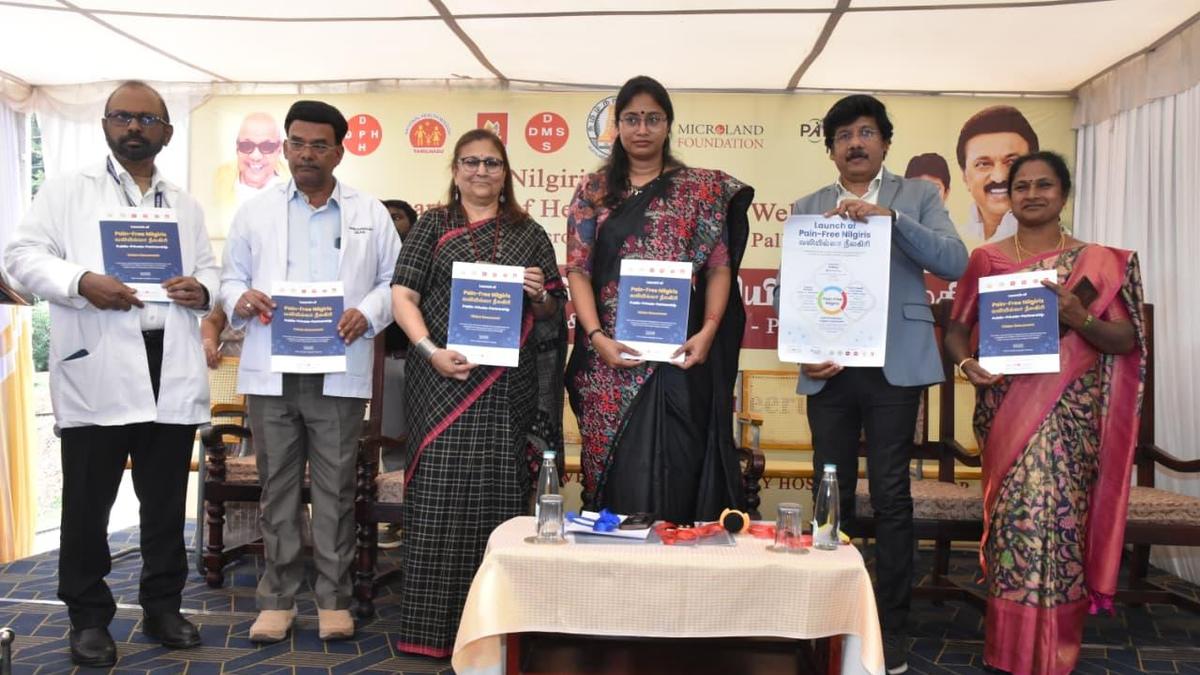
District Collector launches ‘Pain-free Nilgiris’ programme in Udhagamandalam
The Hindu
District Collector launches 'Pain-free Nilgiris' initiative to enhance palliative care and improve quality of life in the district.
The Nilgiris District Collector, Lakshmi Bhavya Tanneeru, launched ‘Pain-free Nilgiris’ – a district-level pain and palliative care initiative at the Government Lawley Hospital in Coonoor on Saturday (February 28, 2026).
Speaking at the event, the Collector said, “In a geographically challenging district — with scattered habitations, hilly terrain, and vulnerable elderly populations — access to long-term pain management and palliative support has often been uneven. Patients with cancer, post-stroke disabilities, chronic illnesses, and age-related degenerative conditions frequently struggle not only with disease, but with untreated pain, repeated hospital visits, and emotional and financial stress on families.”
The Collector added that the objectives of “Pain-free Nilgiris” were to strengthen the District Nodal Centre for Palliative Care, in order to improve the quality of home-based pain management services, to build sustained capacity of healthcare personnel, create awareness about pain relief and palliative care, reduce out-of-pocket expenditure, minimise unnecessary hospital admissions and to improve dignity, comfort, and quality of life.
She stated that under the programme, universal screening of adults is being undertaken across the district, and health volunteers are identifying those requiring palliative care during household visits, and trained healthcare providers and palliative care nurses were ensuring follow-up visits to patients.
“Palliative care is not only about end-of-life support. It is about living well despite illness. It is about relieving suffering — physical, emotional, and social,” she said.
“Each block is supported by a dedicated physiotherapist and palliative care nurse to deliver home-based services. Referral linkages have been strengthened with the Nilgiris Government Medical College Hospital and other government health institutions for advanced and specialised care. This is not a one-time intervention, but a systems approach,” the Collector emphasised.


AIADMK district unit secretaries will meet in Chennai on March 4, chaired by general secretary Edappadi K. Palaniswami.

DCM D.K. Shivakumar emphasises promoting peace to end conflicts in West Asia and protect Indian workers abroad.

Farmers in Kanniyakumari demand urgent repairs for deteriorating irrigation canals to ensure water supply for agriculture.

Vizag officials urge residents to safeguard declining house sparrow populations, highlighting their vital role in agriculture and the environment.

Thirumavalavan calls for India's condemnation of the U.S.-Israel operation that killed Iranian leader Khamenei during a Chennai protest.

Major General Arun C.G. appointed as Additional Director General of NCC for Kerala and Lakshadweep, showcasing extensive military experience.

Demonstration in Mysuru protests the closure of 1,666 government schools under the controversial KPS Magnet Scheme.

CJI Surya Kant lays foundation for A.P. Judicial Academy and High Court guest house in Amaravati, enhancing judicial infrastructure.

IMD forecasts above-normal temperatures and increased heatwave days for Telangana from March to May, raising health and resource concerns.

Every pair of these bins is teamed up with a bench to promote a form of pedestrianisation on this road; while the thinking is praiseworthy, the execution betrays obvious lack of thinking in some areas

Police in Puttaparthi host a cycle rally to promote women's empowerment ahead of International Women’s Day.

District Collector launches 'Pain-free Nilgiris' initiative to enhance palliative care and improve quality of life in the district.

Yadgir authorities enhance support for SSLC students by providing 24/7 study resources at Arivu Kendras ahead of exams.