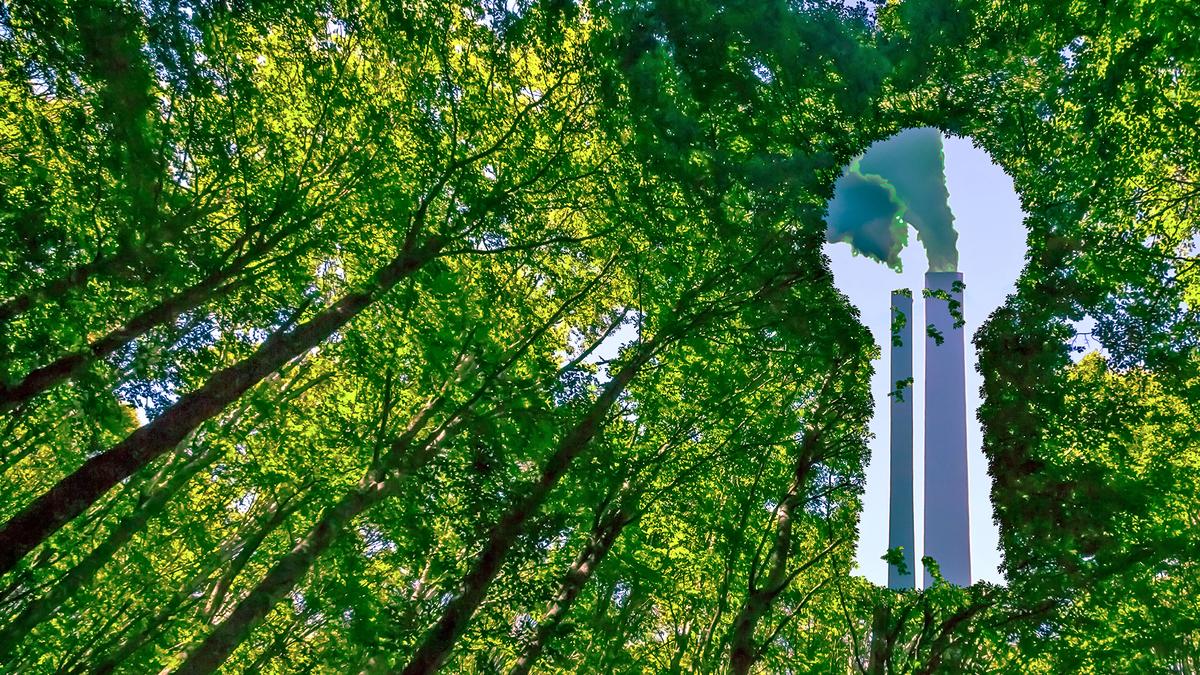
Companies’ appetite for cheap carbon offsets stokes fears of greenwashing
The Hindu
Carbon offsets have become big business as more companies make promises to protect the climate but can’t meet the goals on their own.
Carbon offsets have become big business as more companies make promises to protect the climate but can’t meet the goals on their own.
When a company buys carbon offsets, it pays a project elsewhere to reduce greenhouse gas emissions on its behalf – by planting trees, for example, or generating renewable energy. The idea is that reducing greenhouse gas emissions anywhere pays off for the global climate.
But not all offsets have the same value. There is growing skepticism about many of the offsets sold on voluntary carbon markets. In contrast to compliance markets, where companies buy and sell a limited number of allowances that are issued by regulators, these voluntary carbon markets have few rules that can be enforced consistently. Investigations have found that many voluntary offset projects, forest management projects in particular, have done little to benefit the climate despite their claims.
I specialize in sustainable finance and corporate governance. My colleagues and I recently conducted the first systematic, evidence-based look at the global landscape of voluntary carbon offsets used by hundreds of large, publicly listed firms around the world.
The results raise questions about how some companies use these offsets and cast doubt on how effective voluntary carbon markets – at least in their current state – are in assisting a global transition to net-zero-emissions.
Our analysis shows that the global carbon-offset market has grown to comprise a rich variety of offset projects. Some generate renewable energy, contribute to energy-efficient housing and appliances, or capture and store carbon. Others preserve forests and grassland. The majority are based in Asia, Africa and the Americas, but they exist in other regions too.
Companies use these projects to boost their environmental claims in order to help attract investors, customers and support from various groups. That practice has skyrocketed, from virtually nothing in 2005 to roughly 30 million metric tons of carbon offset per year in 2022. Investment banking firm Morgan Stanley in 2023 forecast that the voluntary offset market would grow to about US$100 billion by 2030 and to around $250 billion by 2050.


A riot of capes, corsets, and carefully crafted armour took centrestage as Chennai Comic Con wrapped up at the Chennai Trade Centre, with cosplay emerging as the undisputed showstopper. From anime icons and gaming legends to beloved Indian comic characters, over 500 fans transformed the venue into a living, breathing multiverse, showcasing how Chennai’s fandom culture has evolved, placing the city on India’s pop culture map.

Warmer oceans and depleting food have affected the ubiquitous loggerhead turtle’s reproductive and migratory patterns — and even its size.

Toyota Urban Cruiser Ebella review: Explore design, range, features, ride comfort and safety of Toyota’s new electric SUV for India. Expected price ₹14–18 lakh, with up to 500 km claimed range and practical urban usability.

Explore India's potential in bio-based chemicals and enzymes, highlighting industry leaders and challenges in sustainable manufacturing.

Astronomers discover an unusual planetary system with a rocky planet formed outside its gaseous neighbors, challenging existing formation theories.

Four new astronauts arrive at the ISS to replace a crew evacuated due to a serious health issue.

Neurobehavioural therapy can transform brain connectivity in functional neurological disorders, highlighting the link between cognition, emotion, and behavior.

The centuries-long quest for synthetic diamonds, also known as lab-grown diamonds or human-made diamonds, came to an end in 1954-55. On February 15, 1955, the creation of the first synthetic diamonds were announced, and it was quickly picked-up by newspapers around the world. A.S.Ganesh tells you more about these diamonds and the man who first made it happen…

Kadhambari S. Viswanathan highlights online education's evolution and its coexistence with traditional methods at The Hindu Tech Summit 2026.

The Hindu science quiz on Charles Darwin on February 13 2026

Explore the immersive art exhibit "A Story in Red" in Fort Kochi, featuring 13 installations celebrating memory, culture, and emotion.

Explore why different animals have varying litter sizes based on reproduction strategies and survival adaptations.

Experience Bitter Nectar at Bikaner House, an engaging exhibition exploring ecological issues through interactive art installations until February 15.