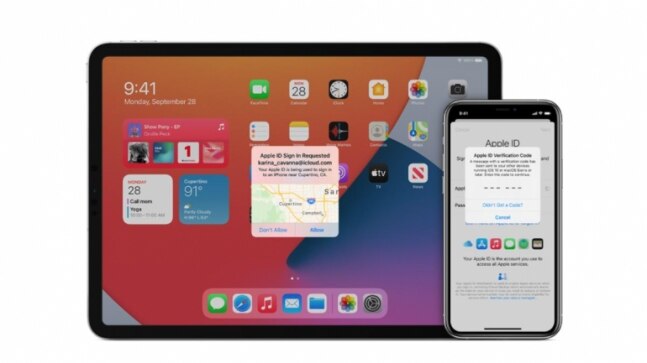
Apple has a simple yet effective new way to beat phishing attempts on OTP verification
India Today
If not already, users of Apple devices may soon see a new format of the message they receive for a verification code for login. The format will attempt to help users not fall prey to any phishing attempts on their OTP verification code.
An increasing number of Apple users are now reporting a change in the SMS they receive for two-factor verification. What used to be a simple SMS containing texts and the 2FA code now also has a strange string of alphabets and letters inside it. It now seems like the change is an effort by Apple to make its 2FA authentication stronger.
The update can be seen in attempts to log in to one's Apple ID using an SMS-based second-factor verification code. Apple users who did so recently were able to spot a strange mix of words, numbers as well as characters within the message that arrives with this code. Something like "@apple.com #[code] %apple.com."
A report by MacWorld explains that the update is an attempt by Apple to thwart any phishing attacks that try to steal users’ data through dubious links. Such attacks often target 2FA authentication login attempts by redirecting the victim to a phishing link. Any credentials thus entered by the victim then straightaway got to the threat actor and are further relayed for login at the actual website or service.
Apple's new form of 2FA code messages will prevent this from happening. How? The basic working is very simple - the altered SMS by Apple will prevent the code from being auto-detected by any service outside of Apple's domain. The feature comes in extension to Apple's proposed changes back in August 2020, as pointed out by MacWorld. At the time, Apple had promised that the feature would bring support for “domain-bound codes” for logins on Apple devices.
This means that the text messages with the login code will be required to make a slight addition. It will now need to provide a destination domain and some other data to the device instead of just the verification code. This way, Apple will be able to judge if the verification code is indeed supplied to a trusted domain or a one that lies outside of Apple's trusted set of domains.
It is a simple update that will understandably prove to be effective against phishing attacks for 2FA codes. Of course, it will limit the tendency of iOS 15, iPadOS 15, and macOS 11 Big Sur to auto-fill passwords onto a service. Though if this happens, the domain should raise a red flag for the users to double-check where they are going to submit their verification code.


Rajkummar Rao and Wamiqa Gabbi's 'Bhool Chuk Maaf' will premiere on Prime Video on June 6, just two weeks after its theatrical release. Originally planned for a direct OTT debut, the film hit cinemas on May 23.

Fresh spy shots suggest the Mahindra Thar 3-door is set for another update, with design cues inspired by the Mahindra Thar Roxx and a more premium positioning in sight.

Samsung has been teasing its upcoming A-series devices since last week, without officially revealing their names. While speculation has largely pointed to the Galaxy A37 and A57, a lengthy video recently surfaced ahead of any official confirmation, revealing the key specs and pricing of the devices.

Sony will hand over most of its TV manufacturing to TCL in a deal likely worth Rs 8,300 crore, but the Bravia brand will live on. Consumers can expect familiar quality, even if the production behind the scenes changes. Here is everything you need to know.

Noble's first 100 days with the Neuralink N1 implant provide valuable insights into the future of mind-controlled devices. Neuralink is owned by Elon Musk.

The Oppo Find X9 Ultra is launching globally in April. It is Oppo's first Ultra-branded phone to launch outside of China.

The Bihar School Examination Board declared the Class 12 results for 2026 with the overall pass percentage announced today. A look at the Board's performance over the last five years shows how student success has evolved.

Nearly 200 AI safety activists protested in San Francisco, urging major AI companies to pause frontier AI development over growing existential risks and safety concerns.

Students who appeared for the Bihar School Examination Board Class 12 exams can now access their results through multiple platforms, including the India Today Board Results page for smoother and quicker access. With heavy traffic expected on official websites, this alternative option ensures students can check their scores without delays or technical glitches.

After fight with US Military, Anthropic starts searching for policy expert on weapons and explosives
Anthropic, the AI startup that found itself at odds with the Pentagon over unrestricted AI use, is now looking for an expert in chemical weapons and explosives. However, the company is not planning to build such weapons, but instead wants to formulate its policy in regard to weapons.

The Bihar School Examination Board will announce the Class 12 results at 1:30 pm today. It said the scores would come through the official portals, with the pass percentage, toppers and compartment schedule shared at the same time.

American astrophysicist Neil deGrasse Tyson believes that artificial intelligence has a lot of positives for humanity. However, the AI that could perhaps reach superintelligence and surpass humans may be nothing short of lethal for humanity, something he urges must not be developed.