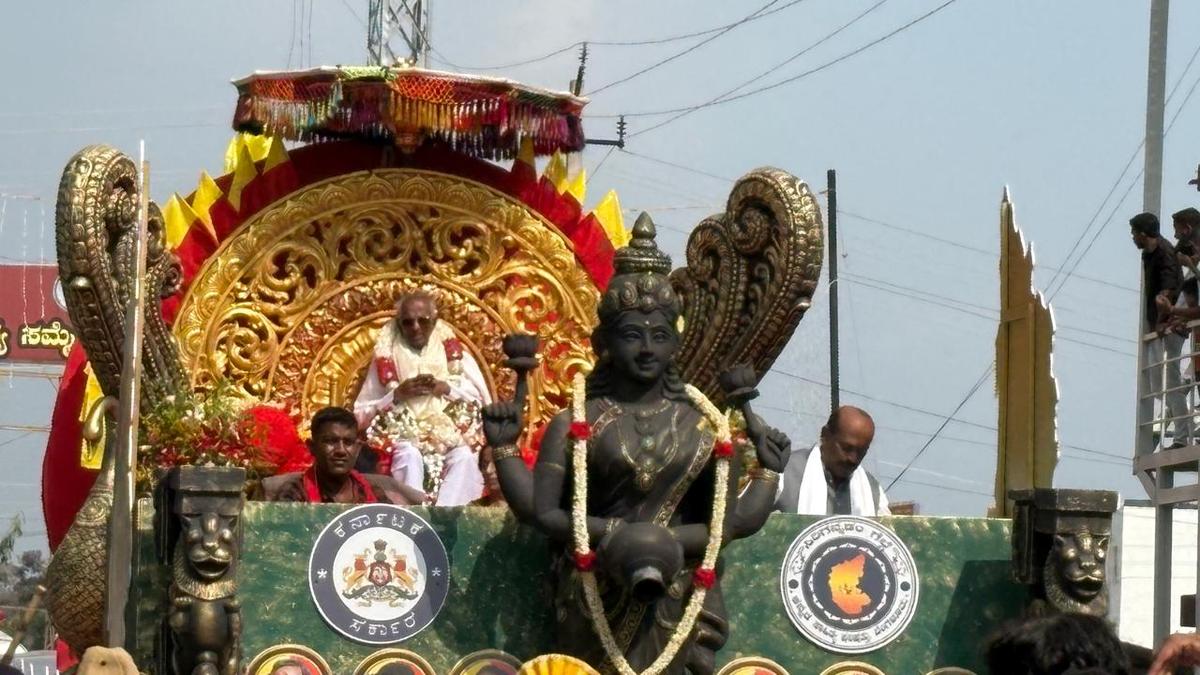
87th Akhila Bharata Kannada Sahitya Sammelana flagged off in Mandya with grand procession
The Hindu
A carnival-like atmosphere prevailed all through the procession route. People from neighbouring districts and taluks joined the procession at various junctions. The procession took three hours to reach the main venue.
The 87th Akhila Bharata Kannada Sahitya Sammelana began with a grand cultural procession in Mandya on December 20 morning.
The procession was led by senior writer and folklorist Go.Ru. Channabasappa, popularly called Go.Ru.Cha, president of the 87th Akhila Bharata Kannada Sahitya Sammelana, who was seated in a chariot.
The procession was flagged off by Nirmalanandanatha swamiji of Adichunchanagiri mutt near Visvesvaraya statue, near the office of the Deputy Commissioner, in the presence of Agriculture Minister N. Chaluvarayaswamy and Kannada Sahitya Parishath (Kasapa) President Mahesh Joshi.
Hundreds of people, including writers, artistes, school children, government staff and officials, marched in the procession waving yellow-red flags and banners. Pro-Kannada slogans reverberated in the air throughout the 6 km procession route.
Go.Ru.Cha. sat on a specially decorated chariot followed by bullock carts, decorated chariots and tableaux, and 87 decorated autorickshaws.
There were hundreds of artistes with various cultural troops showcasing Kamsaale, Dollu Kunitha, Pooja Kunitha, Veeragaase, Nandi Dhwaja, Navilu Kunitha, Bombe Kunitha, Nagari, Kangeelu Kunitha and other performances.
A carnival-like atmosphere prevailed all through the procession route. People from neighbouring districts and taluks joined the procession at various junctions. The procession took three hours to reach the main venue.


AIADMK reveals its first candidate list for Tamil Nadu Assembly election, featuring familiar names and few surprises.

A study reveals antibiotic resistance causes 87% of India's typhoid economic burden, significantly impacting children and families.

How Dikshitar was inspired by Vaduvur Rama to come up with a composition in a raganga raga

Lok Sabha passes Finance Bill 2026 with amendments, completing its budgetary approval before Rajya Sabha's consideration.

Karnataka government to consult legal experts on pursuing action against Adani Group's ACC Ltd. over ₹850 crore in disputed dues.

The FCRA amendment bill aims to create an authority for managing NGO assets after license loss, addressing misuse of foreign funds.

Telangana Minister assures adequate petroleum stocks for three months, warns against illegal fuel carrying amid panic buying rumors.

TMC calls for the removal of Bhabanipur returning officer, citing alleged ties to BJP and concerns over neutrality.

Kerala CM Pinarayi Vijayan condemns UDF's misogynistic attacks on CPI(M) legislator U. Prathibha, highlighting political degeneration.

Selected from 9,400 submissions across 37 countries, the 100 photographs on display traverse intimate and political terrains. In MRC Nagar, photographer Swastik Pal captures life in the Sundarbans, where severe climate change has brought humans and wildlife into closer contact. Shane Hynan’s Beneath Beofhod reflects on Ireland’s boglands as sites of memory and restoration, while Mateo Trevisan’s More than the Sun examines the impact of coal-driven industrialisation in the Western Balkans.

Hyderabad officials assure sufficient fuel supply for 60 days, warn against misinformation and illegal sales amid panic buying.

Telangana MP urges Centre to expedite ₹1,270 crore dues transfer from Andhra Pradesh for financial fairness and development.

A Karnataka man was detained with ₹62.5 lakh in cash during election checks on NH 544, claiming it was from a property sale.