5 million patients worldwide need radiosurgery for brain tumour yearly; less fewer than 10% receive it: John R. Adler
The Hindu
Over five million patients need radiosurgery for brain tumors yearly, but fewer than 10% receive treatment, highlights John R. Adler.
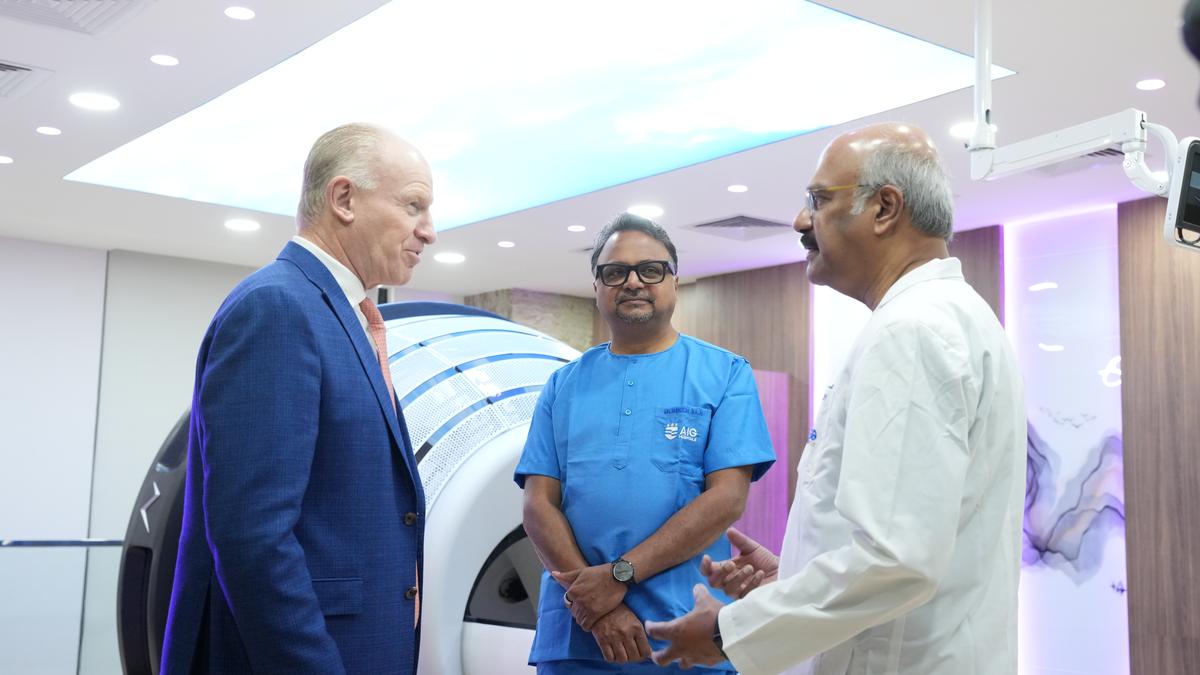
Around five million patients worldwide each year could benefit from radiosurgery for brain tumours and neurological disorders, yet fewer than 10% currently receive such treatment, according to John R. Adler, renowned neurosurgeon and professor at Stanford University. He was speaking at the launch of the ZAP-X Gyroscopic Neuro-Radiosurgery Platform at AIG Hospitals, Hyderabad, on Friday (March 6, 2026).
The ZAP-X system is designed exclusively for treating intracranial conditions and allows doctors to target tumours and abnormal brain tissue with highly focused radiation beams delivered with sub-millimetre accuracy. The technology enables treatment of brain tumours and several neurological disorders without open surgery, without incisions and typically as a day-care procedure.
Explaining the working principle of radiosurgery, Dr. Adler, who is also the inventor of ZAP-X, compared it to the effect of a magnifying glass focusing sunlight. “Hundreds or even thousands of narrow radiation beams are directed at a tumour from multiple angles, and when they converge at the target, the radiation effect becomes extremely powerful at that precise point while surrounding brain tissue receives minimal exposure,” he added.
Subodh Raju, director and head of Neurosurgery at the hospital, said modern neurosurgery increasingly focuses on precision and minimally invasive treatment approaches. “Brain metastases, which occur when cancer spreads to the brain from other organs such as the lungs or breast, are among the most common brain tumours worldwide. Traditional treatment options often include open surgery or whole-brain radiation therapy, which exposes large areas of the brain to radiation and may affect cognitive function. Radiosurgery targets only the tumour deposits while sparing healthy tissue,” he said.
AIG Hospitals chairman, D. Nageshwar Reddy, said the hospital aims to position the treatment in a way that makes it affordable. While similar radiosurgery procedures may cost around ₹30 lakh in the United States, the hospital expects the treatment in India to cost approximately ₹3 to 4 lakh. “We will also explore options such as insurance coverage, charitable support and possible inclusion under government schemes to improve accessibility for patients,” he said.


Tamil Nadu Chief Minister M.K. Stalin greets R.N. Ravi on his appointment as West Bengal Governor during a meeting in Raj Bhavan, Chennai.

Rahul Gandhi visits Sivagiri Mutt in Kerala, paying respects to Sree Narayana Guru during his two-day trip.

Madras High Court directs government officials to sensitise on disability rights after unjust job rejection of a qualified applicant.

While an AI-generated video of a man taking an underwater selfie with a shark is easy to identify as fake, more realistic Gen AI videos can warp the way we think about wild animals and their behavioural traits

Government sets wheat procurement target at 30.3 million tonnes for 2026-27, ensuring adequate supply amid record production.

The Iranian ship IRIS Lavan's docking in Kochi sparks public curiosity amid ongoing Israel-Iran tensions and repair uncertainties.

Over five million patients need radiosurgery for brain tumors yearly, but fewer than 10% receive treatment, highlights John R. Adler.

Karnataka's 2026 budget allocates funds to fill 182 tanks in Chikkaballapur and 59 in Hosakote, enhancing irrigation.

Prashanth Vihari inaugurates the vibrant Sanskriti ’26 fest at KITSW

Join the Grape Festival in Rajendranagar on March 7 to explore 59 grape varieties and enhance farming knowledge.

The trailer of Ranveer Singh’s Dhurandhar 2 was unveiled by the makers on Saturday, March 7, 2026. Written and directed by Aditya Dhar, the film also stars Sanjay Dutt, Arjun Rampal, R Madhavan, Akshaye Khanna and Sara Arjun in pivotal roles.

Saudi Defence Minister warns Iran to avoid miscalculation amidst escalating Gulf tensions and recent missile and drone attacks.

Breast cancer cases in India have doubled in 30 years, highlighting treatment access gaps despite advancements, experts warn.