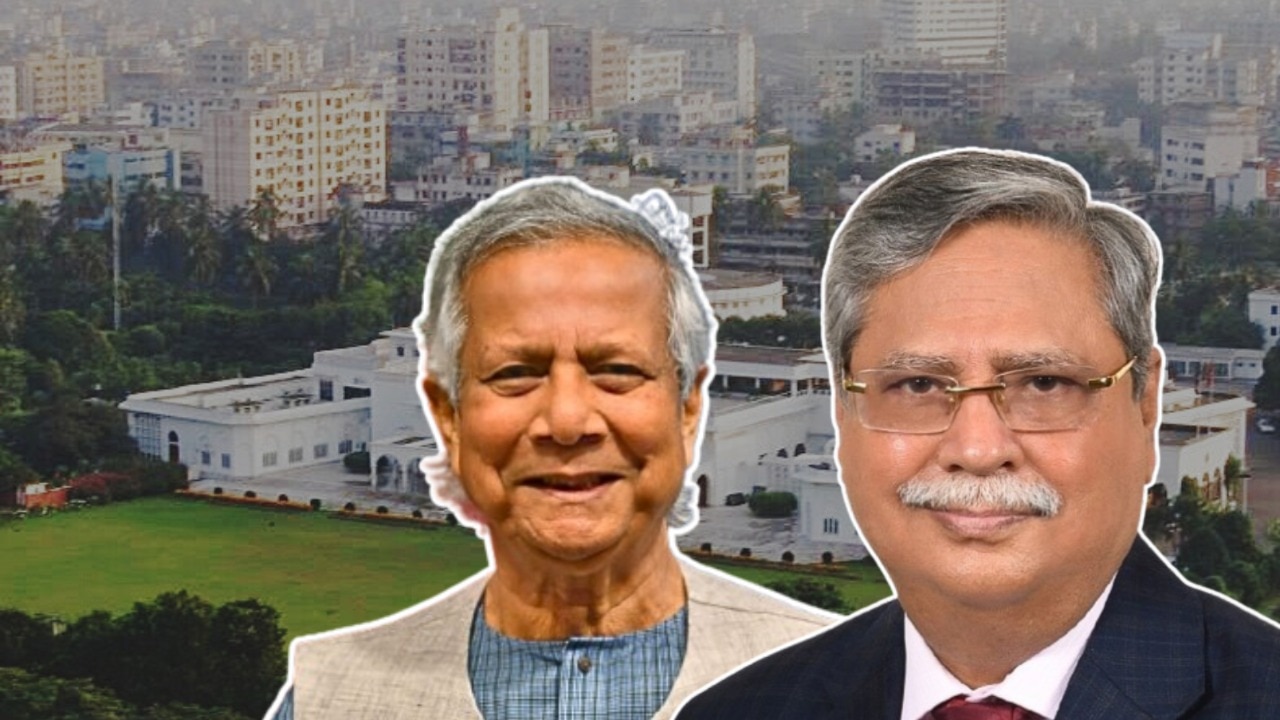
Yunus kept me under house arrest: Bangladesh President's damning accusation
India Today
Bangladesh President Mohammed Shahabuddin told newspaper Kaler Kontho that he was virtually kept under house arrest by the regime of Muhammad Yunus for 18 months. He was neither allowed to venture out for the traditional Eid namaz nor for his treatment after bypass surgery in Singapore. This is a damning indictment of Yunus for the way the head of state was treated.
In a damning indictment of the interim regime led by Muhammad Yunus, Bangladesh President Mohammed Shahabuddin said that he was virtually under house arrest for 18 months, and denied travel rights even for health reasons. In an exclusive interview with Bangladeshi newspaper Kaler Kontho, Shahabuddin said that the restrictions on his travel disrupted the Eid traditions followed by the president since the liberation of the country.
"It was as if I was under house arrest in this palace," said Shahabuddin, referring to Bangabhaban, the official residence of the president.
On Tuesday, Kaler Kontho published the second part of its exclusive interview with Bangladesh President Shahabuddin. In the first part, Shahabuddin described the unconstitutional actions of Yunus, including the plot to remove him, and keeping him in the dark on the US trade deal.
"The President participates in the holy Eid-ul-Fitr and Eid-ul-Azha prayers at the National Eidgah Maidan, this tradition has been going on since the country's independence. But Dr Yunus's government has put obstacles i that tradition," Shahabuddin told Kaler Kontho.
He said he wasn't allowed to go to the National Eidgah Maidan to participate in the two Eid prayers.
"I was clearly informed through the security department that you will not go to the National Eidgah to participate in the Eid prayers," he added.


Indian Railway staff's swift action turned a medical emergency involving a toddler into relief aboard a train from Bengaluru to Gujarat.

Leon Panetta said Iran war was not an unexpected risk. He pointed out that for years, US security officials have known Iran could disrupt global oil supplies by blocking the Strait of Hormuz. According to him, this was a well-known danger, but one that appears to have been overlooked in the current conflict.

Sri Lanka raised fuel prices by about 25% for the second time in a week as the Gulf conflict disrupts global oil supplies via the Strait of Hormuz.

Iran has warned it is ready to respond. Parliament Speaker Mohammad Baqer Qalibaf warned that if Iran's infrastructure is targeted, then key facilities across the region could be "irreversibly destroyed."

Indian Railway staff's swift action turned a medical emergency involving a toddler into relief aboard a train from Bengaluru to Gujarat.

In a post on Truth Social, Donald Trump said ICE personnel would assist Transportation Security Administration (TSA) officers who have continued to work despite uncertainty over funding.

In the viral video, a bus driver named Harish is seen stopping his bus mid-route, not for a passenger, but for a group of hungry puppies waiting by the roadside.

An NRI's creative replica of the Statue of Liberty in Jalandhar sparks cultural interest and local pride.

In a city reshaped by war and displacement, survival in Beirut now rests on quiet acts of care. Each morning, strangers show up — not with answers, but with what little they can carry.

A pricing sheet inside an auto rickshaw has gone viral for being practical and running a good side hustle.

Kremlin said that Kyiv wants to keep the "questionable activities" of its citizens under wraps, after Ukraine issued a statement on the arrests of six Ukrainian citizens in India.

A version that came within minutes is now being questioned days later. As new evidence emerges from Bahrain, the gap between first claims and fresh findings is raising difficult questions.