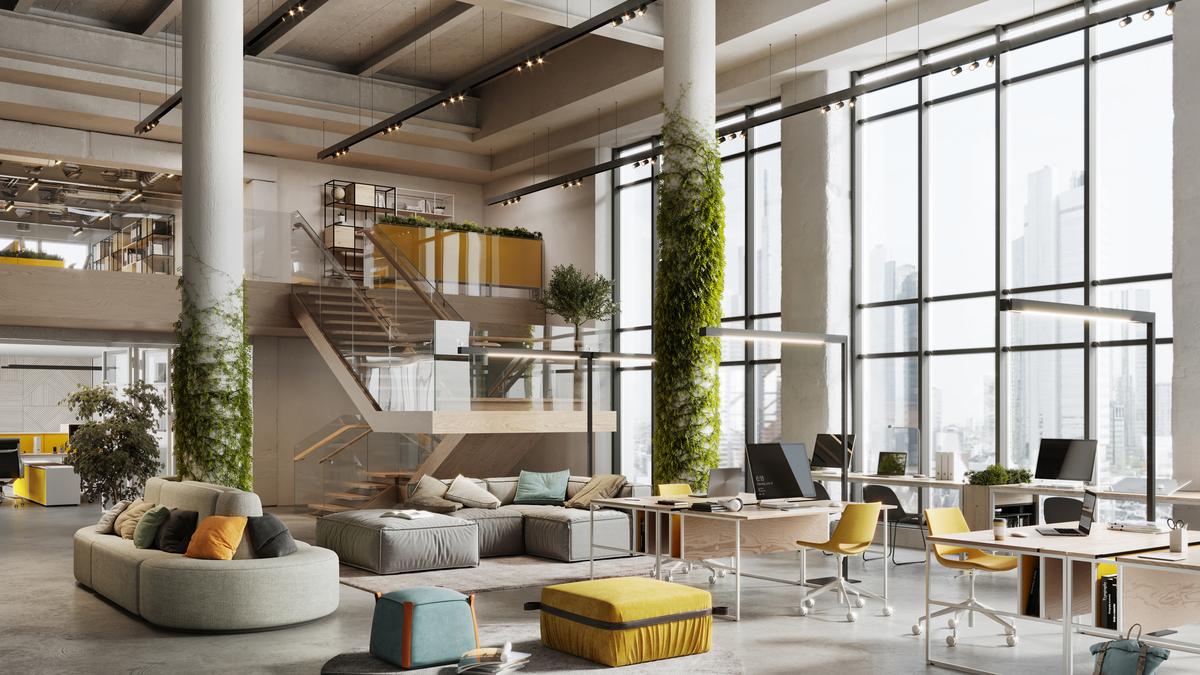
Why offices are starting to look like boutique hotels
The Hindu
Explore how offices are transforming into boutique hotel-inspired spaces that prioritize employee experience and wellbeing.
Sijo Jose
The idea of what an office should be is undergoing a quiet but decisive change. No longer defined by rows of desks and secluded cabins, offices are increasingly being reimagined as spaces that prioritise experience, comfort and human interaction, borrowing heavily from the world of hospitality.
According to JLL’s 2025 Experience Matters research, nearly two-thirds of people globally now expect the spaces where they live, work and spend time to offer enjoyment, variety and meaningful value. That expectation is fast reshaping how companies think about office design, especially in India, where the concept of ‘hotelification’ is gaining traction. This trend reflects a broader rethinking of the workplace: not as a fixed piece of infrastructure but as a service. Employers are recognising that the physical environment plays a critical role in influencing how people feel, collaborate and perform. As a result, offices are beginning to resemble boutique hotels or high-end lounges, where aesthetics and functionality are equally important.
As early adopters of hospitality-led design, flexible workspace operators have long focused on creating environments that combine functionality with experience — offering everything from thoughtfully designed common areas and community programming to concierge-like services and premium amenities. In many ways, coworking spaces have served as live prototypes for what the modern office could become, influencing even large enterprises to rethink their own workplaces. Their emphasis on flexibility, community and service has set new benchmarks, pushing the broader office market towards more human-centric, experience-driven design.
Behind this shift lies a growing body of evidence linking employee experience to business outcomes. Research by McKinsey & Company suggests that improving employee wellbeing could unlock as much as $11.7 trillion in global economic value. Meanwhile, a study by Gallup found that organisations with highly engaged employees report 41% lower absenteeism, 17% higher productivity, and 21% higher profitability.
For companies, the message is increasingly difficult to ignore: investing in employee experience is not just a cultural decision. It is a financial one. In a competitive talent market, the workplace itself has become a differentiator, shaping recruitment, retention and even brand perception.


Astronauts honor Reid Wiseman's late wife by naming a lunar crater "Carroll" during historic Artemis II mission.

NASA's Artemis II crew reaches the moon, approaching a historic distance record from Earth in their Orion capsule.

Inspired by Maharani Gayatri Devi the designer’s new Spring/Summer 2026 edit blends regal detailing with modern sportswear, from hand-painted jackets to embroidered suspenders

Former advertising man Mohan Menon’s new novel takes its protagonists across Kolkata in search of a ninja who enables people to satisfy their bloodthirsty whims

Discover how microRNAs enable early detection and personalized treatment for PCOS and endometriosis, enhancing women's health outcomes.

A study reveals a reproducibility crisis in social sciences, with only half of analyzed research findings being reliably replicable.

ISRO's Mission MITRA in Ladakh tests astronauts' mental and physical strengths, enhancing insights for the Gaganyaan programme.

Artemis II astronauts prepare for a historic lunar flyby, aiming to capture and analyze unique lunar features during their mission.

Explore the geopolitical implications of NASA's Artemis II mission as it competes with China's lunar ambitions for space supremacy.

Explore the geopolitical implications of NASA's Artemis II mission as it competes with China's lunar ambitions for space supremacy.

Artemis II astronauts reach halfway to the Moon, with the lunar flyby milestone celebrated by mission control.

Explore how six architectural firms are transforming Indian bars with immersive designs that blend culture, storytelling, and vibrant aesthetics.

Explore how offices are transforming into boutique hotel-inspired spaces that prioritize employee experience and wellbeing.