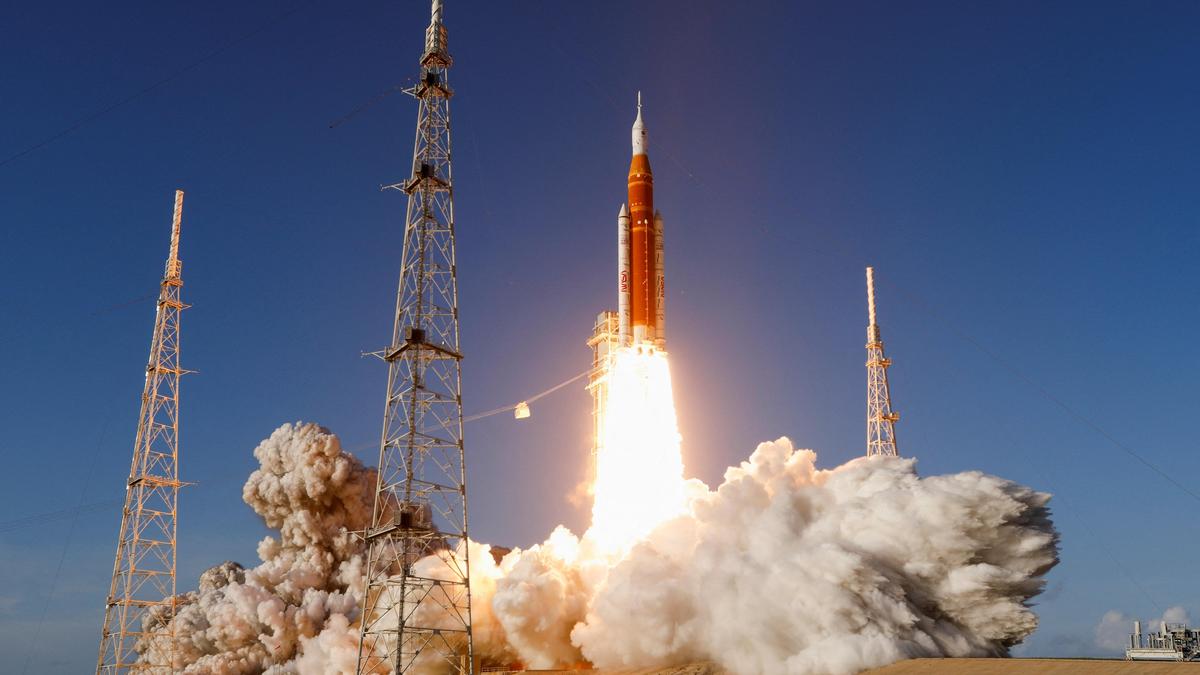
Artemis II | Mission moon
The Hindu
Explore the geopolitical implications of NASA's Artemis II mission as it competes with China's lunar ambitions for space supremacy.
An irony hides in the context of the NASA Artemis II launch on April 2. The U.S. has both openly and in internal reports cast the Artemis programme to return American astronauts to the moon as part of a race against China. But as China in Space editor Jack Congram has pointed out, China does not believe it is racing the U.S. to the moon.
Also read: NASA Artemis II launch highlights
Instead, it has developed its programme to send Chinese astronauts (taikonauts) to the moon as part of a national programme, with ties to local industries and developmental goals. The Chinese Government is thus committed to funding the programme and providing political support for it, allowing it to advance at a steady pace — one that has evidently unnerved the U.S.
Under pressure, NASA, in its public messaging at least, has responded by describing its priorities and urgency in terms of being in a race with the China National Space Administration (CNSA), with the U.S. state providing vacillating support for those priorities: swinging one way because of the costs, then the other because ‘beating’ China offers the prospect of projecting American supremacy in at least one high-technology domain, after having that undermined in semiconductor and clean energy.
Editorial | On the Artemis II launch
The irony? As Mr. Congram put it, the liberal democracy “sees the moon as a proving ground in a geopolitical contest”, with commercial connotations tacked on, while the party state “views it as an extension of long-term science-driven development”. Perhaps this is not an irony at all given the success of China’s state-directed techno-nationalist development in the last half century, or perhaps CNSA’s apparent indifference to NASA’s efforts is rooted in secure knowledge that it is, in fact, ahead. Either way, China is giving the U.S. more than a run for its money.


Astronauts honor Reid Wiseman's late wife by naming a lunar crater "Carroll" during historic Artemis II mission.

NASA's Artemis II crew reaches the moon, approaching a historic distance record from Earth in their Orion capsule.

Inspired by Maharani Gayatri Devi the designer’s new Spring/Summer 2026 edit blends regal detailing with modern sportswear, from hand-painted jackets to embroidered suspenders

Former advertising man Mohan Menon’s new novel takes its protagonists across Kolkata in search of a ninja who enables people to satisfy their bloodthirsty whims

Discover how microRNAs enable early detection and personalized treatment for PCOS and endometriosis, enhancing women's health outcomes.

A study reveals a reproducibility crisis in social sciences, with only half of analyzed research findings being reliably replicable.

ISRO's Mission MITRA in Ladakh tests astronauts' mental and physical strengths, enhancing insights for the Gaganyaan programme.

Artemis II astronauts prepare for a historic lunar flyby, aiming to capture and analyze unique lunar features during their mission.

Explore the geopolitical implications of NASA's Artemis II mission as it competes with China's lunar ambitions for space supremacy.

Explore the geopolitical implications of NASA's Artemis II mission as it competes with China's lunar ambitions for space supremacy.

Artemis II astronauts reach halfway to the Moon, with the lunar flyby milestone celebrated by mission control.

Explore how six architectural firms are transforming Indian bars with immersive designs that blend culture, storytelling, and vibrant aesthetics.

Explore how offices are transforming into boutique hotel-inspired spaces that prioritize employee experience and wellbeing.