From Kolam to Digna: Why floor drawings deserve to be seen as art
The Hindu
Explore how floor drawings, like kolams and digna, embody rich cultural traditions and deserve recognition as true art forms.
Growing up in a South Indian household, kolams were a part of my daily life. It was considered inauspicious to leave the house before the entrance was adorned with a kolam at dawn. On most days, it is a simple, quick one. On special occasions however, the kolams are elaborate and colourful. I would see them everyday and so they became invisible, an afterthought.
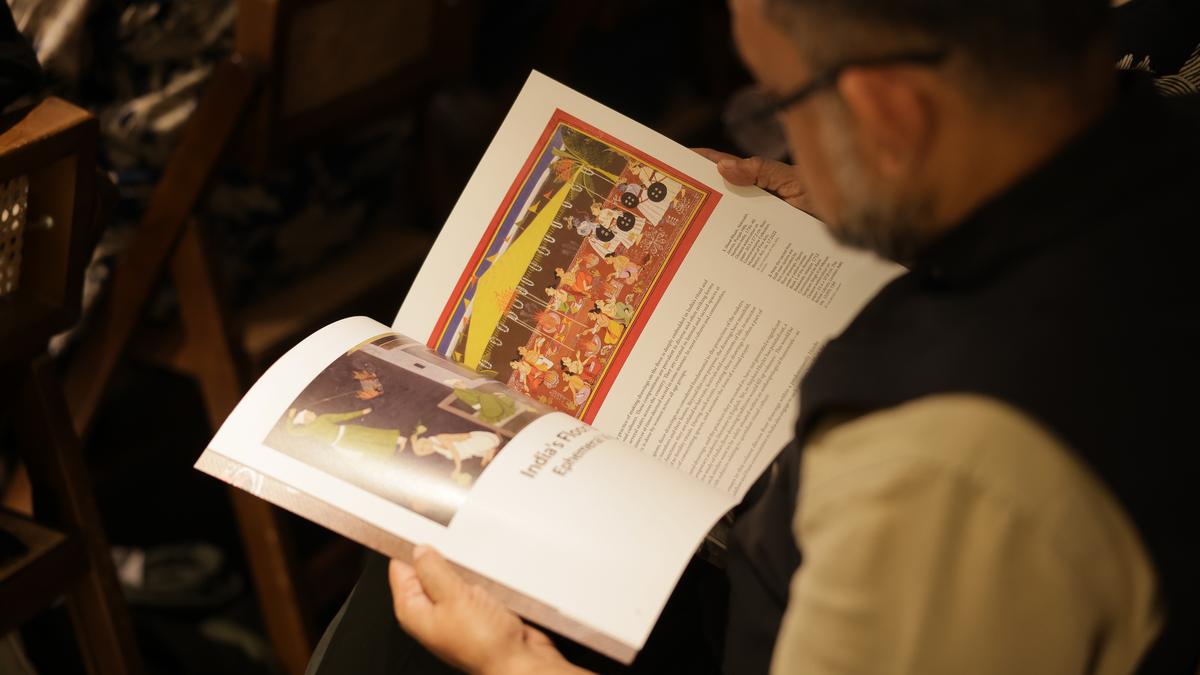
It is only when you stop and really look that you realise how much meaning sits in these everyday patterns. At a recent conversation around floor drawings and art by the MARG Foundation (Modern Architectural Research Group) — a forum for research on Indian art — kolams took centrestage . The catalyst for this conversation was the new volume of the foundation’s magazine, On Painted Ground which looked at floor art not as decoration, but as practices shaped by ritual, memory and everyday life.
Aurogeeta Das | Photo Credit: Special Arrangement
Held at The Folly at Amethyst, the evening unfolded as a layered reflection on floor drawings across India. Moderated by Rosella Stephen, editor Sunday Magazine and Literary Review , The Hindu, the discussion brought together the magazine’s guest editor Aurogeeta Das and art historian John H Bowles, each approaching the subject from vastly different vantage points, yet arriving at a shared understanding: that what we often overlook may, in fact, hold some of the most complex cultural knowledge systems.
“If it gives us meaning, if it has beauty, if it has variety and richness, and if it can be interpreted in diverse ways, how is it not art?” asked Aurogeeta. “Art, as we define it today, is often removed from life… something that sits in a museum or gallery. But these practices are part of everyday life.”
According to Aurogeeta, it is precisely this that has kept these practices on the margins. Made largely by women, and made to disappear by rain, worn down by footsteps, or erased and redrawn the next day — floor drawings cannot be preserved like most art.


Astronauts honor Reid Wiseman's late wife by naming a lunar crater "Carroll" during historic Artemis II mission.

NASA's Artemis II crew reaches the moon, approaching a historic distance record from Earth in their Orion capsule.

Inspired by Maharani Gayatri Devi the designer’s new Spring/Summer 2026 edit blends regal detailing with modern sportswear, from hand-painted jackets to embroidered suspenders

Former advertising man Mohan Menon’s new novel takes its protagonists across Kolkata in search of a ninja who enables people to satisfy their bloodthirsty whims

Discover how microRNAs enable early detection and personalized treatment for PCOS and endometriosis, enhancing women's health outcomes.

A study reveals a reproducibility crisis in social sciences, with only half of analyzed research findings being reliably replicable.

ISRO's Mission MITRA in Ladakh tests astronauts' mental and physical strengths, enhancing insights for the Gaganyaan programme.

Artemis II astronauts prepare for a historic lunar flyby, aiming to capture and analyze unique lunar features during their mission.

Explore the geopolitical implications of NASA's Artemis II mission as it competes with China's lunar ambitions for space supremacy.

Explore the geopolitical implications of NASA's Artemis II mission as it competes with China's lunar ambitions for space supremacy.

Artemis II astronauts reach halfway to the Moon, with the lunar flyby milestone celebrated by mission control.

Explore how six architectural firms are transforming Indian bars with immersive designs that blend culture, storytelling, and vibrant aesthetics.

Explore how offices are transforming into boutique hotel-inspired spaces that prioritize employee experience and wellbeing.